Baseball Card Values (2026): The Free Price Guide Built on Real Sales
On this page
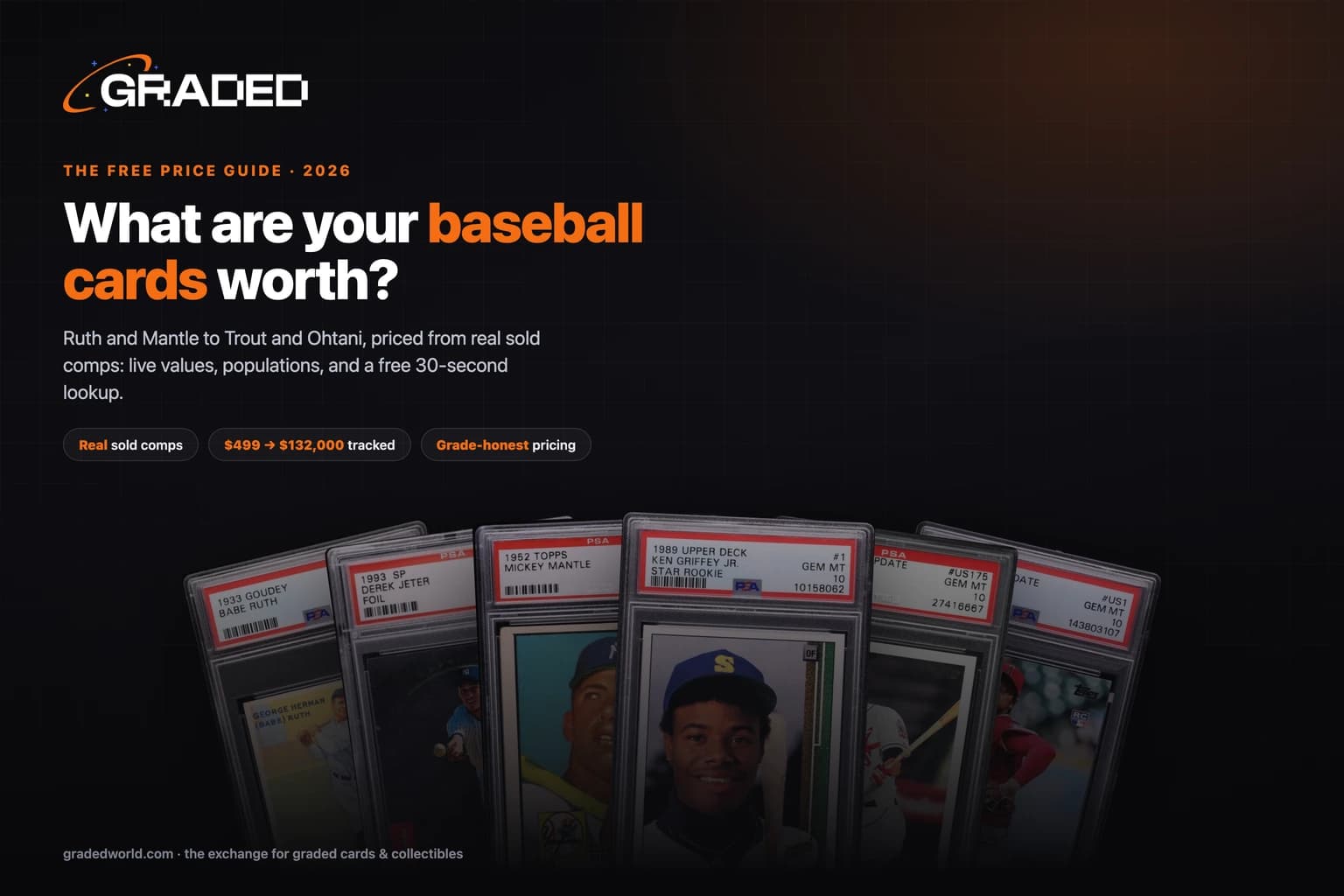
This is a working price guide, not a listicle. Every value on this page comes from real sold comps tracked by Graded's pricing engine, the same data that powers our live baseball market index. No asking prices, no book values from a magazine. If you are holding a card and wondering what it is worth, the lookup workflow below takes about 30 seconds and costs nothing.
- Most baseball cards are worth under $1. Value concentrates in pre-war and 1950s vintage, icon rookies, and high grades.
- The tracked blue chips run from $499 to $132,000, and the ceiling card, the 1952 Topps Mickey Mantle, is quoted in PSA 4 because true vintage almost never trades in gem mint.
- Grade decides most of the price. On vintage, every grade rung multiplies the value; on modern cards, nearly all the value sits in PSA 10.
- You can price any card for free with the three-step lookup below: cert check, sold comps, live index.
How much are baseball cards worth?
The overwhelming majority of baseball cards sell for less than $1, while the graded blue chips we track run from $499 to $132,000 as of July 2026. Baseball has the oldest card market of any sport, and that shapes the pyramid differently than basketball or football. The base is enormous: cards printed from the mid-1980s through the 1990s exist in such quantities that raw copies are effectively worthless. The top is genuinely old: the most valuable baseball cards are vintage survivors from the 1930s and 1950s, where condition is the entire story and even a beaten-up copy of the right card is worth five or six figures.
Four questions predict a baseball card's value: Who is on it? Is it the key card for that player? What condition or grade is it in? And how many copies survive? The table below shows the live numbers.
The most valuable baseball cards in 2026
The most valuable baseball card we track is the 1952 Topps Mickey Mantle #311, at $132,000 in PSA 4. These are the cards in Graded's baseball index, priced from actual sales and refreshed with every index rebuild. Click any card for its full price history and population data.
| # | Card | Grade | PSA 10 pop | Value (real comps) |
|---|---|---|---|---|
| 1 | 1952 Topps Mickey Mantle #311 | PSA 4 | — | $132,000 |
| 2 | 1933 Goudey Babe Ruth #144 | PSA 4 | — | $21,000 |
| 3 | 1993 SP Foil Derek Jeter #279 | PSA 9 | 22 | $8,100 |
| 4 | 1989 Upper Deck Ken Griffey Jr. #1 | PSA 10 | — | $5,640 |
| 5 | 2011 Topps Update Mike Trout #US175 | PSA 10 | — | $1,050 |
| 6 | 2018 Topps Update Shohei Ohtani #US1 | PSA 10 | — | $499 |
Read the grade column carefully, because it is where honest baseball pricing lives. The Mantle and the 1933 Goudey Babe Ruth are quoted in PSA 4: mid-grade is the tier that actually trades, and gem copies are auction events, not markets. The 1993 SP Foil Derek Jeter is quoted in PSA 9 for the same reason; the foil surface chips so easily that only 22 PSA 10s exist, so the 9 is the tradable tier at $8,100. The full index view lives at the baseball market index.
How to look up your baseball card's value for free
You can price any baseball card in three steps, free, without an account. Start by searching your card right here; if you do not know its exact name, type what you can read off the card (year, brand, player) and pick from the matches.
Look up any baseball card
Showing grade 10 — add a grade to your search (e.g. “psa 9”, “bgs 9.5”) to change it. Works for PSA, BGS, SGC, CGC & CSG. No login.
- If the card is graded, verify the cert first. Type the cert number into our cert lookup to confirm the grade, the card's exact identity, and its population.
- Check real sold prices, not asking prices. Our PSA value lookup shows what a card actually sells for by grade. Listing prices run 20% to 50% above what buyers pay, which is why price-guide sites that scrape listings mislead you.
- For blue chips, read the index. The baseball index tracks the bellwether cards with monthly medians, so you know whether you are selling into strength.
Deciding whether to grade a raw card? Read PSA 10 vs raw first; grading only pays when the card and the likely grade clear a threshold.
What makes a baseball card worth money?
Era, player, survival, and grade. Vintage baseball value is a condition census: the print runs are fixed, most copies were played with or thrown out, and the market prices each surviving grade rung separately. The 1952 Topps Mantle is the defining example. It is the sport's most important post-war card, and even in PSA 4, a grade that means visibly worn corners, it trades at $132,000. Each rung up the ladder multiplies the price, and the famous top-grade copies have sold for eight figures at auction.
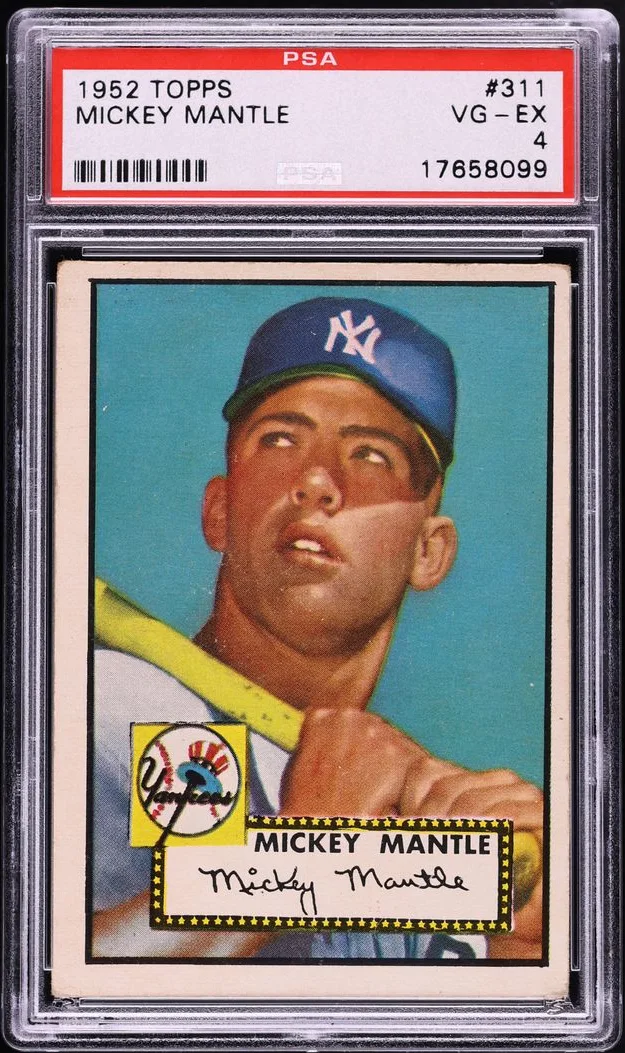
Real sold comps from Graded's pricing engine · 13 sales (eBay & Fanatics).
Modern baseball flips the logic. Print runs are huge, survival is near-total, and the grade is everything: value concentrates almost entirely in PSA 10, with the raw card worth a small fraction of the gem. The 2011 Topps Update Mike Trout at $1,050 and the 2018 Topps Update Shohei Ohtani at $499, both in PSA 10, are the reference modern rookies; we quantified the grade gap across the market in PSA 9 vs PSA 10.
How much is a Mickey Mantle card worth?
Mickey Mantle cards run from double digits for worn late-50s commons to $132,000 for the 1952 Topps rookie-year card in PSA 4, and into the millions for top-grade copies at auction. The 1952 Topps #311 is the card that anchors the entire vintage market. Later Mantles, like the 1958 Topps #150, trade for four and five figures depending on grade, and because Mantle cards exist at every grade rung, there is an entry point at almost every budget. The full ladder, with per-card comps and charts, is in the best Mickey Mantle cards guide.
Are 1980s and 1990s baseball cards worth anything?
Mostly no in raw form; this is the most overprinted era in the hobby. The late 80s and early 90s produced cards in the billions, and the shoebox collections of that era are worth close to nothing ungraded. The exceptions follow a pattern: the iconic card, in gem mint. The 1989 Upper Deck Ken Griffey Jr. #1, the most famous card of the era, trades around $5,640 in PSA 10 even though raw copies are everywhere. The 1993 SP Foil Jeter shows the other path to value: a premium, condition-sensitive product where high grades are genuinely scarce.
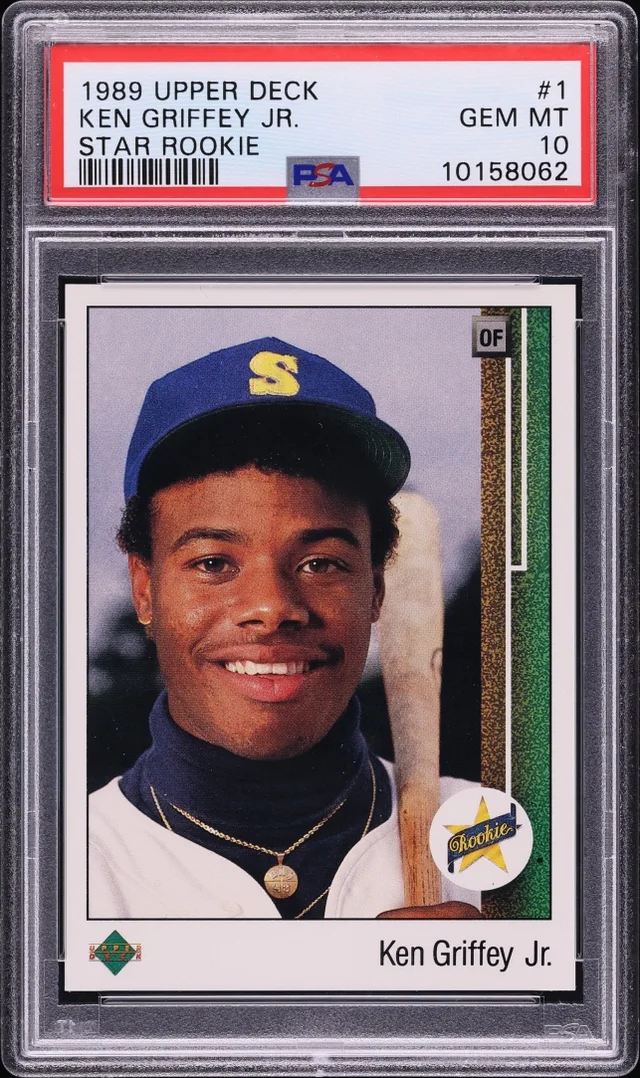
Real sold comps from Graded's pricing engine · 42 sales (eBay & Fanatics).
The honest playbook for an attic collection: pull the star rookies and premium inserts, assess condition ruthlessly, and run the numbers with the PSA value lookup before paying for grading. Everything else is nostalgia, not inventory.
Baseball card value FAQ
What is the most expensive baseball card?
Among cards we track with live comps, the 1952 Topps Mickey Mantle at $132,000 in PSA 4. At auction, the finest known copies transcend that entirely: a top-grade 1952 Mantle sold for $12.6 million in 2022, the record for any sports card.
How can I check baseball card prices for free?
Use the three-step lookup above: verify the cert at our cert lookup, pull real sold comps with the PSA value lookup, and check the live baseball index. All three are free.
Are baseball cards from the junk wax era worth grading?
Only the icons in genuinely sharp condition. A 1989 Upper Deck Griffey that gems is worth around $5,640; the same card in PSA 8 is worth a small fraction of that, and a common from the same year is worth nothing in any grade. Grade the card the market already cares about, not the card you have the most copies of.
Should I get my baseball cards graded?
Only when the expected graded value clears the grading fee with room to spare. Vintage in any respectable condition usually qualifies; modern cards need to be gem candidates. Our PSA 10 vs raw guide covers the real multipliers by tier.
When you know what your card is worth and want to act on it, the Graded marketplace aggregates listings across eBay, Collector Crypt, Phygitals, and Courtyard, and the trading floor lets you swap cards directly with escrow. For the investing angle, start with the best baseball cards to invest in or the player guides for Griffey, Trout, and Ohtani.