The Best Mickey Mantle Cards to Invest In (2026): The $132,000 Icon & the Real Grade Ladder
On this page
Every vintage baseball portfolio is benchmarked against one piece of cardboard: the 1952 Topps Mickey Mantle #311. Exactly three PSA 10s exist and none has ever sold publicly. A PSA 8 printed $1,020,000 in September 2025. The collector's market lives at PSA 4, where sixteen archived sales run to $192,000. This guide maps the Mantle ladder the way the market actually works: every card at its most-traded grade, with the exact PSA census behind it.
Built the same way as our baseball, Jordan, and Brady guides: every price below is a real sold comp from Graded's pricing engine (eBay and Fanatics), never an asking price. Ten cards, 1951 to 1969, 280 archived comps, tracked live on the Mickey Mantle market index.
Nothing here is financial advice. Cards are a real but volatile asset class. Here's what the data shows.
- The '52 Topps is the hobby's reference asset: $132,000 fair market value in PSA 4 (a $156,000 print in June 2026), a $1,020,000 PSA 8 sale in 2025, and a census of three PSA 10s that have never publicly traded.
- No honest Mantle guide quotes PSA 10 prices: across his 1950s Topps run the entire PSA 10 census is one or two copies per card, and the 1958 has zero. Every card here is quoted at the grade with a real market.
- PSA 8 is the vintage collector's gem: the '57 ($15,600 on 44 comps), '58 ($11,250 on 41), and '59 ($9,000 on 46) are the deepest high-grade Mantle tapes in existence.
- The '51 Bowman is the true rookie at a 82% discount: $23,500 in PSA 4 against the '52 Topps at $132,000, on the same grade and era.
- The 1968 Topps is the only near-gem market: PSA 9s exist in the hundreds and trade weekly ($9,750 on 43 comps).
- Closed-résumé, maximum-lore profile: the most collected name in baseball, with demand that has survived every hobby cycle since the 1980s.
The Framework: How Mantle Cards Actually Trade
- The grade ladder is inverted versus modern cards: for a 1950s Mantle, PSA 8 is the "gem", PSA 4 is the liquid collector grade, and PSA 10 is a museum rumor. Pricing a Mantle off a phantom PSA 10 is the most common mistake in vintage.
- Centering and print quality set the ceiling: 1950s Topps cards came off wet presses into wax packs; the census pyramid collapses above PSA 8 on every card before 1965.
- The icon premium is real and specific: the '52 Topps trades at 5-6x the '51 Bowman in the same grade despite the Bowman being the true rookie. The market pays for the card, not the chronology.
- No career risk, maximum lore: the switch-hitting Triple Crown legend of the Yankees dynasty. The bid rotates less than any other name in the sport.
The Mickey Mantle Card Ladder
Ten cards, each at its tracked grade, on real sold comps:
Bars use a logarithmic scale so every rung is visible. Every value is a real sold comp at the labeled grade, never an asking price. Vintage Mantles have no PSA 10 market, so each card tracks the grade that actually trades.
The Census: Why There Is No PSA 10 Mantle Market
Before the cards, the single most important table in vintage collecting. We resolved the exact PSA population for each Mantle through the GemRate cert chain:
| Card | PSA 10 pop | PSA 9 pop | PSA 8 pop | Tracked here |
|---|---|---|---|---|
| 1952 Topps #311 | 3 | 6 | 35 | PSA 4 |
| 1951 Bowman #253 | — | — | — | PSA 4 |
| 1957 Topps #95 | 1 | 22 | 280 | PSA 8 |
| 1958 Topps #150 | 0 | 28 | 212 | PSA 8 |
| 1959 Topps #10 | 1 | 27 | 330 | PSA 8 |
| 1961 Topps #300 | 2 | 71 | 520 | PSA 8 |
| 1968 Topps #280 | 11 | 186 | 1240 | PSA 9 |
| 1969 Topps #500 | 2 | 65 | 533 | PSA 8 |
Population counts are the exact PSA census for each card, resolved per-spec through the GemRate cert chain. The 1958 Topps has never received a PSA 10. Dashes mean the census was not resolved for that card.
Three '52 Topps PSA 10s. One '57. Zero '58s. Two '69s. This is why every serious Mantle position is built in PSA 8 and below, and why this guide quotes the grade that actually trades instead of a hypothetical gem price.
1952 Topps #311: The Hobby's Icon
The engine has every archived PSA 4 sale:
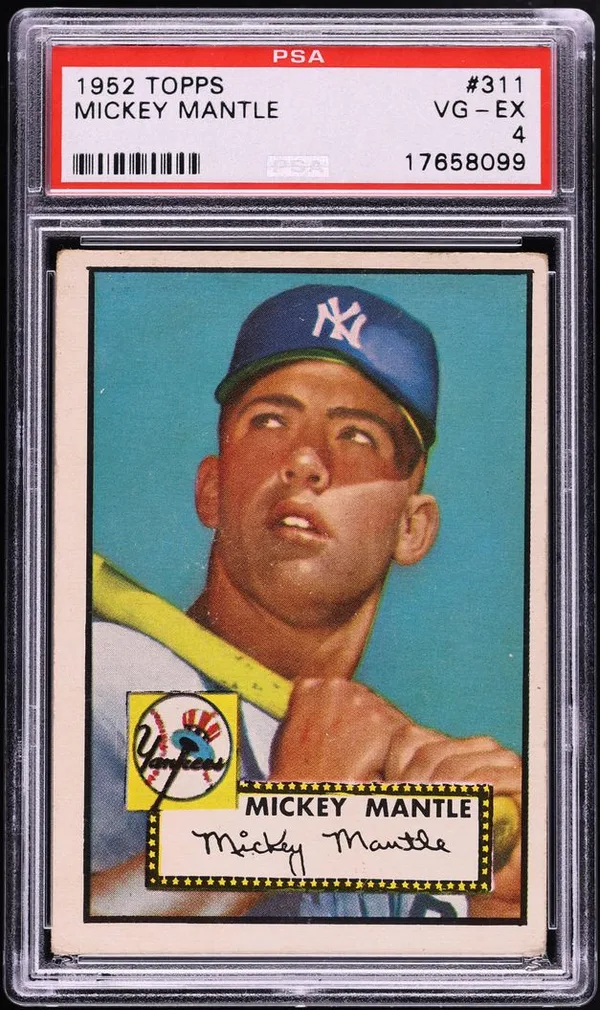
Real sold comps from Graded's pricing engine · 16 sales (eBay & Fanatics).
$132,000 fair market value in PSA 4, with prints of $156,000 (June 2026) and $192,000 (September 2025). The tape runs from $11,700 in 2012 through the 2021 boom and keeps setting highs in 2026: the icon repriced and never gave it back. Above this grade the market goes vertical: the September 2025 Fanatics Premier sale of a PSA 8 at $1,020,000 is the card's public high-grade benchmark, and the three PSA 10s in the census have only ever moved privately. The '52 is the most famous card in the sport for a reason: the double-printed #311 high series was famously dumped into the Atlantic, and survivorship built the legend.
1951 Bowman #253: The True Rookie
Real PSA 4 sales:
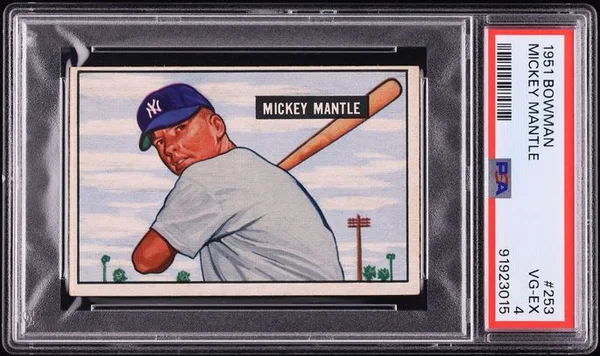
Real sold comps from Graded's pricing engine · 20 sales (eBay & Fanatics).
$23,500 on 20 archived comps ($48,000 top print). This is Mantle's actual rookie card, issued a year before the Topps, and it trades at roughly 18% of the '52 in the same grade. That gap is the deepest family discount in vintage baseball, and it has narrowed every cycle as collectors relearn the chronology.
The 1950s Topps Run: '53, '56, '57, '58, '59
The 1953 Topps #82 is the short-print artist's card ($13,050 in PSA 5, with $14,400 prints in 2026):
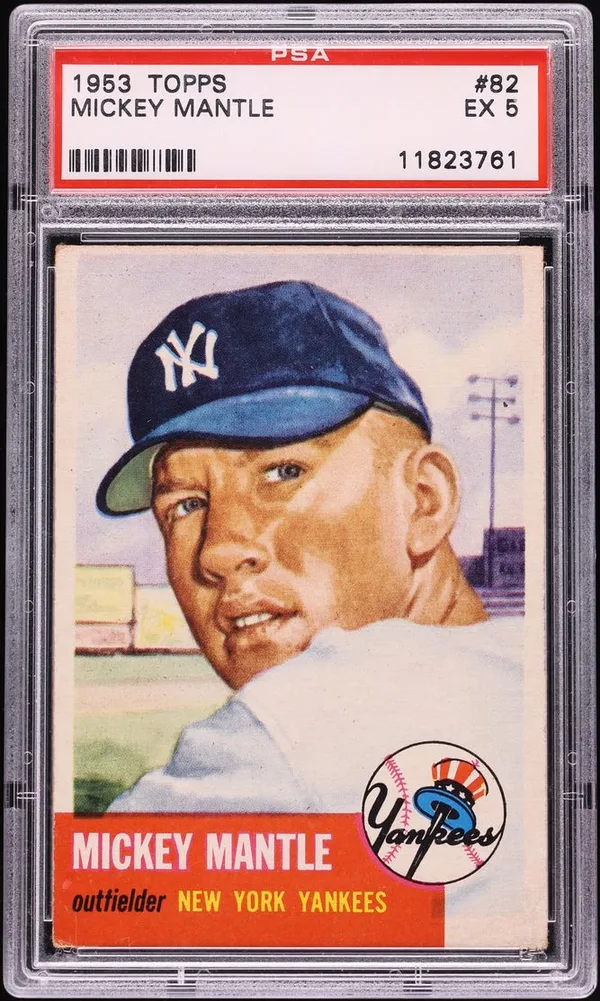
Real sold comps from Graded's pricing engine · 10 sales (eBay & Fanatics).
The 1957 Topps #95 is the set collectors call his cleanest portrait, and its PSA 8 tape is one of the deepest in vintage: 44 comps to $15,600, against a census of exactly one PSA 10:
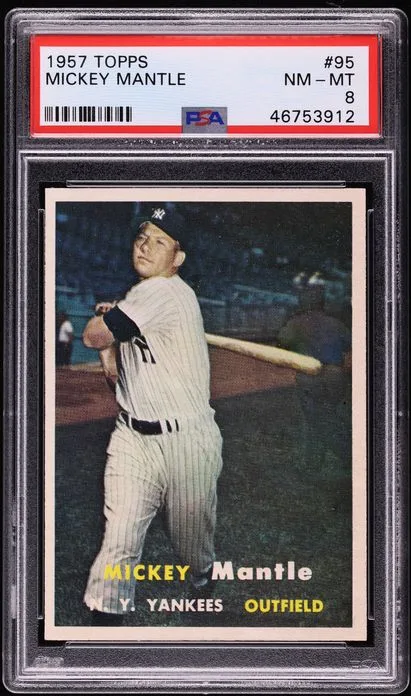
Real sold comps from Graded's pricing engine · 44 sales (eBay & Fanatics).
The 1958 Topps #150 has never received a PSA 10 in the card's entire grading history, which makes its PSA 8 at $11,250 the literal top of the practical market:
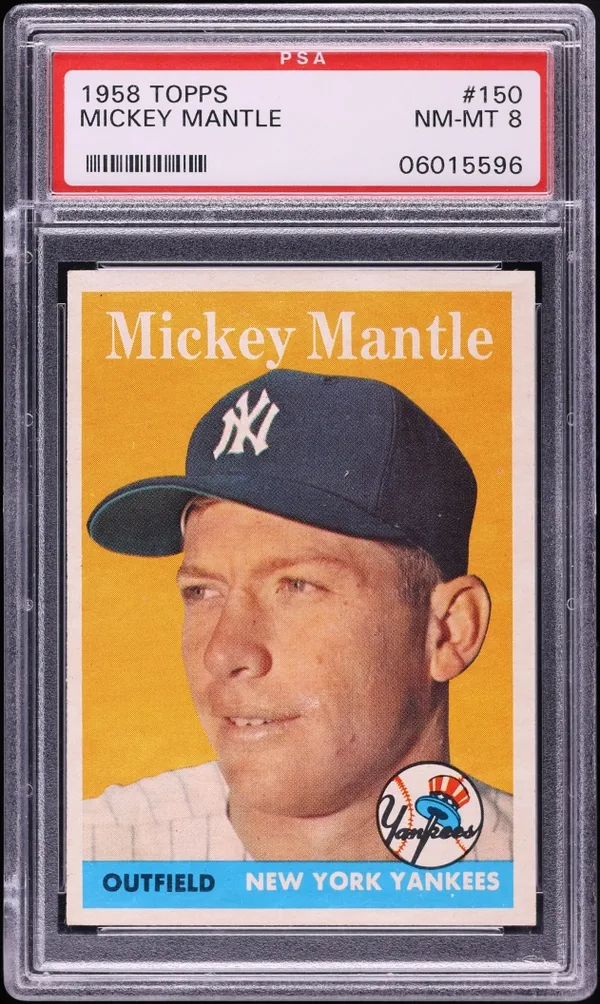
Real sold comps from Graded's pricing engine · 41 sales (eBay & Fanatics).
The 1959 Topps #10 is the volume play: 46 archived PSA 8 comps, the deepest Mantle tape in the guide, at $9,000. And the 1956 Topps #135, his Triple Crown year, tracks PSA 6 at $4,800:
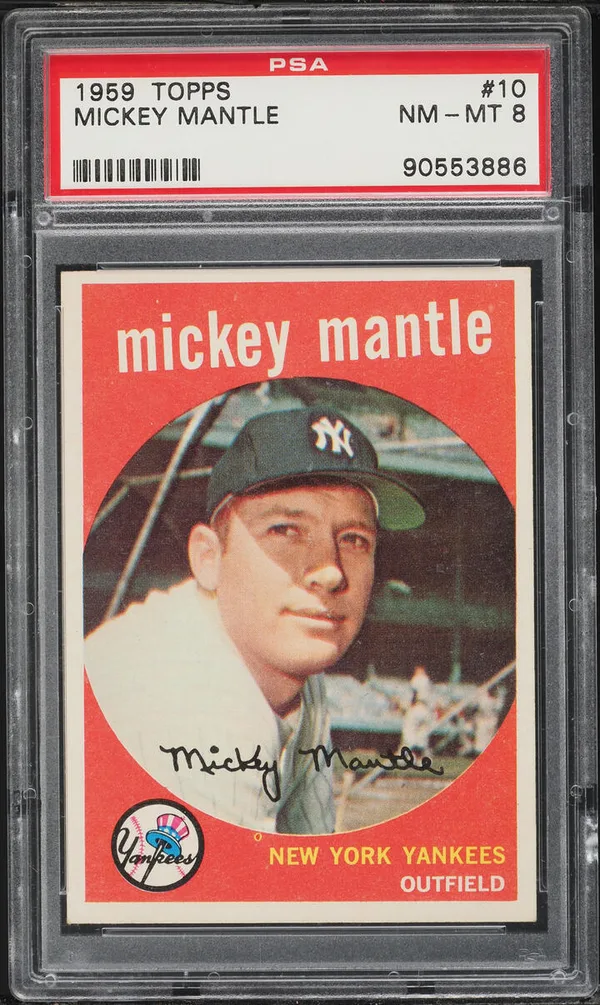
Real sold comps from Graded's pricing engine · 46 sales (eBay & Fanatics).
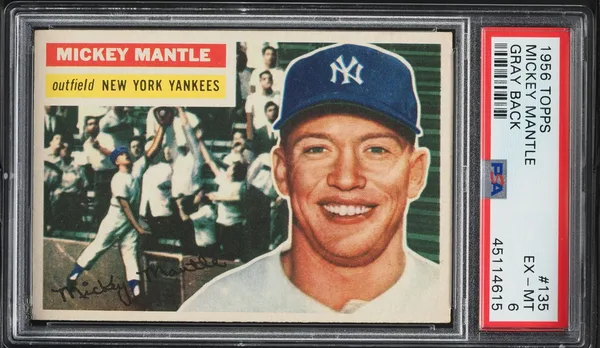
Real sold comps from Graded's pricing engine · 13 sales (eBay & Fanatics).
The 1960s: '61, '68, '69
The 1961 Topps #300, from the 61-homer summer he shared with Roger Maris, is the four-figure entry into 1960s Mantle ($3,885 in PSA 8 on 29 comps). The 1968 Topps #280 is the only Mantle with a real near-gem market: 186 PSA 9s exist and 43 have traded, at $9,750:
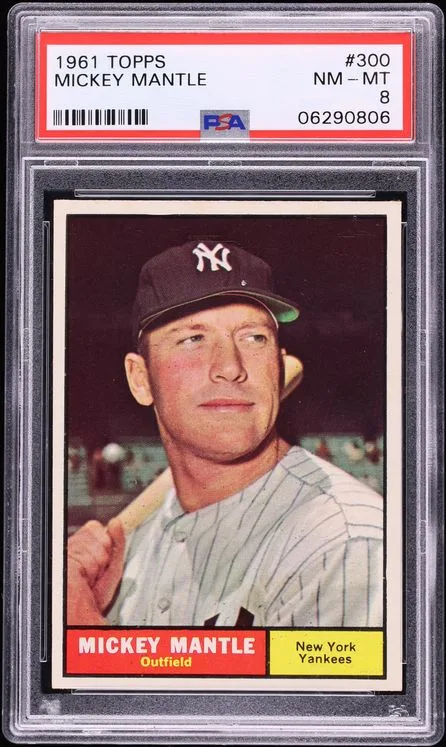
Real sold comps from Graded's pricing engine · 29 sales (eBay & Fanatics).
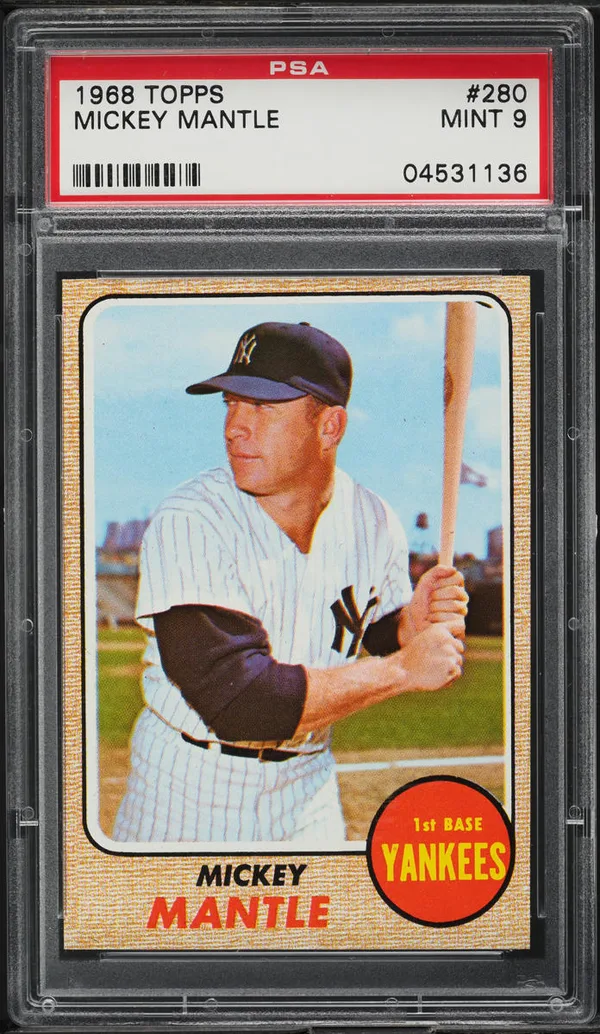
Real sold comps from Graded's pricing engine · 43 sales (eBay & Fanatics).
The 1969 Topps #500 is the farewell card, issued the spring he retired. The common "Last Name in Yellow" version tracks PSA 8 at $3,960; its White Letter variation is a five-figure short print we exclude from this tape entirely:
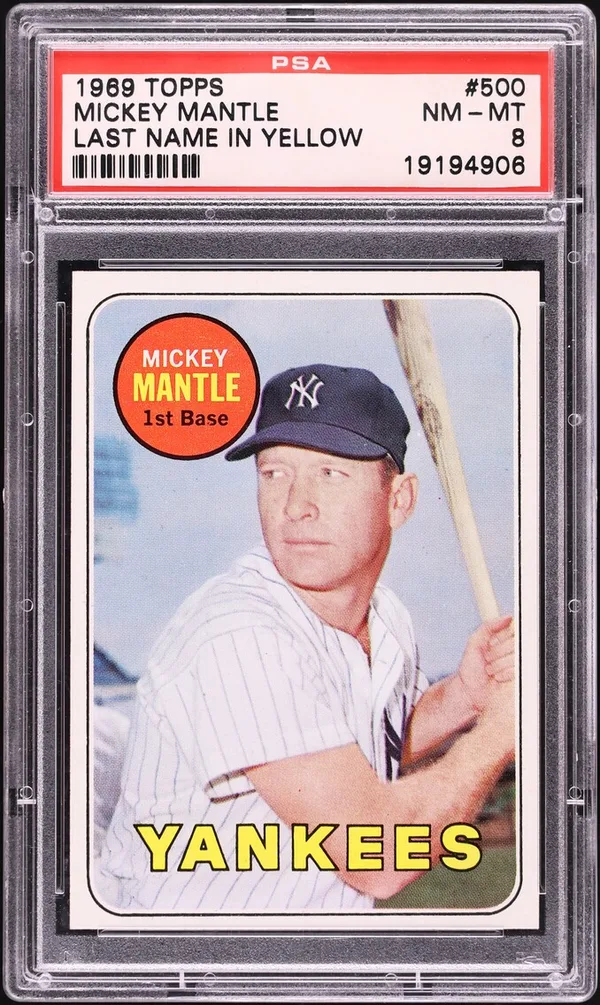
Real sold comps from Graded's pricing engine · 18 sales (eBay & Fanatics).
Reading the Ladder: Icon Premium, Family Discounts, Grade Truth
- The icon premium: the '52 Topps at $132,000 is 5.6x the true-rookie '51 Bowman in the same grade. No other sport prices the second-year card above the rookie this way.
- The PSA 8 belt is the market's core: '57 through '59 give you 131 archived comps between $9,000 and $15,600. That is where Mantle positions get built.
- Grade truth beats grade fantasy: a seller quoting a "PSA 10 book value" on a 50s Mantle is quoting a card that exists one to three times on Earth, or not at all.
- The '69 White Letter trap: two versions share #500 at a 10x-plus spread. The label says which one you own.
How High Can Mantle Cards Go?
The '52 PSA 4 has compounded from $11,700 (2012) to $132,000 (2026) without a failed cycle, and the million-dollar PSA 8 print reset the card's entire grade curve in 2025. The asset class it anchors is still tiny:
Total market value: collectibles as an asset class, next to gold, mega-cap tech, and crypto.
The right column is how many times bigger each one is than the entire collectibles market. Collectibles are already a real asset class, larger than a top-ten crypto like Dogecoin, yet still a fraction of a single mega-cap stock and barely a rounding error next to gold. That gap is the runway: as collectibles mature into a transparently priced, investable asset class, the best cards have room to re-rate that the giants no longer do.Figures approximate, 2026: gold = all above-ground gold; equities = market cap; crypto = network value; collectibles = estimated global market size. Bars use a log scale for visibility.
And the returns case is on the board:
Matching Mantle Cards to Your Risk Tolerance
Mantle is the lowest-narrative-risk ladder in collecting: the résumé closed in 1969 and the legend only grows. What remains is macro beta and liquidity risk, and the ladder prices both: the '59 and '57 PSA 8s are the liquid core (44-46 comps each), the '52 and '51 are the trophies, and the 1960s cards are the accumulation tier. Buy the grade that trades, anchor in the PSA 8 belt, and treat anything above PSA 8 on a 1950s card as an auction event.
Why These Cards Are Not Quoted in PSA 10
Our standing rule across this series is real PSA 10 sold comps only. Vintage Mantle is the honest exception that proves it: with censuses of zero to three gems per card, a "PSA 10 price" would be fiction. Each card here is quoted at its most-traded grade, labeled on every table and on the live index. The full grade math is in our PSA 10 price guide, and the value calculator prices any card at any grade.
How to Buy Mantle Cards Safely
- Price off sold comps at the exact grade, via Graded's value calculator. A half-grade moves five figures on the '52.
- Assume trimming, recoloring, and reprints everywhere. The '52 is the most counterfeited card in the hobby. Cert-verified slabs only, checked against PSA's registry.
- '52 Topps vs '51 Bowman: the Bowman is the rookie; the Topps is the icon. Listings blur them; prices do not.
- Check qualifiers: OC (off-center), MK (marks), and ST (stain) qualifiers trade at deep discounts to clean grades. Our comps exclude qualified slabs.
- Trade without shipping risk on Graded's Trading Floor, with instant on-chain escrow.
Investing in Mantle Cards on Graded
Everything this guide measures, Graded does live: real fair-market values with the value calculator, authenticated vaulted slabs in the marketplace, live tracking on the Mickey Mantle index, and instant peer-to-peer settlement on the Trading Floor.
FAQs
What is the best Mickey Mantle card to invest in?
The 1952 Topps #311 if capital allows: $132,000 in PSA 4 on sixteen archived comps, with a $1,020,000 PSA 8 print in 2025 and a three-copy PSA 10 census that has never publicly traded. For a liquid position, the 1957-1959 Topps PSA 8 belt offers 131 comps between $9,000 and $15,600.
How much is a 1952 Topps Mickey Mantle worth?
By grade, from real sold comps: about $132,000 in PSA 4 (June 2026 print $156,000), $198,000 for a PSA 5.5, $288,000 in PSA 7, and $1,020,000 for the September 2025 PSA 8. The three PSA 10s in existence have only changed hands privately; the last public PSA 9-or-better sales predate the modern archive.
What is Mickey Mantle's true rookie card?
The 1951 Bowman #253, issued a full year before the 1952 Topps. It trades at $23,500 in PSA 4, roughly 18% of the '52 in the same grade. The market pays the icon premium for the Topps, but the chronology belongs to the Bowman.
Why are Mantle cards not priced in PSA 10?
Because the gems barely exist: the exact PSA census shows three 10s for the '52 Topps, one for the '57, zero for the '58, and two for the '69. Every card in this guide is priced at its most-traded grade instead, which is how the vintage market actually functions.
What is the most liquid Mickey Mantle card?
The 1959 Topps #10 in PSA 8: 46 archived sales at about $9,000. The '57 (44 comps) and '68 in PSA 9 (43 comps) are right behind it. These three cards are where positions can be built and exited without moving the market.
Are Mickey Mantle cards a good investment?
Mantle is vintage baseball's reference asset: a closed résumé, the strongest name recognition in the sport, and a 2012-2026 tape on the '52 that compounded through every cycle including the 2021 boom and correction. The risks are macro and liquidity, not narrative. Anchor in the PSA 8 belt, treat the '52 and '51 as trophies, and never pay a phantom-gem price.