The Best Kobe Bryant Cards to Invest In (2026): The $102,000 Refractor & the Full Ladder, in PSA 10
On this page
One card rules every 1996 draft-class conversation: the 1996 Topps Chrome Refractor Kobe Bryant #138. It printed $500,000 in February 2021, trades in the low six figures today on 29 real gem comps, and sits at the top of a ladder that runs through an acetate 90s grail, the deepest chrome rookie tape in the class, and paper entries you can buy for the price of dinner. This guide maps all of it on real sold comps.
Built the same way as our basketball, Jordan, and LeBron guides: every price below is a real PSA 10 sold comp from Graded's pricing engine (eBay and Fanatics), never an asking price. Ten cards, all from his 1996-97 rookie season, $624 to $102,000, tracked live on the Kobe Bryant market index.
Nothing here is financial advice. Cards are a real but volatile asset class. Here's what the data shows.
- The Chrome Refractor is the Kobe grail: $102,000 fair market value on its 2024-2025 prints, with a $500,000 peak in 2021 and a $5,835 comp back in 2014.
- Base Topps Chrome is the core position: the same card number without the refractor shine, $10,800 on 52 gem comps, the most liquid four-figure Kobe.
- The E-X2000 is the design cult: $16,800 on 38 comps for the acetate see-through card collectors call the best-looking rookie of the 90s.
- The paper tier is real liquidity: 1996 SP has 61 gem comps around $624, the cheapest way to own a real Kobe rookie gem.
- Every card in this guide is quoted in PSA 10, and the base-vs-refractor trap on #138 is the single most expensive mistake in the class.
- Retired-legend risk profile: the résumé is closed, demand is global, and the ladder moves on supply and macro alone.
The Framework: What Makes a Kobe Card an Investment
- One rookie season, many products: 1996-97 Topps Chrome, E-X2000, SP, Fleer, Metal, Ultra, Finest. The whole ladder is rookie-year cardboard; there is no second-year discount tier like Jordan's Fleer run.
- Chrome survivorship is the scarcity: 1996 Topps Chrome was a low-print product with brutal centering, and the refractor parallel is the class trophy.
- Global demand floor: Kobe is the most collected Laker and one of the most collected athletes in the world; the bid never rotates.
- No career risk: like Jordan, the ladder moves on supply and macro, nothing else.
The Kobe Card Ladder
Ten cards, on real PSA 10 sold comps:
Bars use a logarithmic scale so every rung is visible. Every value is a real PSA 10 sold comp, not an asking price.
1996 Topps Chrome Refractor #138: The Kobe Grail
The engine has every PSA 10 sale back to 2014:
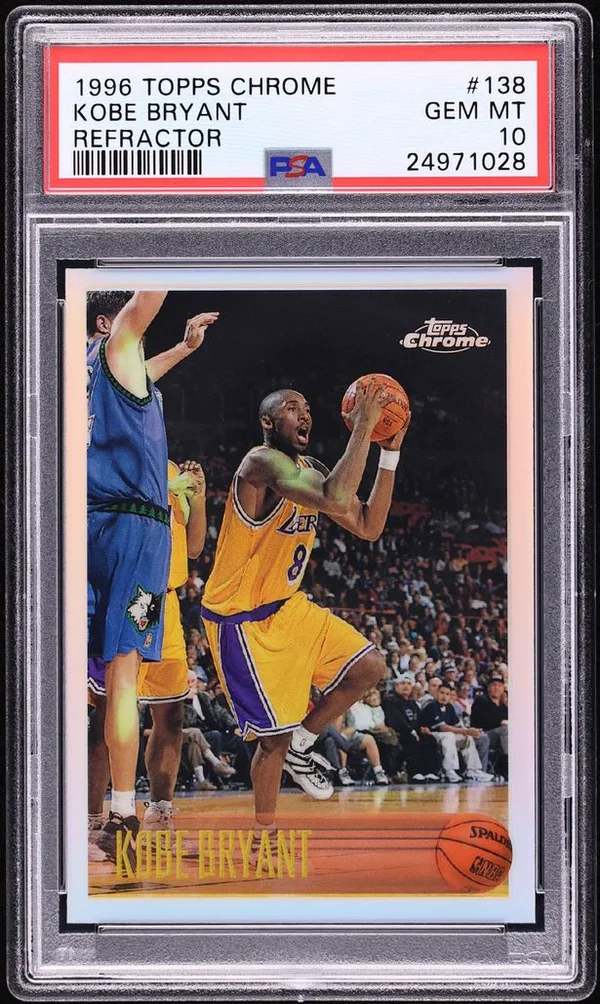
Real sold comps from Graded's pricing engine · 29 sales (eBay & Fanatics).
$102,000 fair market value on its recent prints ($117,000 in October 2025). The curve tells the whole asset's story: $5,835 in 2014, $16,100 in 2019, a $500,000 print in February 2021, then a repricing into the $96,000-$168,000 band where it has traded for four years. Twenty-nine gem comps make it one of the deepest six-figure tapes in basketball: this is a trophy with actual liquidity.
1996 Skybox E-X2000 #30: The Acetate Grail
Real PSA 10 sales:
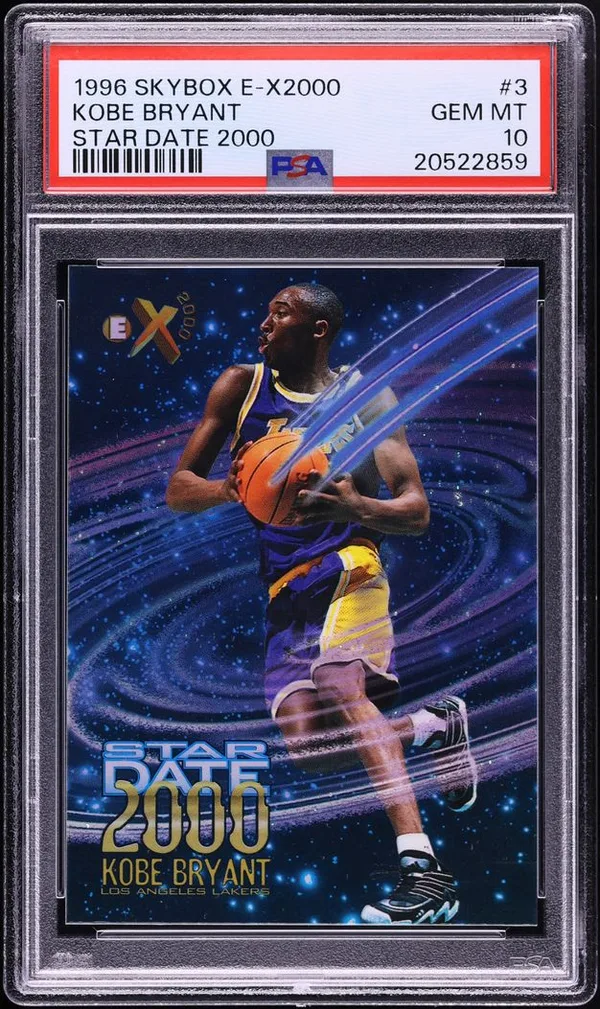
Real sold comps from Graded's pricing engine · 38 sales (eBay & Fanatics).
$16,800 (May 2026) on 38 gem comps, with an $87,100 print at the 2021 peak. The see-through acetate frame is routinely called the best-looking card of the 90s, and acetate is condition-brutal: it shows every scratch, which keeps the gem float thin against a cult following that spans every sport.
1996 Topps Chrome #138: The Core Position
Real PSA 10 sales:
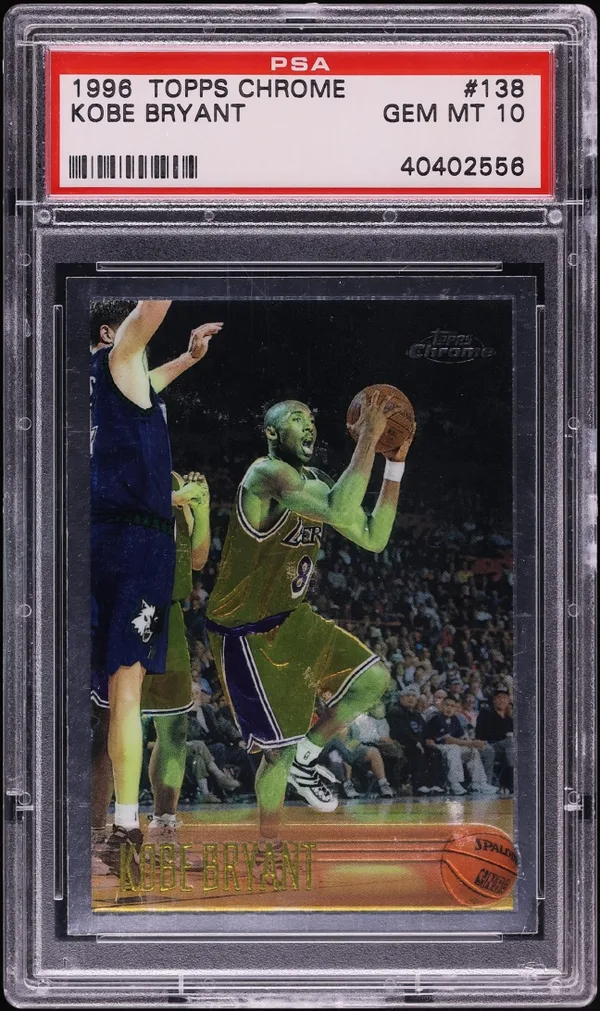
Real sold comps from Graded's pricing engine · 52 sales (eBay & Fanatics).
$10,800 on 52 gem comps, the deepest chrome tape in the class. Same card number as the refractor at roughly a tenth of the price, and the most liquid way to hold a serious Kobe position. Its all-time tape runs from $750 pre-2020 through $42,101 at the peak to a stable five-figure market today.
The Insert Tier: Ultra Rising Stars, Youthquake, Finest, Metal
The 90s insert class is where the cult money lives. The Ultra Rising Stars is its current leader:
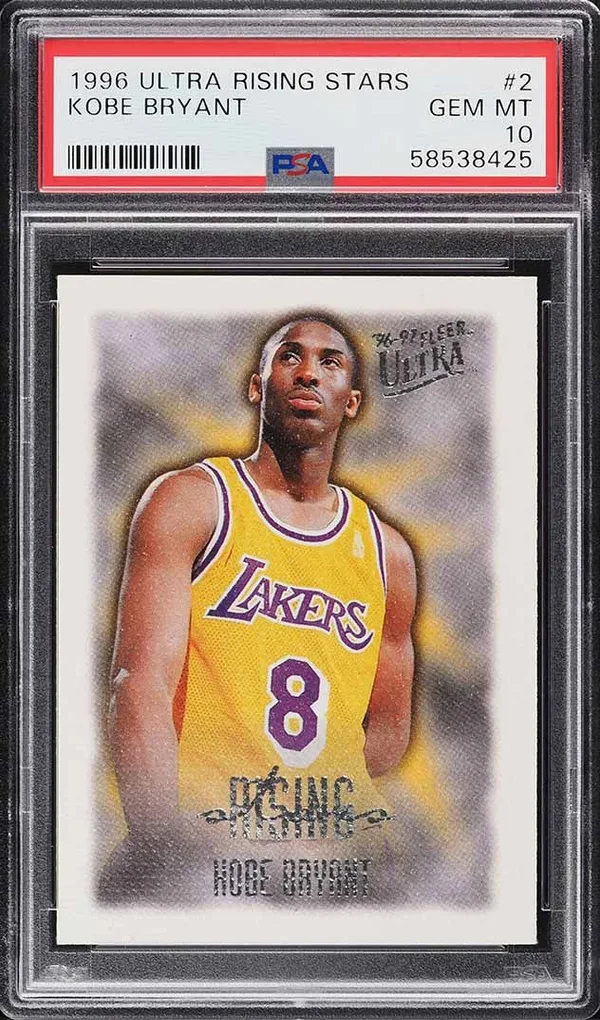
Real sold comps from Graded's pricing engine · 12 sales (eBay & Fanatics).
The Topps Chrome Youthquake (31 comps) and Finest (31 comps, the famous "w/ Coating" slabs) are the liquid chrome inserts, and Metal #181 carries the Skybox steel look:
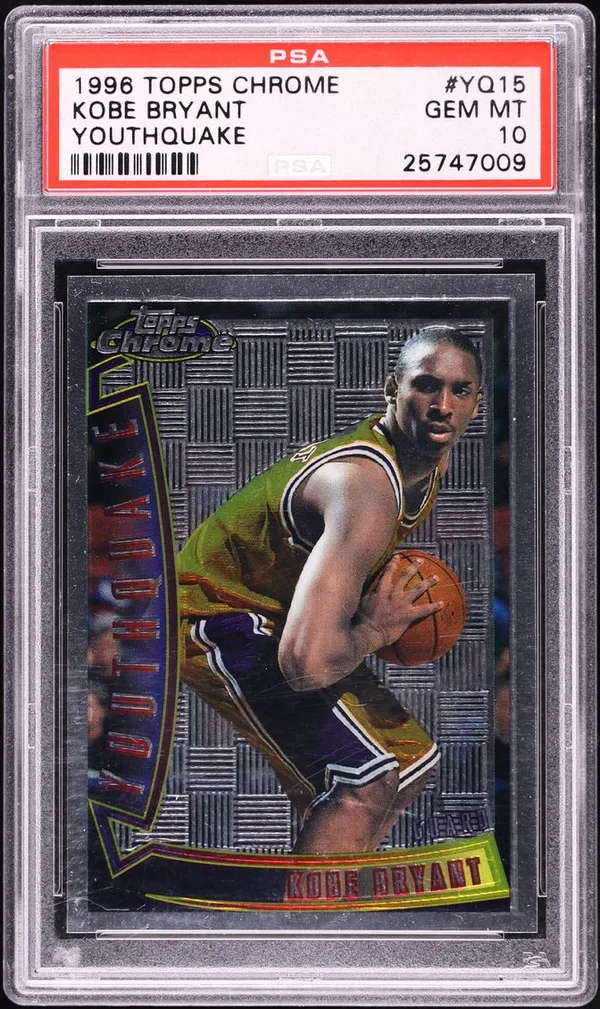
Real sold comps from Graded's pricing engine · 31 sales (eBay & Fanatics).
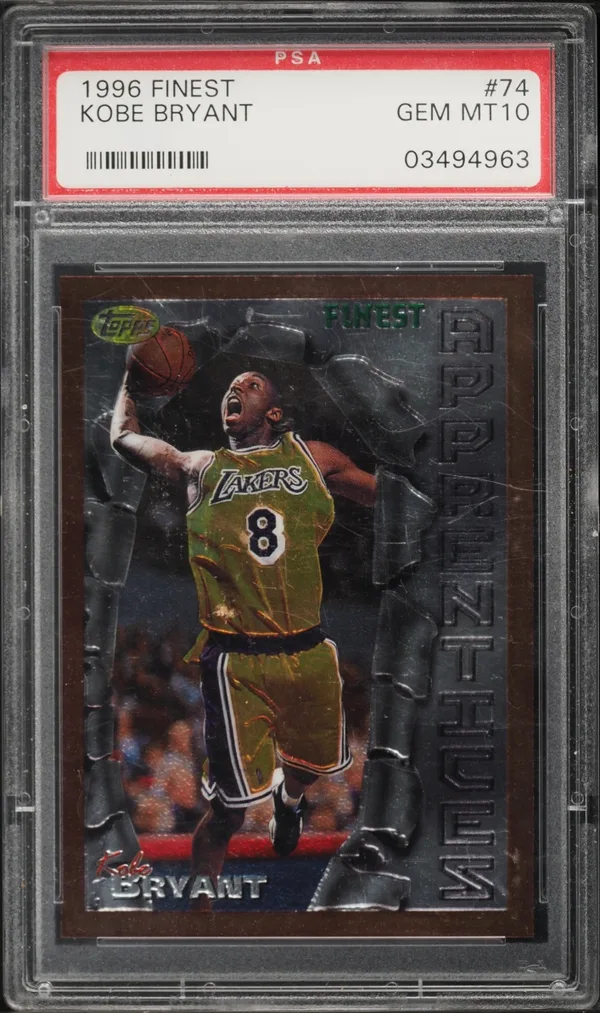
Real sold comps from Graded's pricing engine · 31 sales (eBay & Fanatics).
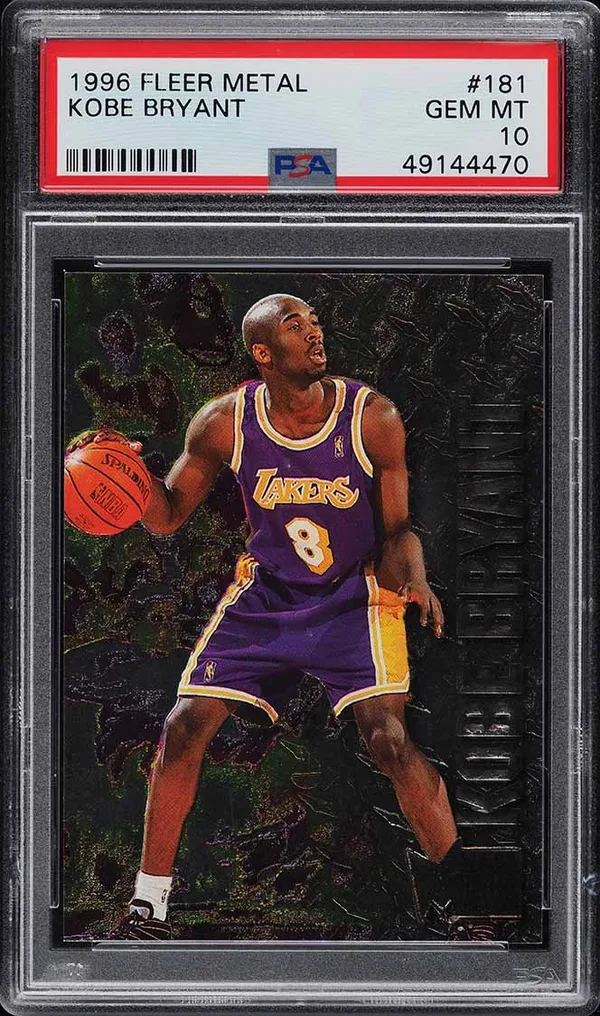
Real sold comps from Graded's pricing engine · 22 sales (eBay & Fanatics).
Above all of these sit the serial-numbered 90s parallels (Ultra Gold Medallion, Flair Showcase Row 0 Legacy /150, Precious Metal): five-figure cards that trade too thinly for an honest fair market value. When their tapes deepen, they join this guide.
The Paper Tier: Topps, Fleer, SP
Three liquid entries close the ladder. The flagship 1996 Topps #138 is the paper version of the chrome pair:
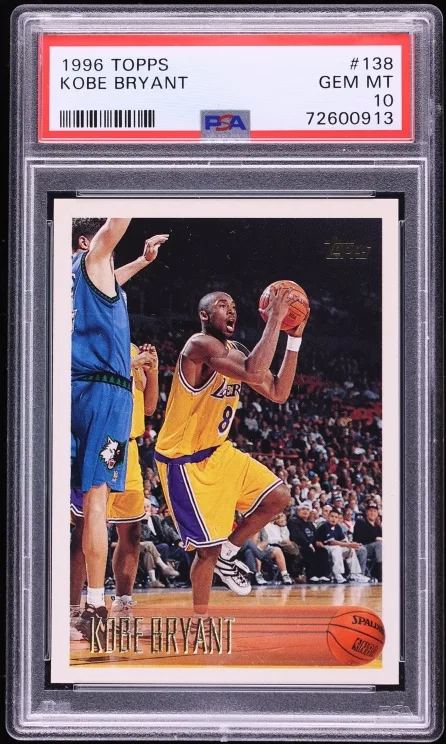
Real sold comps from Graded's pricing engine · 11 sales (eBay & Fanatics).
The 1996 Fleer #203 (24 comps) and 1996 SP #134 (61 comps, the most liquid Kobe gem market in existence) are the accumulation cards:
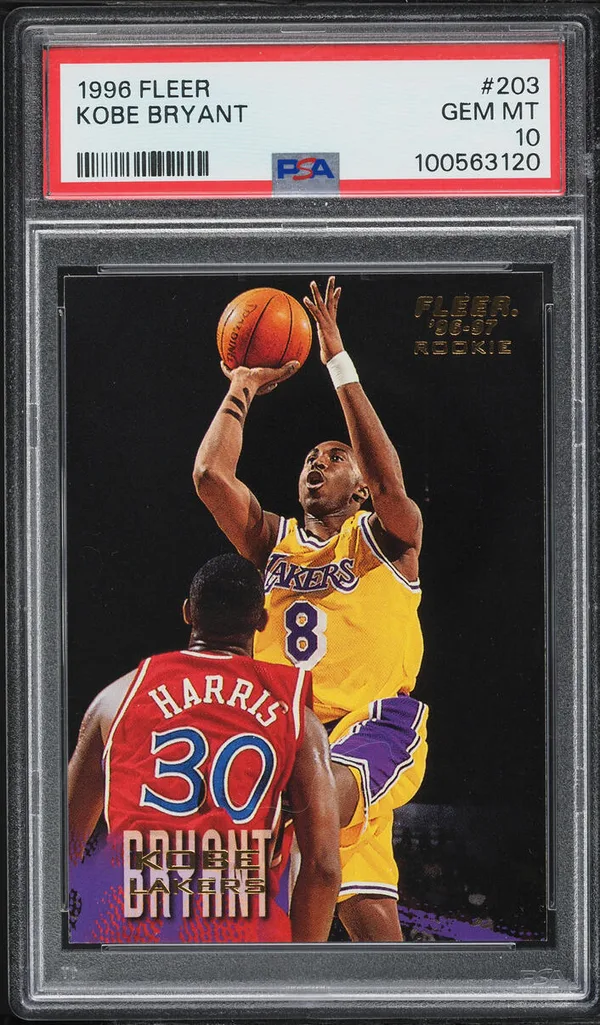
Real sold comps from Graded's pricing engine · 24 sales (eBay & Fanatics).
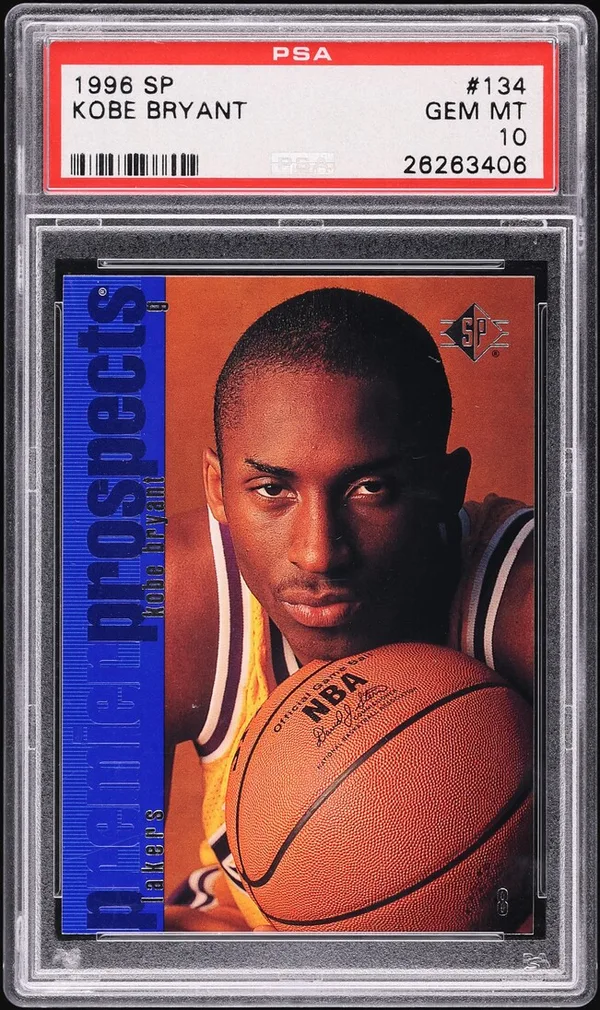
Real sold comps from Graded's pricing engine · 61 sales (eBay & Fanatics).
Reading the Class: the Refractor Trap and the Family Discounts
- The #138 trap is the expensive mistake: base Topps Chrome and the Refractor share a card number at a 10x spread. The refractor says "Refractor" on the PSA label; never trust a listing title alone.
- The family discount is the trade: base Chrome at ~11%, E-X2000 at ~16%, and the paper tier at under 2% of the refractor, all on the same rookie season.
- Liquidity lives at the bottom: SP's 61 comps and base Chrome's 52 are where positions can actually be built and exited.
- The trophy repriced and held: the refractor's four-year $96k-$168k band after the 2021 spike is what a maturing trophy market looks like.
How High Can Kobe Cards Go?
The refractor peaked at $500,000, retraced to a six-figure band, and has printed between $96,000 and $168,000 every year since. The asset class it belongs to is still tiny:
Total market value: collectibles as an asset class, next to gold, mega-cap tech, and crypto.
The right column is how many times bigger each one is than the entire collectibles market. Collectibles are already a real asset class, larger than a top-ten crypto like Dogecoin, yet still a fraction of a single mega-cap stock and barely a rounding error next to gold. That gap is the runway: as collectibles mature into a transparently priced, investable asset class, the best cards have room to re-rate that the giants no longer do.Figures approximate, 2026: gold = all above-ground gold; equities = market cap; crypto = network value; collectibles = estimated global market size. Bars use a log scale for visibility.
And the returns case is on the board:
Matching Kobe Cards to Your Risk Tolerance
Kobe is a closed-résumé ladder: no career risk, no rotation risk, permanent global demand. What remains is macro beta and the 2021 lesson that trophy prints can halve. Anchor in the liquid tapes (base Chrome, SP), size the refractor as a trophy, and let the insert tier carry the upside case.
Why Every Card Here Is a PSA 10
The gem premium runs roughly 10x across this ladder, and every card in this guide has a real, active PSA 10 market, from the refractor's 29 comps to SP's 61. Our PSA 10 price guide covers the grade math in depth, and the value calculator prices any card instantly.
How to Buy Kobe Cards Safely
- Price off sold comps, never listings, via Graded's value calculator.
- Check the refractor line on the PSA label. The #138 base-vs-refractor spread is 10x; the label, not the listing title, is the truth.
- Cert-verify every slab against PSA's registry before paying five figures.
- Watch the Finest coating: "w/ Coating" is the standard PSA designation for unpeeled Finest; peeled and unpeeled are graded as different cards.
- Trade without shipping risk on Graded's Trading Floor, with instant on-chain escrow.
Investing in Kobe Cards on Graded
Everything this guide measures, Graded does live: real fair-market values with the value calculator, authenticated vaulted slabs in the marketplace, live index tracking on the Kobe Bryant index, and instant peer-to-peer settlement on the Trading Floor.
FAQs
What is the best Kobe Bryant card to invest in?
The 1996 Topps Chrome Refractor #138: $102,000 fair market value on 29 real PSA 10 comps, the undisputed grail of the class. For a liquid core position, the base 1996 Topps Chrome at $10,800 on 52 comps is the deepest tape; the E-X2000 at $16,800 is the design cult's pick.
How much is a Kobe Bryant rookie card worth?
In PSA 10, from $624 (1996 SP, 61 comps) through $2,190 (1996 Topps), $10,800 (Topps Chrome), $16,800 (E-X2000), to $102,000 for the Topps Chrome Refractor. Every one of those is a real sold comp from our archive, not an asking price.
What is the most expensive Kobe Bryant card?
Among cards with public PSA 10 comps in our archive: the 1996 Topps Chrome Refractor at $102,000 (peak $500,000 in February 2021). Serial-numbered parallels like the Flair Showcase Legacy Row 0 /150 ($96,000) and Ultra Gold Medallion ($66,000) trade higher on single prints but too thinly for an honest fair market value.
Is the 1996 Topps Chrome Kobe base or refractor worth more?
The refractor, by roughly 10x: $102,000 against $10,800. They share card #138, which makes the refractor line on the PSA label the most expensive detail in the class. The base card's 52 gem comps make it the more liquid position.
Are Kobe Bryant cards a good investment?
Kobe has the profile long-term collectors want: a closed résumé, permanent global demand, and a ladder with real liquidity at every price point. The 2021-2023 cycle proved the trophy tier can halve and stabilize; the liquid tapes (base Chrome, SP) held their markets throughout. Anchor in liquidity, size trophies as trophies.