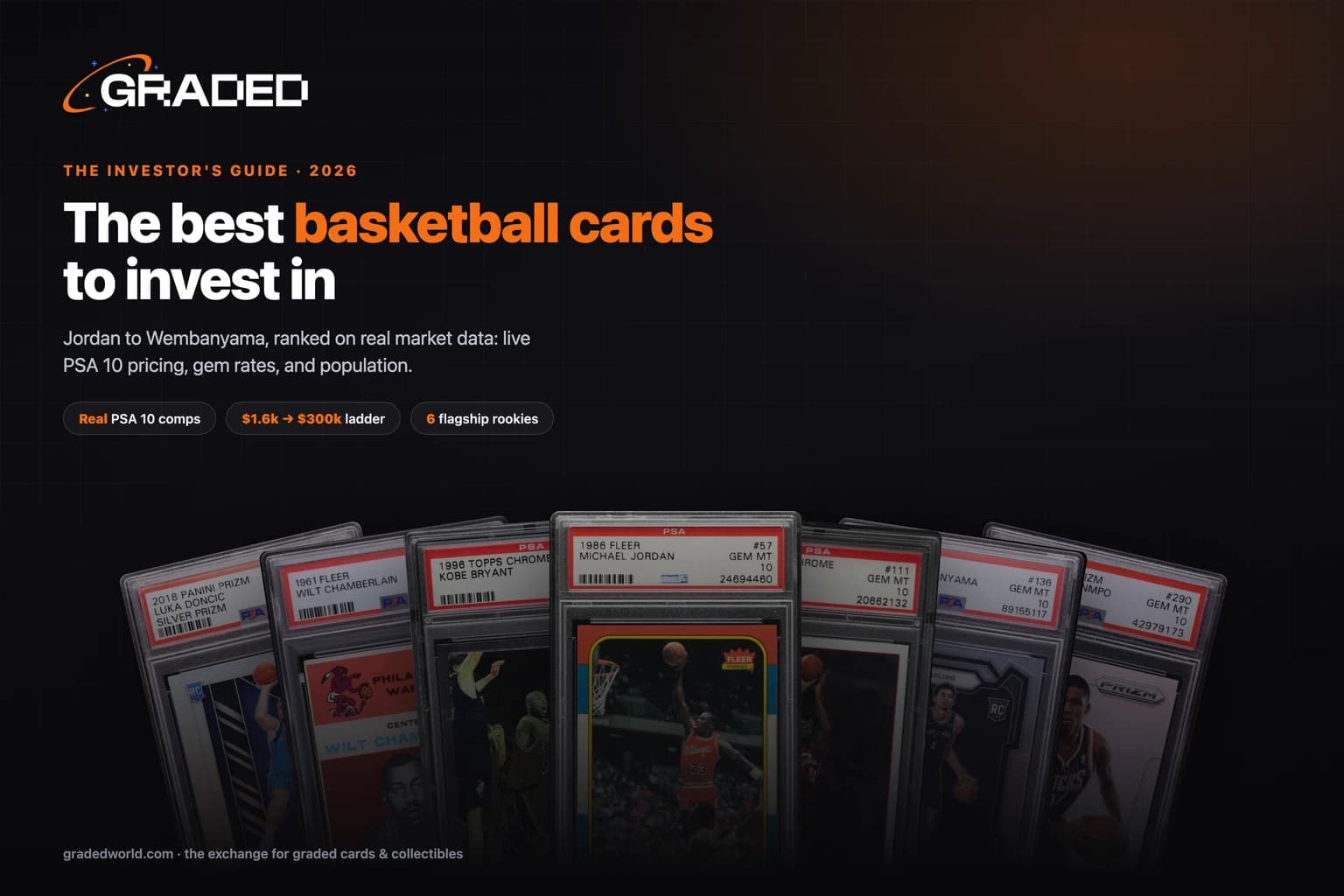
The Best Basketball Cards to Invest In (2026): Jordan to Wembanyama, With Real Pricing
On this page
- 01The basketball framework
- 02The basketball card ladder
- 031986 Fleer Jordan
- 041961 Fleer Wilt Chamberlain
- 05Topps Chrome Kobe
- 06Topps Chrome LeBron
- 07Refractors & numbered rookies
- 08Silver Prizm Giannis
- 09Silver Prizm Luka
- 10Silver Prizm Wembanyama
- 11How high can they go?
- 12Match cards to your risk
- 13How to buy safely
- 14Investing on Graded
Basketball is the deepest, most liquid corner of the entire sports-card market. It has the single most valuable sports card of the modern era (the 1986 Fleer Jordan), the most global fanbase of any American sport, and a constant pipeline of new demand every time a generational rookie arrives. If you only invest in one sport's cardboard, this is the one with the strongest case.
This guide is basketball only, and it's built the same way we built our flagship card-investing guide: on numbers. We run Graded's pricing engine, so the prices below come from real sold comps, not asking prices. We'll cover the framework that separates an investment from a fan purchase, the specific rookies worth owning at every budget from four figures to $300,000, live sales charts for each, and how to buy them safely.
Nothing here is financial advice. Cards are a real but volatile asset class, and you should never put in money you can't afford to lose. With that said, here's what the data shows.
- The best basketball cards to invest in are flagship rookies in the top grades: the 1986 Fleer Jordan and 1961 Fleer Wilt Chamberlain at the top, the 1996 Topps Chrome Kobe and 2003 Topps Chrome LeBron in the middle, and the Silver Prizm rookies of Giannis, Luka, and Wembanyama as the modern tier.
- One player, one card. The market anchors almost all of a player's value to his flagship rookie: Jordan means 1986 Fleer, Kobe means 1996 Topps Chrome, LeBron means 2003 Topps Chrome, and everyone since 2012 means Panini Prizm.
- From Giannis onward, the parallels are the investment, not the base. Silver Prizms trade at roughly 8-9× the base rookie in PSA 10, which is why every modern pick in this guide is the Silver Prizm in a PSA 10. Numbered colors sit higher still, and the jersey-color-match parallel (like Luka's Blue Prizm /199 in Mavericks blue) is the numbered rookie the market crowns.
- Career risk is the price of entry on modern. A Wembanyama rookie is a bet on a career that's still being written. A Jordan rookie is a settled fact. Price the difference.
- Population decides the ceiling. The Jordan PSA 10 (pop ~326) trades near $300k while modern base rookies with five-figure gem populations trade in the hundreds. Same sport, same icon status, opposite supply.
- Basketball is the most global sports-card market. The NBA's international reach keeps pulling new collectors in, which is the demand engine everything above depends on.
The Framework: What Makes a Basketball Card an Investment
Every card in this guide has to pass the same five-part filter we use across the hobby. Buy on these and you're investing; buy on anything else and you're gambling on a highlight reel.
- The flagship rookie, not just any rookie. Basketball is ruthless about this. One set defines each era: Fleer in the '80s, Topps Chrome from 1996 to 2009, and Panini Prizm since 2012. The flagship rookie is the reference card the whole market prices around. Everything else is a side bet.
- Scarcity you can measure (gem rate). A 1986 Fleer Jordan gems about 1.2% of the time. A 2023 base Prizm Wembanyama gems closer to half the time. That difference is the entire reason one is $300,000 and the other is $330 — and why the scarcer Silver Prizm of the same rookie runs about $2,800.
- Low absolute population. Check the PSA 10 count, not just the gem rate. Modern base rookies can carry five-figure gem populations, which caps the upside no matter how good the player is. See our guide to PSA pop reports.
- A settled (or settling) career narrative. This is basketball-specific and it matters enormously. Jordan's legacy can't change. LeBron's is essentially closed. A second-year player's can collapse with one injury. The more open the narrative, the bigger the discount you should demand.
- Liquidity. Basketball is the most liquid sports-card market on earth, but it concentrates in the icons. A Jordan or LeBron PSA 10 sells this week at a knowable price. A fringe all-star's parallel might sit for months.
The Basketball Card Ladder
"Best basketball cards to invest in" spans two orders of magnitude. Here's where the marquee rookies actually sit by market value, from a $1,600 Luka Silver Prizm to the $300,000 Jordan.
Bars use a logarithmic scale so every rung is visible. Each gridline up is roughly a 10× jump in value. The modern rungs are the Silver Prizms in PSA 10; the base rookies of the same players trade at roughly an eighth to a ninth of these prices.
Read the ladder as three tiers. The bottom is the modern Silver Prizm rookies (Luka, Wemby, Giannis): the scarce chase version of each flagship rookie, trading in the four figures where the base versions trade in the hundreds. The middle is the chrome-era grails (Kobe, LeBron): five-figure cards with two decades of track record. The top is true vintage (Wilt, Jordan): fixed-supply trophy assets that behave more like fine art than cardboard. Where you buy depends on budget and risk tolerance, not on which card is "better."
1986 Fleer Michael Jordan #57: The Benchmark
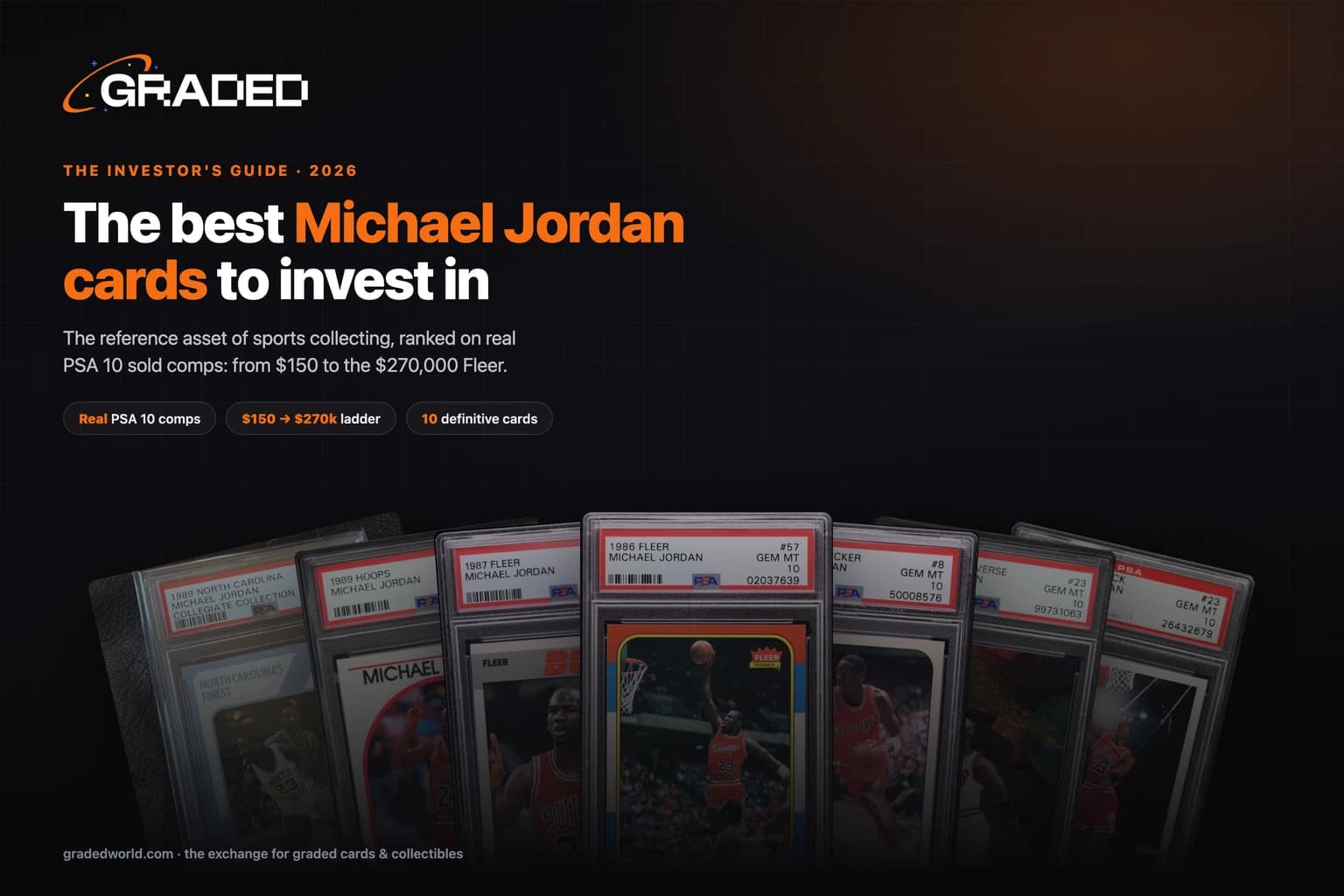
Every sports-card conversation eventually arrives here. The 1986 Fleer Michael Jordan #57 is the most important basketball card ever printed: the flagship rookie of the greatest player of all time, from a set so condition-sensitive that only about 326 of 28,000+ graded copies have ever come back PSA 10. That's a 1.2% gem rate on the most submitted vintage basketball card in existence.
The long-term chart is the whole thesis in one picture. A PSA 10 traded around $2,000 in the early 2000s, crossed $50,000 by 2019, spiked past $500,000 in the 2021 mania, and has settled near $300,000 today. Not a straight line, but two decades of higher lows on a supply that cannot grow.
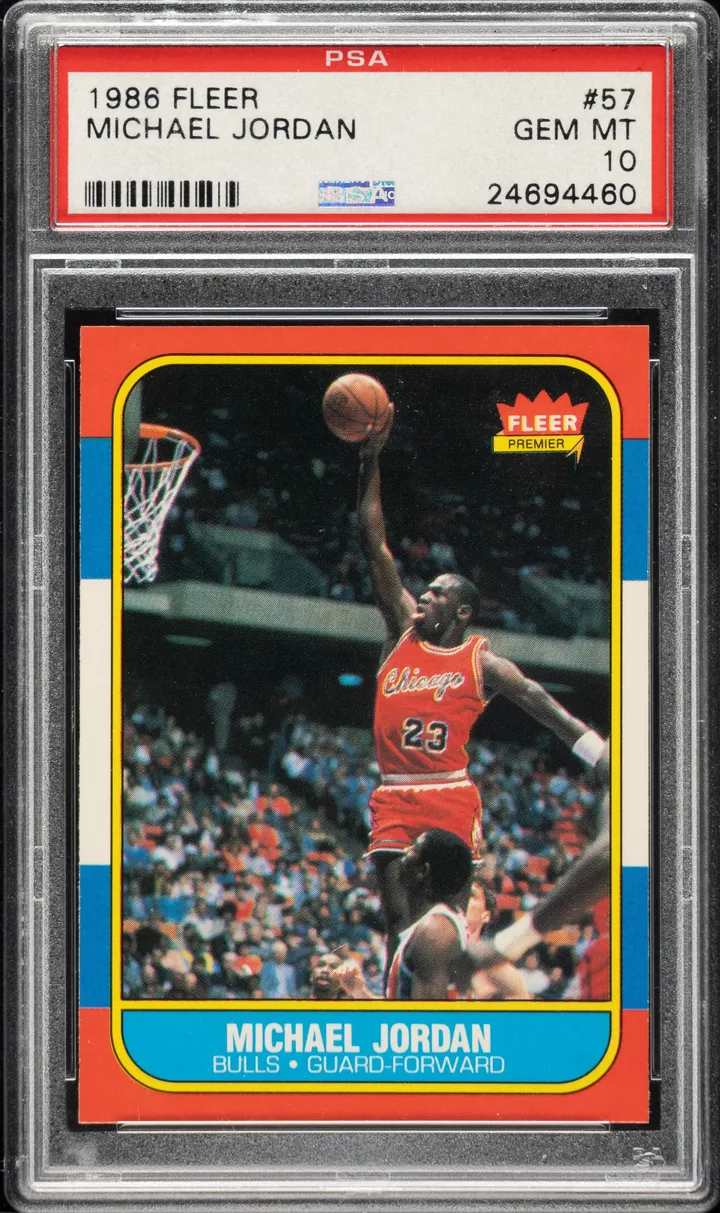
The benchmark of the entire sports-card market. Only about 326 PSA 10s of 28,000+ graded (a 1.2% gem rate), trading in the six figures. The rookie every other basketball card is measured against.
Market cap = PSA 10 population × fair-market value. Sources: Card Ladder · PSA APR · PriceCharting.
The PSA 10 is a museum piece, and that's fine. The thesis extends down the grade ladder: PSA 8s and 9s of the same card trade in the five figures with the same fixed supply and the same demand engine. In basketball, owning any strong grade of the '86 Jordan is the closest thing the hobby has to owning an index of the sport itself.
1961 Fleer Wilt Chamberlain #8: The Original Giant
Before Jordan there was Wilt, and basketball's other vintage pillar is the 1961 Fleer Wilt Chamberlain #8: the rookie card of the most statistically dominant player the sport has ever produced, from the one true vintage basketball set of its era. The man averaged 50 points a game for a season and scored 100 in a night, and his rookie has a scarcity profile even the Jordan can't match: no PSA 10 exists. Sixty-five years of handling means the census tops out at a handful of PSA 9s, and investment-grade copies are PSA 7s and 8s (pictured: a PSA 7 example).
Here's the real market, PSA 8 sales from Graded's pricing engine:
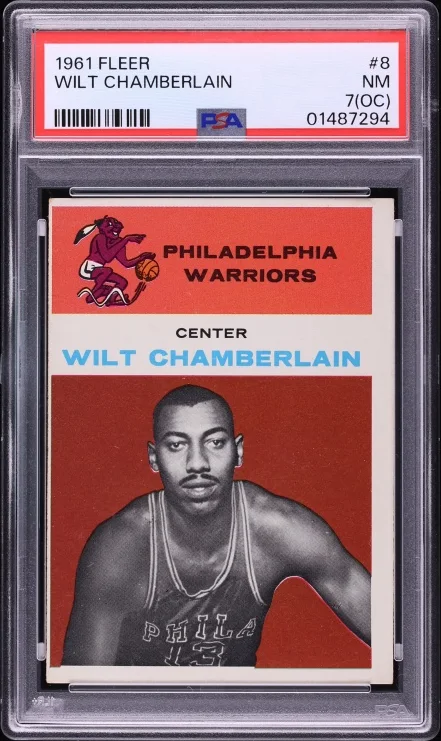
Real sold comps from Graded's pricing engine · 11 sales (eBay & Fanatics).
View live data on Graded →A PSA 8 trades around $40,000 to $46,000, mid-grade copies (PSA 5-6) run $5,000 to $7,000, and the few PSA 9s are six-figure auction events. That grade ladder is the opportunity: unlike modern cards, where only the gem matters, true vintage lets you own the same fixed supply at whatever rung your budget reaches. Sixty-five-year-old cardboard, a fanbase that predates the NBA's television era, and a supply that can only shrink. It's the purest fixed-supply asset in basketball.
1996 Topps Chrome Kobe Bryant #138: The Modern-Vintage Grail
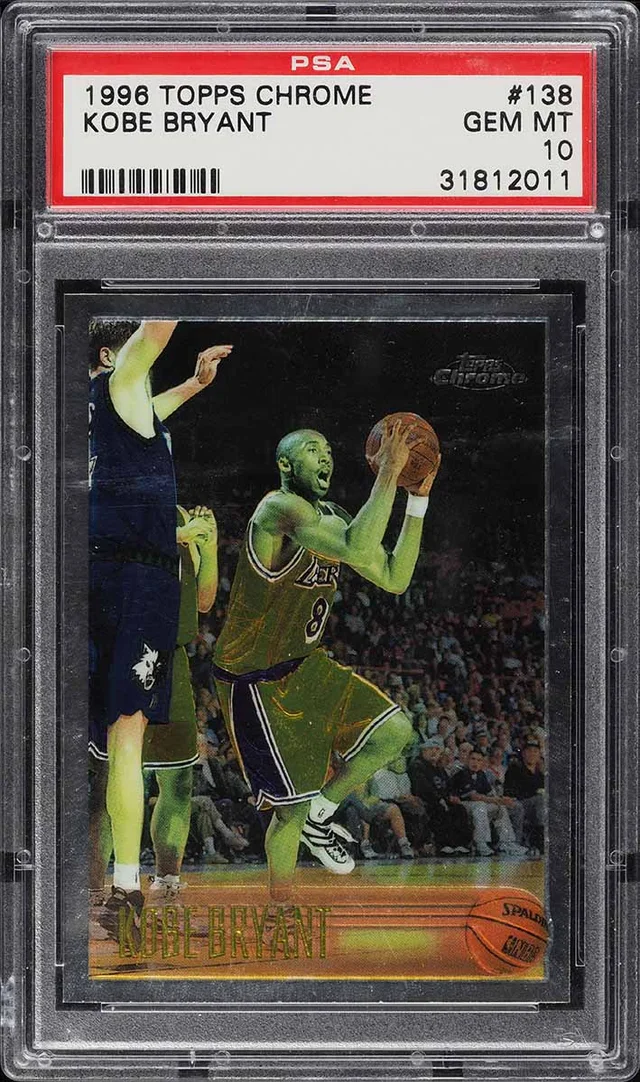
Kobe's flagship rookie is the 1996 Topps Chrome #138, from the first Topps Chrome basketball set ever printed. That first-year chrome stock chips and scratches if you look at it wrong, which is why the gem rate sits around 4% and the PSA 10 carries a heavy premium. Six years of real sales from Graded's pricing engine, 2020 to today:
Real sold comps from Graded's pricing engine · 49 sales (eBay & Fanatics).
View live data on Graded →Read the chart honestly, because it teaches the most important lesson in the hobby. The PSA 10 ran from about $10,000 in 2020 to nearly $40,000 at the 2021 peak, gave most of it back through 2022-2024, and has climbed from $5,000 back to roughly $10,800 today on steady demand. The Refractor parallel of this same card has crossed seven figures, which tells you where the ceiling is when scarcity meets a legacy this deep. The investment case: a permanently closed, permanently elite narrative (five rings, two decades, one franchise), a pre-grading-boom gem population, and demand that has now proven itself through a full boom-and-bust cycle. Our full Kobe Bryant guide maps the entire ten-card ladder, refractor to paper.
2003 Topps Chrome LeBron James #111: The Liquid Blue-Chip
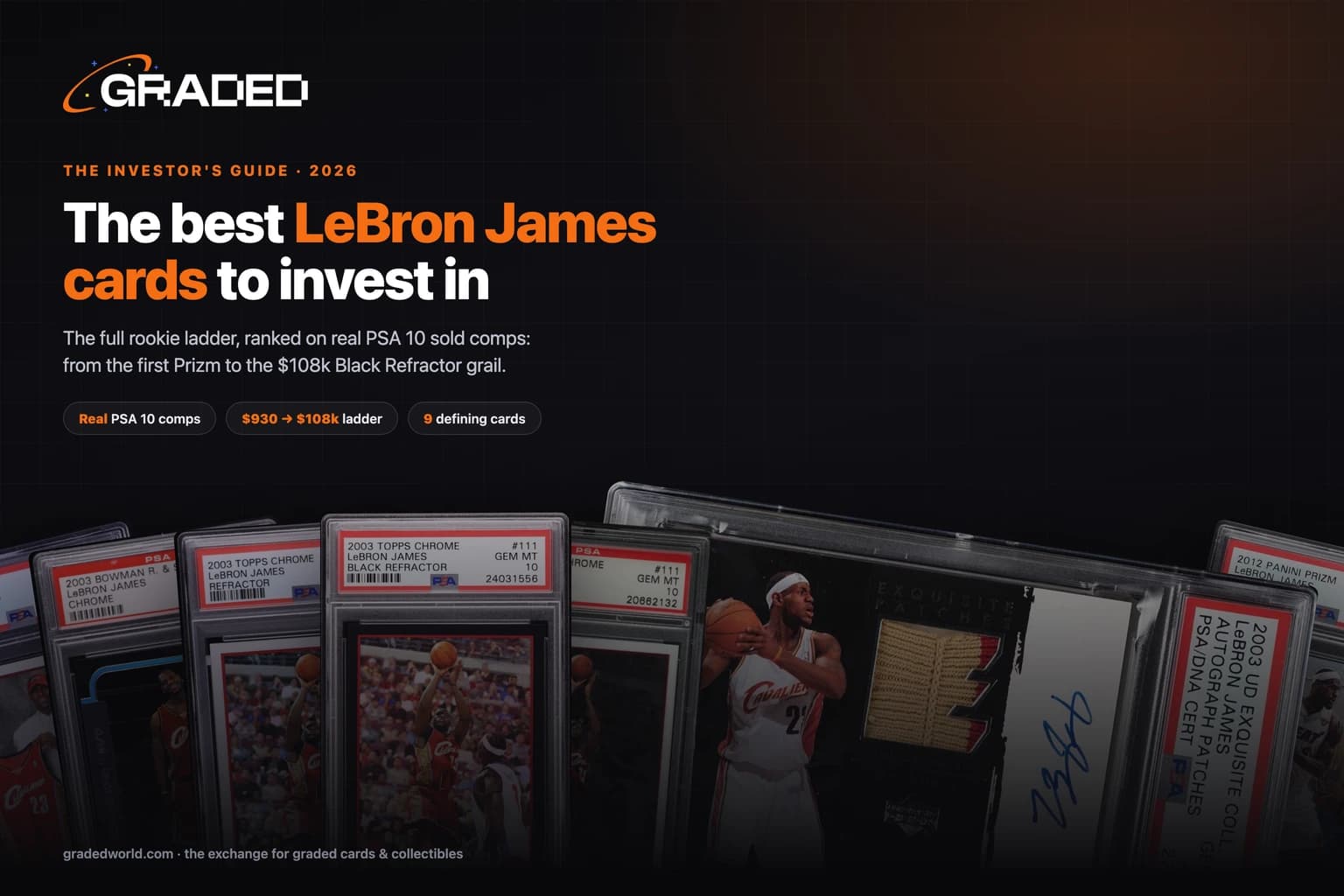
LeBron's reference card is the 2003 Topps Chrome #111, the chrome flagship from the deepest rookie class in NBA history. The career case closed itself: all-time scoring leader, four rings, and twenty-plus seasons of relevance. Here are the live numbers from Graded's pricing engine, real PSA 10 sales, not estimates:
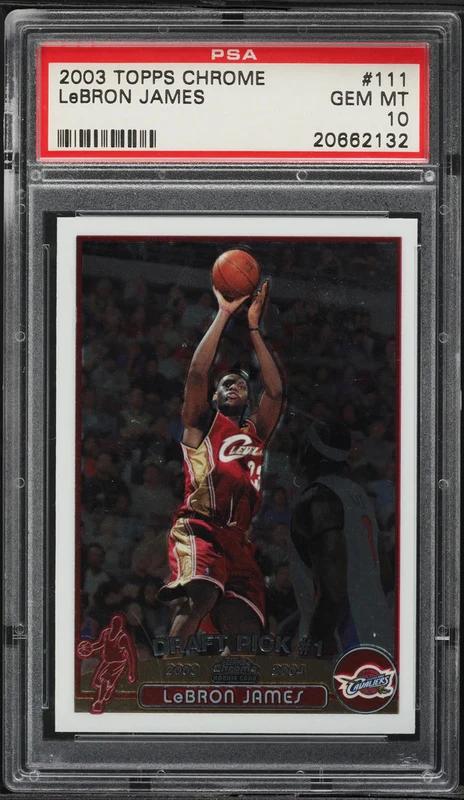
Real sold comps from Graded's pricing engine · 60 sales (eBay & Fanatics).
View live data on Graded →The PSA 10 trades around $12,600 as of mid-2026, and the chart above shows a year of real comps climbing steadily from about $4,900 to today's level, more than a double in twelve months with a sale or two every single week. That liquidity is the point: this is one of the most tradeable five-figure cards in the hobby, with a constant bid on both sides. The raw card sells near $1,200, so the grade carries a roughly 10× premium, which means the slab, not the cardboard, is doing the work. It's the card to own if you want blue-chip basketball exposure with the ability to exit any week you choose.
Refractors, Numbered Rookies, and On-Card Autos: Where Modern Money Actually Goes
Before the Prizm-era picks, one thing has to be said plainly: from Giannis onward, the base rookie is not the investment. The parallels are. Modern print runs are enormous, so the base PSA 10 is the liquid entry ticket, and the refractors and numbered versions of the exact same card are where serious modern money concentrates. Our full LeBron James guide covers the whole parallel ladder. This is the K-shaped economy playing out inside a single player's card sheet: the base sits on the bottom leg, and the scarce versions keep setting records on the top one. That is why all three modern picks below are the Silver Prizm in a PSA 10, with the base quoted only as the liquidity reference.
The hierarchy, bottom to top
- Base Prizm. Liquid, cheap, supply-capped. Own it for exposure, not appreciation.
- Silver Prizm (the refractor). The default investment tier of the modern era, unnumbered but genuinely scarce in gem. The market prices this gap brutally: a Wembanyama Silver PSA 10 trades around $2,800 against $330 for the base, and a Luka Silver runs near $1,600 against a $200 base. Same card, same player, roughly 8-9× the price, purely on scarcity.
- Numbered colors (/299, /199, /99, /49, /24, /10). This is where the modern chase really lives, and the print run is only half the story. The other half is the jersey-color match: the Luka Blue Prizm /199 matches his Mavericks blue, and it routinely trades at multiples of the Red /299 even though the print runs sit one tier apart. The color match makes it the numbered Luka rookie to own, and the same logic prices every modern star's rainbow. These trade so rarely that most weeks there isn't a single public comp, which is exactly the population math the framework asks for.
- On-card rookie autos (the modern grail format). At the very top sit the on-card rookie patch autographs from National Treasures, Flawless, and Immaculate, numbered to /99 or lower. On-card beats sticker autos, and the ceiling is real: LeBron's 2003-04 Exquisite RPA has sold for over $5 million. For any modern star, the NT RPA /99 is the single card the whole market treats as his trophy piece.
The practical playbook: hold the base for liquidity, make the Silver your core position, chase the jersey-color-match numbered parallel when you can find one priced off real comps, and treat an on-card RPA as the trophy allocation. Every modern section below leads with the Silver Prizm in PSA 10, on its own real comps, and names the rest of the ladder in exactly those terms.
2013 Panini Prizm Giannis Antetokounmpo #290 Silver Prizm: The Proven Modern Pick
The Prizm era starts in 2012, and its first great investment story is the Silver Prizm of the 2013-14 Prizm Giannis #290. A skinny unknown from Greece became a two-time MVP and a champion, and that first-year silver, from Prizm's smallest modern print run, went from junk-wax prices to a five-figure card at the peak. Live comps:
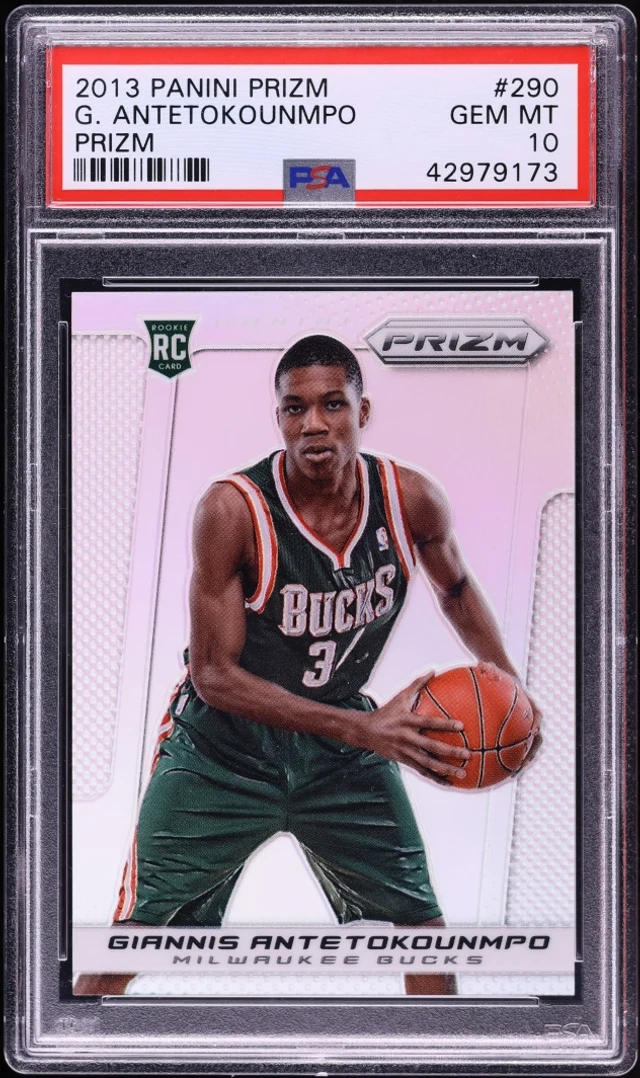
Real sold comps from Graded's pricing engine · 17 sales (eBay & Fanatics).
View live data on Graded →The Silver PSA 10 trades around $7,500 today, down from over $30,000 in the 2021-22 mania, the same boom-and-settle shape as the Kobe chart. What makes it interesting is the shape of the career behind it: the narrative is already proven (MVPs, a ring, a finals MVP) while the player is still active and adding to it. That combination, proven floor plus open upside, is rare in modern basketball, and the 2013 set's early print run keeps this silver genuinely scarce in gem: it trades a handful of times a year, not dozens of times a week.
The rest of the ladder: the base #290 (~$725 in PSA 10) is the liquid, low-cost way to hold the player. Above the Silver, the numbered Prizms (topped by the Gold /10) and his 2013-14 National Treasures on-card RPA /99 are auction-house cards that trade like the vintage grails do: rarely, and higher every cycle.
2018 Panini Prizm Luka Dončić #280 Silver Prizm: The Discounted Superstar
The Silver Prizm of the 2018-19 Prizm Luka #280 is the most interesting value case on this list. The player is a five-time first-team All-NBA scoring machine. His default investment card trades around $1,600 in PSA 10. That gap between resume and price exists for exactly one reason: supply. The 2018 Prizm print run was enormous, and even the unnumbered Silver is plentiful next to the 2013 Giannis. Live comps:
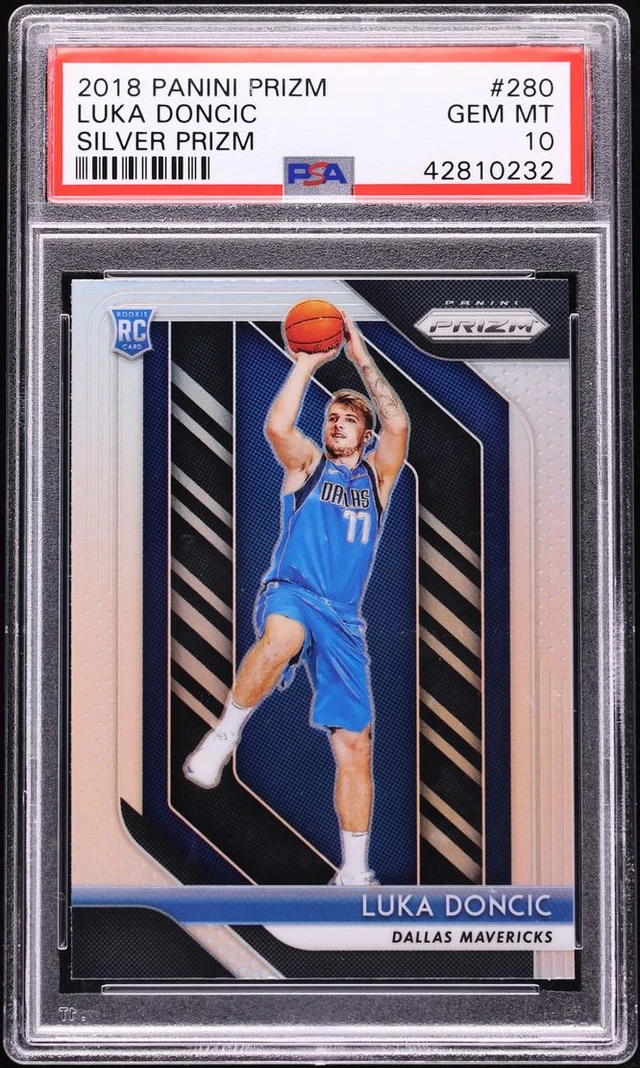
Real sold comps from Graded's pricing engine · 60 sales (eBay & Fanatics).
View live data on Graded →The chart shows the same 2021 reset as every modern card: $5,000-$6,000 at the mania peak, a long floor near $1,100-$1,200, and a steady grind back toward $1,600 on weekly volume. That volume is the point: this silver is liquid enough to exit any month you choose, and if a title run or an MVP reprices Luka demand, the Silver is the version that captures it.
The rest of the ladder: Luka is the cleanest case study of the parallel hierarchy in the entire hobby. The base #280 trades near $200 in PSA 10, roughly an eighth of the Silver on the same card, capped by a gem population deep into five figures. And the numbered rookie to own is the Blue Prizm /199: it matches his Mavericks jersey, and that color match makes it trade at multiples of the Red /299 when print run alone says the gap should be small. That is modern collecting in one card. The color that matches the player is the one the market crowns, and it's the K-shaped economy again: base on the bottom leg, jersey-match numbered on the top. Above them all sits his National Treasures on-card RPA /99, Luka's trophy card.
2023 Panini Prizm Victor Wembanyama #136 Silver Prizm: The Generational Bet
Every era gets one prospect the entire hobby bets on at once. This era's is Wembanyama, and the version investors actually hold is the Silver Prizm of the 2023-24 Prizm #136. His rookie is the most actively traded basketball card in the hobby right now, and even the Silver sells multiple times a week in PSA 10. Live comps:
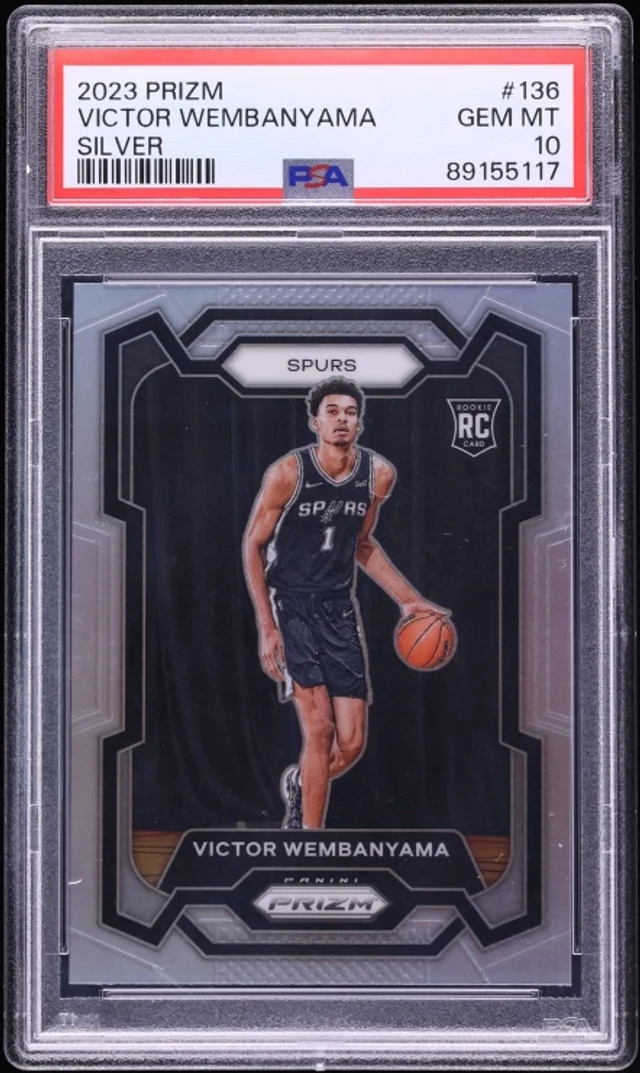
Real sold comps from Graded's pricing engine · 60 sales (eBay & Fanatics).
View live data on Graded →The Silver PSA 10 sits around $2,800 on dozens of recent comps, roughly nine times the base rookie, and it's the version that appreciates if the career delivers. And be clear that it is a bet: the career narrative is wide open, the gem population is still growing with every submission, and the price already includes a lot of hope. Size it like the venture position it is.
The rest of the ladder: the base #136 (~$330 in PSA 10, with dozens of sales a week and a tight spread) is the most liquid way to hold the bet and what still holds a bid if the projections miss. Above the Silver, the numbered colors thin out fast, and his on-card National Treasures RPA is already a six-figure auction card. If the projections land, the asymmetric returns are up there.
How High Can Basketball Cards Go?
Zoom out from any single card and the argument gets stronger. Basketball cards sit inside a collectibles asset class that is still tiny next to the markets it has started trading like:
Total market value: collectibles as an asset class, next to gold, mega-cap tech, and crypto.
The right column is how many times bigger each one is than the entire collectibles market. Collectibles are already a real asset class, larger than a top-ten crypto like Dogecoin, yet still a fraction of a single mega-cap stock and barely a rounding error next to gold. That gap is the runway: as collectibles mature into a transparently priced, investable asset class, the best cards have room to re-rate that the giants no longer do.Figures approximate, 2026: gold = all above-ground gold; equities = market cap; crypto = network value; collectibles = estimated global market size. Bars use a log scale for visibility.
And the returns case is already on the board. Indexed from 2010, blue-chip cards (with basketball icons like the Jordan doing much of the pulling) have out-compounded the S&P 500:
Basketball's specific edge inside that story is demand growth. The NBA is the most international of the American leagues, with stars from Greece, Slovenia, France, and Serbia carrying the game to new collector bases that didn't exist a decade ago. Every one of those markets buys the same short list of icons, and the vintage supply they're bidding on was fixed decades before they arrived.
Matching Basketball Cards to Your Risk Tolerance
The tiers above are not interchangeable. They sit in very different places on the risk map:
A sane basketball portfolio mirrors any other: anchor in the settled legends (Jordan, Kobe, LeBron in the best grade you can afford), take a measured position in proven-but-active stars (Giannis, Luka), and treat prospect bets (Wembanyama) as the small, high-risk sleeve where you can afford a zero. The most common mistake in this hobby is inverting that pyramid because the prospect is the exciting one.
Why Every Card Here Is a PSA 10
Every card in this guide is quoted in PSA 10 because, for investing, the grade is the asset. The same 2003 LeBron is $1,200 raw and $12,600 in a PSA 10 slab. Grading authenticates the card, certifies the condition, makes every copy fungible with every other copy at the same grade, and produces the population data this entire analysis runs on. An ungraded card is a claim; a graded card is a fact. Our flagship investing guide covers this in depth, and our PSA 10 vs. raw breakdown shows the premium card by card.
How to Buy Basketball Cards Safely
- Price off sold comps, never listings. Look up the exact card, set, and grade on Graded's value calculator before you bid. Asking prices are wishes; sold comps are the market.
- Read the pop report before every purchase. The difference between pop 326 and pop 32,000 is the difference between an asset and a liquid collectible. Both are fine; know which one you're buying.
- Buy graded, buy authenticated, or don't buy. At these prices, raw cards from a stranger's photos are how people get burned. Slabs with cert numbers you can verify are the floor.
- Beware the parallel maze. Modern Prizm sets have dozens of parallels. The base and the Silver are the reference cards; exotic colors need their own comps, not vibes.
- Trade without shipping risk. On Graded's Trading Floor, vaulted cards trade instantly with on-chain escrow, so a $12,000 LeBron never rides in a mailer.
Investing in Basketball Cards on Graded
Everything this guide measures, Graded does live. Look up any basketball card's real fair-market value, population, and gem rate with the PSA 10 value calculator, browse authenticated, vaulted slabs across every major tokenization platform in the marketplace, and trade peer-to-peer with instant on-chain settlement on the Trading Floor. No shipping, no scam risk, and you don't need to know anything about crypto to use any of it. The rails just make it faster and safer.
FAQs
What is the best basketball card to invest in?
The 1986 Fleer Michael Jordan #57 is the benchmark: the sport's definitive rookie with a PSA 10 population around 326 and a six-figure price. For most budgets, the 2003 Topps Chrome LeBron (~$12,600 in PSA 10) and 1996 Topps Chrome Kobe (~$10,800) are the blue-chip tier, the 1961 Fleer Wilt Chamberlain (~$45,000 in PSA 8) is the deep-vintage play, and the Silver Prizm rookies of Giannis, Luka, and Wembanyama cover the modern end from about $1,600 to $7,500 in PSA 10.
Are basketball cards a good investment?
The blue-chip tier has a strong track record: basketball icons anchor the card indices that have out-compounded the S&P 500 since 2010. But it's a volatile, career-sensitive market. The settled legends are the investment tier; active players carry narrative risk, and prospects are venture bets.
Why are Prizm rookies the modern standard?
Since Panini took the NBA license in 2012, Prizm has been the flagship set the market prices everything against, the way Topps Chrome was from 1996 to 2009 and Fleer was in the '80s. The base Prizm rookie is each modern player's reference card, and the Silver Prizm is the standard chase parallel — the version this guide picks, in PSA 10, for every modern rookie.
Should I buy base rookies or parallels?
Base PSA 10s are the liquid, low-cost way to hold a player, but big populations cap their upside. The Silver Prizm is the default investment tier (about 8-9× the base for Wemby and Luka), numbered colors carry the real scarcity, and on-card RPAs are the trophy tier. Base for liquidity, parallels for appreciation, and never buy an exotic color without its own sold comps.
What is a jersey-color-match parallel and why does it matter?
It's a numbered parallel whose color matches the player's team jersey, and the market pays a real premium for it. Luka's Blue Prizm /199 matches his Mavericks blue and trades at multiples of the Red /299, a gap the print runs alone can't explain. When collectors pick one numbered rookie to chase, the color match is usually the one, so it carries the deepest demand of any card in the rainbow.