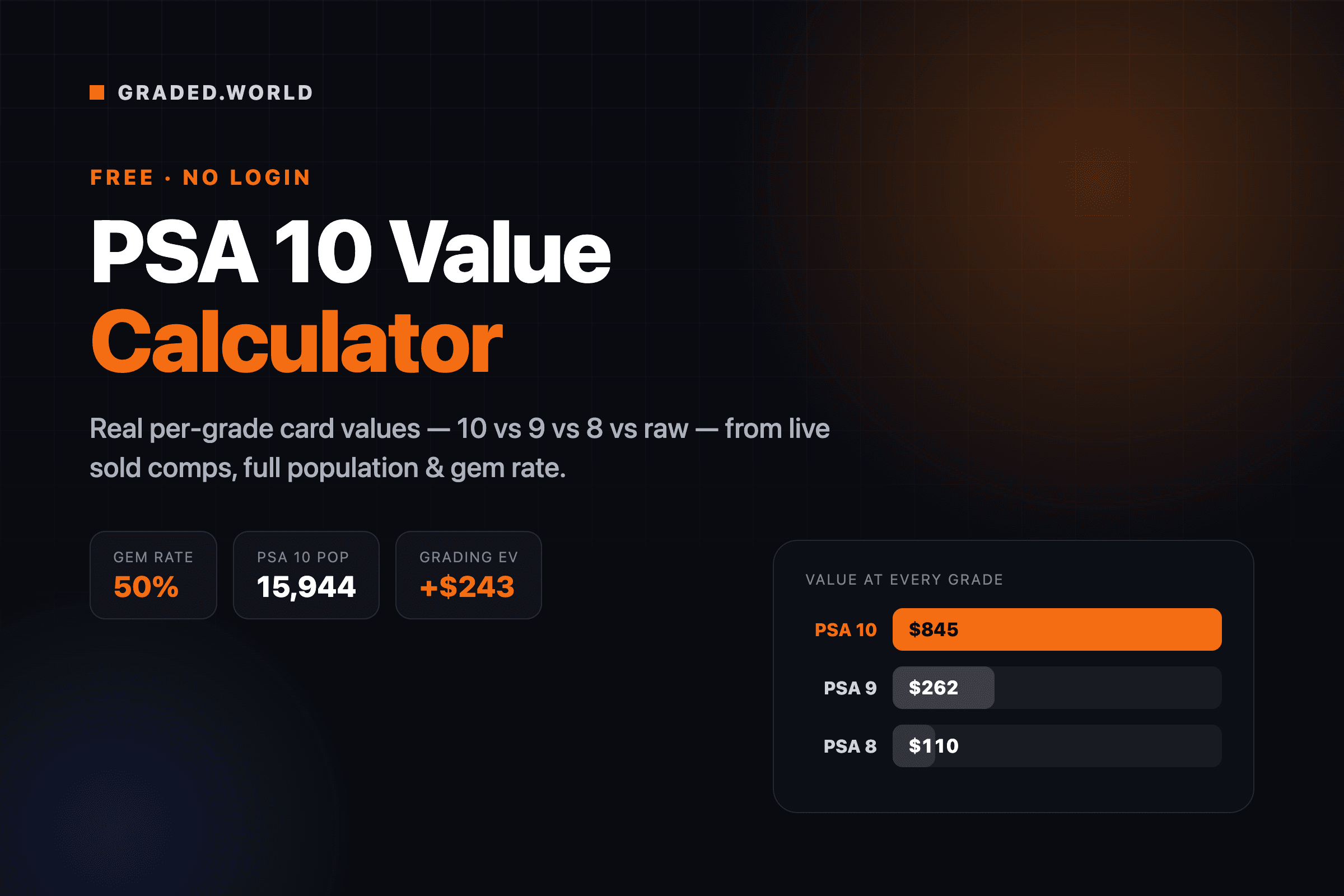
PSA 10 Value Calculator: Real Per-Grade Card Values
Most "PSA 10 value calculators" are guessing. They take one raw price you typed in, multiply it by a static number like "5×," and call it a valuation. That's not how the market actually prices a gem-mint slab — and it's why those tools send people to grade $40 cards that will never clear break-even.
This one is different. Search any card by name — Pokémon, sports, One Piece, Magic, Yu-Gi-Oh — and we pull real sold prices at every grade where comps exist, the full PSA / BGS / SGC / CGC population pyramid, and the gem rate behind it. No static multipliers. No login wall. Where a card has thin sales we say so out loud and show you population everywhere — we never dress up two lonely sales as a firm market price.
Then we answer the only question that matters before you ship a card to a grader: should you grade it at all? Below the tool is the full methodology — the per-grade value ladder, the gem-rate model, and a grading-EV framework that nets out 2026 grading fees, marketplace fees, and shipping.
Last updated June 8, 2026 · grading fees verified Feb 2026 — confirm current pricing at the grader.
Look up any graded card
Showing grade 10 — add a grade to your search (e.g. “psa 9”, “bgs 9.5”) to change it. Works for PSA, BGS, SGC, CGC & CSG. No login.
How PSA 10 Value Is Actually Calculated
A PSA 10's value isn't a number a grader assigns. It's whatever the last clean buyers paid for that exact card, in that exact grade, recently. Everything else is noise. So we build value from the bottom up:
- Live sold comps tagged by grade — grades 1–10 plus halves and Authentic, from eBay, auction houses, and on-chain marketplaces, each carrying a price, date, source, and cert.
- Recency weighting — a sale from last week outweighs one from eight months ago (a 120-day half-life). We surface the sample size n next to every grade so you can see when a "price" is really just two sales.
- Population context — the same dollar figure means something completely different on a card with 124 PSA 10s than on one with 15,000.
The output is a median sold price per grade with n-counts and dates — not a modeled estimate. Where a grade has no sales, we mark it "modeled, no sale." We never hide which is which.
The Per-Grade Value Ladder: 10 vs 9 vs 8
The biggest mistake in card valuation is treating "PSA 10" as the only number. The truth lives in the ladder — the gap between each grade. If a PSA 9 is worth 80% of the PSA 10, grading a card you think might 9 is low-risk. If a PSA 9 is worth 8% of the PSA 10, that one-point miss is catastrophic — and the gem rate suddenly matters enormously. You can't see that from one number; you see it instantly from the ladder.
Here's a real all-grade ladder from a vintage chrome refractor in our data:
Two things to notice. The 10-over-9 multiple (10.4×) is bigger than the 9-over-8 (5×) — premiums accelerate as you climb a scarce ladder. And that PSA 10 average rests on n=3. A responsible tool tells you that; it doesn't quietly average three sales and present it as gospel. For a deeper teardown of the single most important rung, see the PSA 9 vs PSA 10 price difference.
What Drives the PSA 10 Premium: Gem Rate × Population × Demand
Three forces set the premium:
- Gem rate — the number of PSA 10s divided by the total number of that card ever graded, i.e. how hard the 10 is to earn. Low gem rate = genuinely scarce = bigger premium. 1st Edition 1999 Base Charizard gems at ~3%; the Shadowless version gems at ~0.6% — same art, different print run, roughly 5× harder to gem.
- Population — how many already exist. Even a low gem rate loses its edge if total pop is in the thousands. When a card's PSA 10 pop exceeds its PSA 9 pop, that's a crack-and-resub oversupply warning that can depress future 10 prices — the tool flags it in red.
- Demand — iconic names (Charizard, Jordan, Luffy) carry premiums because more people want them.
Our gem-rate gauge compares this card's actual 10/9 premium to what its gem rate should imply, and flags it as the 10 being bid up, fairly priced, or soft. Read our PSA pop report guide for the deep dive on population data.
Should You Grade It? The EV Math
"Should I grade this?" is a probability question, not a vibe. We use the card's real population pyramid as the outcome distribution, weight every outcome (including the rejects and low grades, not just the 10) by its per-grade value, then net out marketplace fees (~13%), outbound shipping, and the correct 2026 grading tier before subtracting your raw cost. The result is an honest expected value, a break-even raw price, and a verdict: Grade, Marginal, or Don't Grade.
Enter your actual acquisition cost — the verdict can flip on a guessed raw price, so we won't pretend to know it. PSA's 2026 floor is $32.99 (Value, $500 cap); we auto-pick the cheapest tier whose value cap clears your card. This is an estimate, not financial advice.
Reading the Population Pyramid
The pyramid shows how many copies exist at every grade for each grader. Gem rate is just the PSA-10 slice of that population — the number of 10s divided by the total graded — and it's a historical population gem rate, not your card's odds: the best raw copies get submitted first, and cracking 9s to resubmit for 10s inflates both the 10 pop and the apparent rate. We show PSA, BGS, SGC, and CGC populations side by side so you can see which grader gems highest. Realized dollar values are shown per-grader only — a PSA 10, BGS 9.5, and SGC 10 are different assets and don't trade interchangeably, so we never substitute one grader's price for another.
Methodology
Values are recency-weighted (120-day half-life) from real completed sales, shown in USD with the sample size and date next to every grade. We trim outliers, prefer a weighted median once a grade has four or more sales, and fall back to a recency-weighted mean below that. Raw value and any interior grade with no sales are modeled estimates, clearly labeled — never presented as sales. The grading-EV engine weights outcomes across the full population pyramid, applies an oversupply haircut when PSA 10 pop exceeds PSA 9, and nets marketplace fees, shipping, and the correct grading tier before your raw cost. Gem rate is normalized so a value above 1 is treated as a percent already. This is an estimate, not an appraisal or financial advice.
Related Reading
- PSA 9 vs PSA 10: Is the Price Difference Worth It?
- PSA Pop Report Explained: Find Undervalued Cards
- Pokémon PSA 10 Price Guide 2026
- Best Cards to Invest In 2026
PSA 10 Value Calculator — FAQ
What is my PSA 10 worth?
Search the card in the tool above. We return its PSA 10 fair market value from recent sold comps, with the sample size and date — or, when sales are thin, an “indicative” range plus the full population so you still get a grounded read.
How much more is a PSA 10 worth than a PSA 9?
It varies by card, not by a fixed rule. The calculator computes this card’s exact PSA 10 / PSA 9 multiple and dollar gap from its own sales. Vintage chase cards run ~5–20×; modern standard rares are closer to ~1.3–3×.
What percentage of a PSA 10 is a PSA 9 worth?
Often 30–50% on modern cards, but as little as 5–10% on scarce vintage. The ladder shows the real figure for your specific card instead of a rule of thumb.
Is it worth grading my card?
Use the “Should You Grade It?” panel. It weights every grade outcome by your card’s real population, nets out 2026 grading fees plus a ~13% marketplace fee and shipping, and returns Grade / Marginal / Don’t Grade with a break-even raw price. Enter your actual raw cost for an accurate verdict.
What raw value does a card need before grading is worth it?
There’s no flat number — it depends on the 9→10 price cliff and your gem odds. The calculator outputs the maximum raw price you should pay (the break-even) for grading to stay positive after all fees.
How much does PSA grading cost in 2026?
PSA Value is $32.99 (up to $500 declared value), Value+ $49.99, Value Max $64.99 ($1,000), Regular $79.99 ($1,500), Express $149 ($2,500), Super Express $299, Walk-Through $599. CGC Economy is ~$20 and BGS Standard ~$25. Always verify current pricing at the grader.
What is a gem rate?
A card’s gem rate is the number of PSA 10s divided by the total number of that card ever graded — the share of the graded population that earned the top grade. So a card with 1,000 PSA 10s out of 10,000 graded has a 10% gem rate. A low gem rate means a 10 is genuinely scarce, which drives a bigger premium. It’s a historical population rate, not a guarantee for your specific copy.
What is a good gem rate for grading?
Counterintuitively, a low one — scarcity is where the premium lives. But a low gem rate also means most copies miss the 10, so pair it with the 9→10 cliff and the EV verdict before submitting.
Does population affect PSA 10 value?
Heavily. Two cards with identical gem rates but 124 vs 15,000 PSA 10s are not the same asset. Our scarcity score blends absolute PSA 10 population, gem rate, and copies graded higher into one 0–100 read.
What are the odds my card gets a PSA 10?
The population gem rate is the historical base rate. Your specific copy can be better or worse, and early gem rates run high because the best copies get submitted first. Treat it as directional, not a guarantee.
Is a BGS 9.5 worth more than a PSA 10?
Usually not — a PSA 10 typically commands the highest premium, but it’s card-specific. We show cross-grader populations and gem rates side by side; realized prices are shown per-grader because the slabs aren’t interchangeable.
Should I crack and resubmit my PSA 9?
Only when the expected upgrade value clears the grading fee. As a rule, crack-and-resub makes sense when your probability of an upgrade times the 9→10 value gap (after fees) is greater than the cost to regrade.
How do I check a PSA card value by cert number?
You can, but searching by name is faster and works for cards you don’t own yet. Either way you land on the same per-grade value ladder, population pyramid, and grading-EV read.
Where do these numbers come from?
Real completed sales (eBay, auction houses, on-chain marketplaces) weighted by recency, joined to live GemRate population reports across PSA, BGS, SGC and CGC. We show sample sizes and dates and label every modeled value. Not financial advice.
Track your full collection with live FMV on Graded.World. Every card, every grade, real sales.