Basketball Card Values (2026): The Free Price Guide Built on Real Sales
On this page
This is a working price guide, not a listicle. Every value on this page comes from real sold comps tracked by Graded's pricing engine, the same data that powers our live basketball market index. No asking prices, no "estimated book value." If you came here holding a card and wondering what it is worth, the answer workflow below takes about 30 seconds.
- Most basketball cards are worth under $1. Value concentrates in a small set of stars, rookie cards, scarce parallels, and high grades.
- The tracked blue chips run from $150 to $270,000 in graded form. The 1986 Fleer Michael Jordan rookie in PSA 10 is the ceiling at $270,000 with a population of just 340.
- Grade decides most of the price. The same card can differ by 5x to 20x between raw and PSA 10. Check the PSA value lookup before you sell anything raw.
- You can price any card for free with the three-step lookup below: cert check, sold comps, live index.
How much are basketball cards worth?
The overwhelming majority of basketball cards sell for less than $1, while graded rookies of the sport's icons run from a few hundred dollars to $270,000 as of July 2026. The market is a pyramid. At the base sit billions of common cards from the overproduced late 80s and 90s that carry no resale value. In the middle are modern rookies and inserts of stars, worth real money mainly in high grades. At the top are a few dozen cards, vintage rookies and scarce serial-numbered parallels, that trade like blue-chip assets with five- and six-figure prices.
Four questions predict almost all of a card's value: Who is on it? Is it the rookie card or a key parallel? What condition or grade is it in? And how many copies exist? The table below shows what that looks like in practice with live numbers.
The most valuable basketball cards in 2026
The most valuable basketball card we track is the 1986 Fleer Michael Jordan rookie #57, at $270,000 in PSA 10. These are the 24 cards in Graded's basketball index, priced from actual sales and refreshed with every index rebuild. Click any card for its full price history, chart, and population data.
Note the grade column: the 1961 Fleer Wilt Chamberlain is quoted in PSA 8 because true vintage almost never exists in gem mint, and an honest guide prices the grade that actually trades. The full index view, with 12-month charts and per-card movement, lives at the basketball market index.
How to look up your basketball card's value for free
You can price any basketball card in three steps, free, without an account. Start by searching your card right here; if you do not know its exact name, type what you can read off the card (year, brand, player) and pick from the matches.
Look up any basketball card
Showing grade 10 — add a grade to your search (e.g. “psa 9”, “bgs 9.5”) to change it. Works for PSA, BGS, SGC, CGC & CSG. No login.
- If the card is graded, verify the cert first. Type the cert number into our cert lookup to confirm the grade, see the card's exact identity, and pull its population. Fake slabs exist; thirty seconds here protects you.
- Check real sold prices, not asking prices. Our PSA value lookup shows what the card sells for by grade, from actual comps. Listing prices on marketplaces run 20% to 50% above what buyers actually pay, which is why "price guide" sites that scrape listings mislead you.
- For blue chips, read the index. The basketball index tracks the market's bellwether cards with monthly medians, so you can tell whether you are selling into strength or weakness.
If you are deciding whether to grade a raw card, read PSA 10 vs raw first. Grading costs money and takes weeks; it pays for itself only when the card and the likely grade clear a threshold.
What makes a basketball card worth money?
Player, rookie status, print scarcity, and grade, in that order. A LeBron James card is worth more than a role player's card in any form. His rookie cards are worth more than his later cards. His scarce parallels are worth more than the base version. And the gem mint copy is worth a multiple of the raw one.
The 2003 Topps Chrome LeBron rookie shows the whole hierarchy on a single card number. The base card in PSA 10 trades around $12,600 to $12,800 with a population of 2,466. The Refractor parallel in PSA 10 brings about $45,600. The Black Refractor, serial-numbered to 500 with just 2 gems graded, last sold for $108,000. Same photo, same card number, an 8x spread driven purely by scarcity.
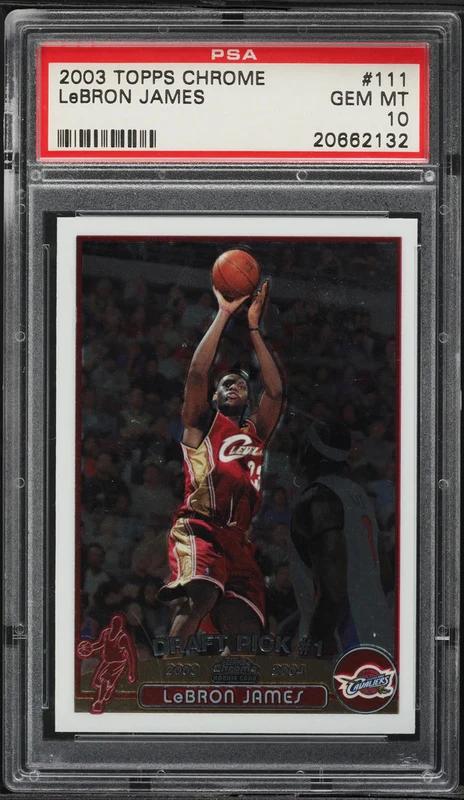
Real sold comps from Graded's pricing engine · 60 sales (eBay & Fanatics).
View live data on Graded →Grade works the same way. The difference between a PSA 9 and a PSA 10 of the same card is routinely 2x to 5x and sometimes far more; we quantified it across the market in PSA 9 vs PSA 10. This is why an unverified "mint" raw card and a certified gem are different assets.
How much are Michael Jordan cards worth?
Michael Jordan cards run from about $150 to $270,000 in graded form, depending on the card and grade. The 1986 Fleer rookie #57 in PSA 10 is the crown of the entire sport at $270,000, with only 340 gem copies in existence. Below it, the ladder is remarkably complete: the 1986 Fleer Sticker at $60,600, the 1987 Fleer at $29,500, the 1988 Fleer at $8,500, the 1997 Metal Universe at $4,920, the 1996 Topps Chrome at $1,680, the 1989 Hoops at $504, the 1993 Upper Deck at $312, and the 1989 North Carolina Collegiate at $150, all in PSA 10.
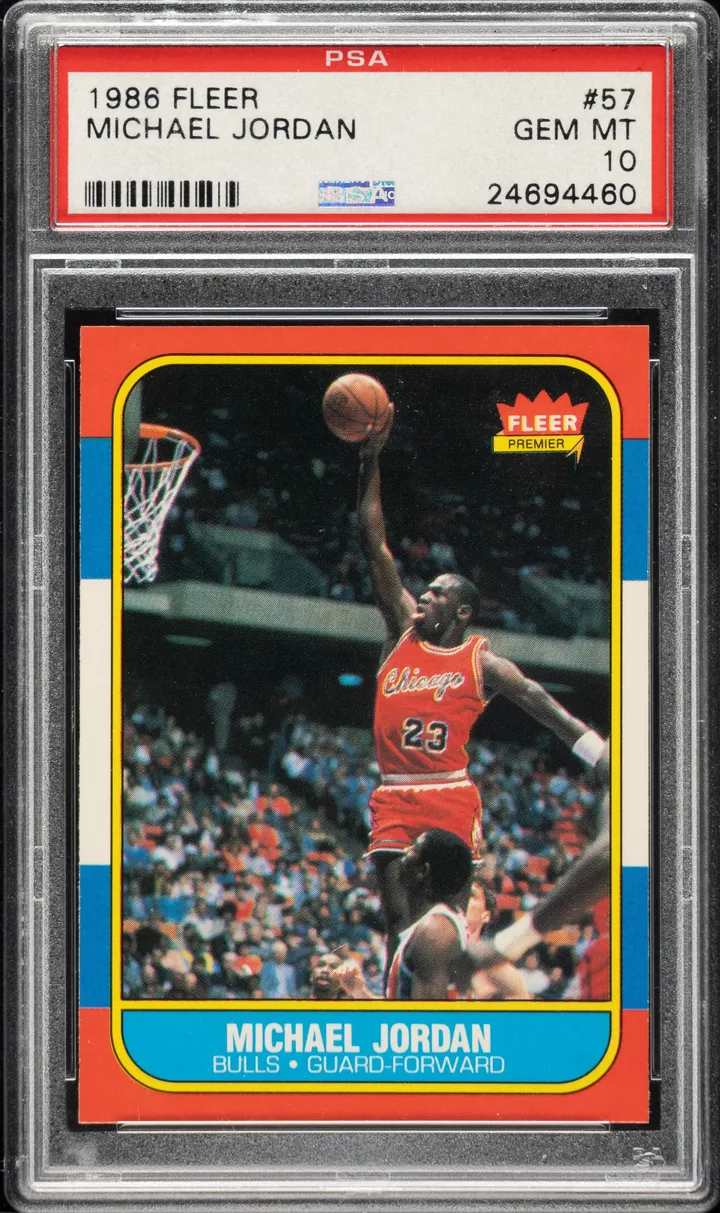
The benchmark of the entire sports-card market. Only about 326 PSA 10s of 28,000+ graded (a 1.2% gem rate), trading in the six figures. The rookie every other basketball card is measured against.
Market cap = PSA 10 population × fair-market value. Sources: Card Ladder · PSA APR · PriceCharting.
That spread is the practical answer to "is my Jordan card worth anything?": if it is from 1989 or later and mass-produced, it is probably worth little raw but can still carry real value as a gem. Full rankings and buying guidance are in the best graded Michael Jordan cards.
How much is a LeBron James card worth?
Common LeBron James cards sell for a few dollars; his key graded rookies run from about $1,000 to $108,000. The liquid blue chip is the 2003 Topps Chrome rookie in PSA 10 around $12,800, one of the most heavily traded five-figure cards in the hobby. The 2003 Topps base rookie in PSA 10 brings about $6,300, the Bowman Chrome rookie about $7,100, the Upper Deck Star Rookie about $1,020, and the trophy tier tops out with the Black Refractor at $108,000 and the Exquisite rookie patch autograph at $97,500. Outside the rookie year, his 2012 Prizm Silver, the first Prizm card, brings about $21,300 in PSA 10. The full ladder is in the best graded LeBron James cards.
Are Topps, Panini Prizm, and NBA Hoops cards worth anything?
Brand alone does not make a basketball card valuable; the player, the year, and the grade do. Still, brands tell you where to look. Topps Chrome (1996 to 2009) is the era's gold standard: the 1996 Kobe Bryant rookie trades around $10,800 in PSA 10 and the 2003 LeBron is the modern benchmark. Panini Prizm took over after 2012, and its Silver parallels are the investment tier: Luka Dončić's Silver rookie sits near $1,440 and Victor Wembanyama's near $2,800 in PSA 10. NBA Hoops, especially the 1989 to 1994 print runs, was produced in enormous quantities; most of it is bulk, with exceptions like the 1989 Hoops Jordan at $504 in gem mint.
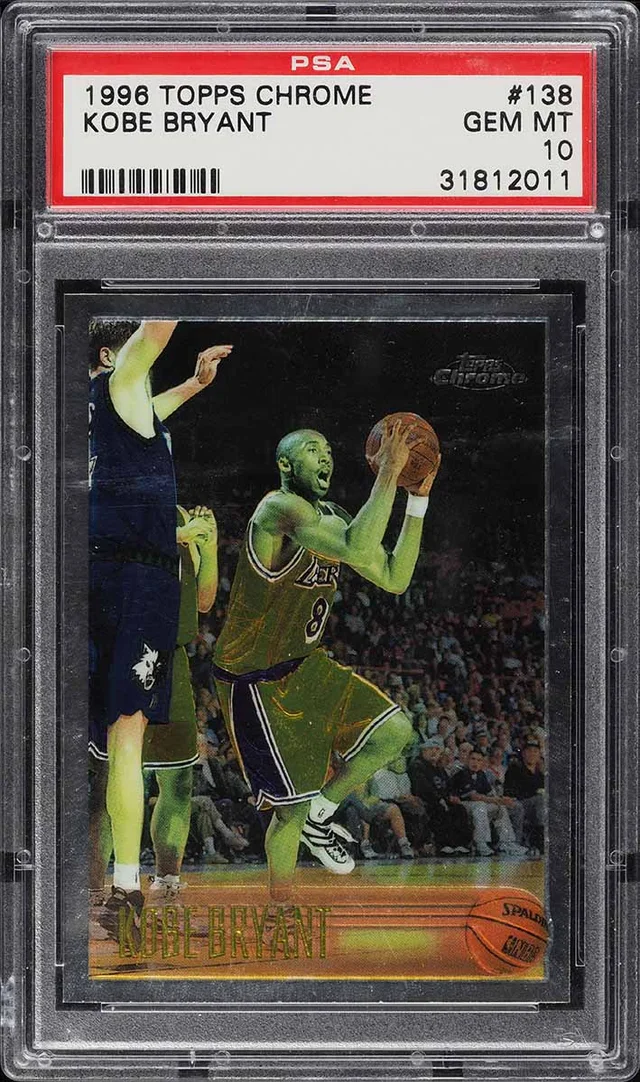
Real sold comps from Graded's pricing engine · 49 sales (eBay & Fanatics).
View live data on Graded →If you are sitting on a 90s shoebox collection, the honest expectation is that raw commons are worth close to nothing, and the lottery tickets are star rookies and scarce inserts in sharp enough condition to gem. Before paying for grading, run the numbers with the PSA value lookup.
Basketball card value FAQ
What is the most expensive basketball card?
Among cards we track with live comps, the 1986 Fleer Michael Jordan rookie in PSA 10 at $270,000. One-of-one serial-numbered cards (like Logoman patches) have sold for more at auction, but they trade so rarely that no honest price guide can quote them as a market.
How can I check basketball card prices for free?
Use the three-step lookup above: verify the cert at our cert lookup, pull real sold comps with the PSA value lookup, and check the live basketball index. All three are free and require no account.
Are basketball cards from the 1990s worth anything?
Mostly no in raw form; the era was massively overprinted. The exceptions are star rookies (the 1996 Topps Chrome Kobe), premium inserts (the 1997 Metal Universe Jordan at $4,920 in PSA 10), and early Chrome refractors, and nearly all of that value requires a high grade.
Should I get my basketball cards graded?
Only when the expected graded value clears the grading fee with room to spare, which usually means a star rookie or key insert in genuinely sharp condition. Our PSA 10 vs raw guide covers the real multipliers by card tier, and the calculator runs the math per card.
When you know what your card is worth and want to act on it, the Graded marketplace aggregates listings across eBay, Collector Crypt, Phygitals, and Courtyard, and the trading floor lets you swap cards directly with escrow. For the investing angle rather than the pricing angle, start with the best basketball cards to invest in.