PSA 10 vs Raw: How Much Does Grading Increase a Card's Value?
You pulled a card from a pack, it looks mint, and now you're wondering: should I get it graded, or just sell it raw? That question comes down to one thing — how much more money does a PSA 10 actually get you?
The honest answer is: it depends heavily on the card. But there are real patterns you can use to make the call.
What the PSA 10 Premium Actually Looks Like
The "PSA 10 multiplier" is not a fixed number. It shifts based on the card's raw demand, set size, print run, and how many PSA 10s already exist in the population report.
Here's a rough framework based on how the market behaves in 2026:
| Card Tier | Raw Value Range | Typical PSA 10 Multiplier |
|---|---|---|
| Budget commons / bulk | Under $5 raw | 2x–4x (rarely worth grading costs) |
| Mid-tier holos / rares | $10–$50 raw | 3x–6x |
| Desirable vintage / chase cards | $50–$300 raw | 5x–15x |
| High-demand vintage / iconic cards | $300+ raw | 10x–30x or more |
A raw Charizard base set might trade for $400 in near-mint condition. A PSA 10 of the same card can fetch multiples of that, depending on the specific print run and current demand. On the flip side, a raw common from a recent set worth $3 might grade out to $10 as a PSA 10 — but grading fees alone can eat that margin entirely.
The multiplier is real. It's just not uniform.
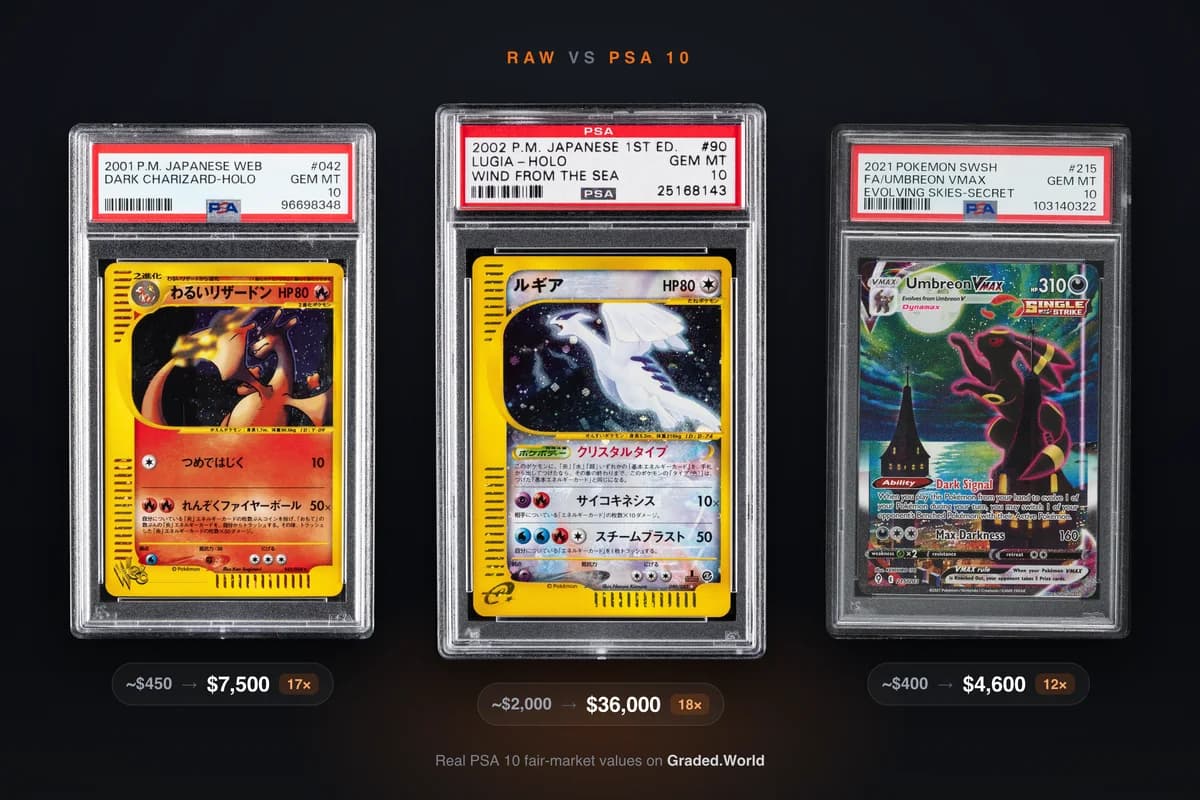
Real PSA 10 Examples (Live from Graded.World)
Here are real graded cards from the Graded.World catalog — actual PSA 10 slabs with their live fair-market value next to an approximate raw near-mint price. Notice how the multiplier widens with scarcity and demand, exactly as the framework predicts.
Run Your Own Numbers
Instead of guessing, plug your card's figures into the calculator below. Pick a tier (or type your own raw price), set the PSA 10 multiplier from the table above, and add your grading cost. It nets out marketplace fees and tells you the break-even multiplier and whether grading actually pays. The second tab estimates a PSA 10 value from a known PSA 9 comp when no PSA 10 sales exist.
Why PSA 10s Command a Premium
A few things drive the price gap between raw and graded:
Certainty. A raw card is a guess. You're trusting the seller's eye, the photo quality, and your own assessment of centering and surface. A PSA 10 removes that uncertainty. Buyers pay for the guarantee.
Liquidity. PSA 10s sell faster and more predictably than raws, especially for high-value cards. When you need to move a slab, there's a ready market. Raw cards at higher price points require more trust and negotiation.
Scarcity signal. PSA 10s on vintage cards are genuinely rare. A card with a low PSA 10 population (check the PSA Pop Report for the breakdown) commands a scarcity premium that raw copies simply can't replicate.
Condition lock-in. A graded card can't deteriorate further. A raw card in a sleeve can. Long-term holders prefer slabs for that reason.
When Grading Is Worth the Cost
Grading fees in 2026 range from around $25 for standard service up to $150+ for express tiers, depending on the grading company and turnaround time. That cost has to make sense against the expected value increase.
Grading is generally worth it when:
- The raw card is worth $50 or more and you're confident it grades PSA 9 or PSA 10
- The card has a low PSA 10 population, meaning yours adds real scarcity value
- You're holding long-term and want condition protection
- The card is from a set or era with strong collector demand (vintage Pokémon, key sports rookies, sought-after anime cards)
Grading is usually not worth it when:
- The raw card is worth under $20 — fees eat the upside
- The card has heavy print lines, off-centering, or edge wear that will knock it to PSA 8 or lower
- The set has thousands of PSA 10s already in the population — the scarcity premium is gone
- You need liquidity quickly and can't wait on grading turnaround
How to Estimate PSA 10 Value When No Sales Exist
This is a real problem with newer cards or lower-population slabs. You can't just look up a sold listing if one doesn't exist.
A few approaches that work:
Use the raw price as a baseline. Find the current raw near-mint price, then apply a multiplier based on comparable cards in the same set or tier. If similar holos from the same set show a 5x PSA 10 premium, start there.
Check the PSA 9 sold price and work up. PSA 9s sell more frequently than PSA 10s on many cards. The PSA 9 vs PSA 10 price difference varies by card, but PSA 10s typically sell for 1.5x–3x a PSA 9 on desirable cards. If you know the PSA 9 market, you can estimate upward — that's exactly what the "Estimate from PSA 9" tab in the calculator above does.
Look at population. Low pop PSA 10s (under 50 copies) on a card with real demand can command a significant premium over what comparable-grade cards with higher populations fetch. High pop PSA 10s trade closer to the raw near-mint price.
Cross-reference across platforms. A single eBay listing tells you one data point. Comparing prices across eBay, Courtyard, Collector Crypt, and Phygitals gives you a real picture of where the market sits. Graded World pulls all of those listings into one place, so you're not making decisions based on a single platform's thin data.
Raw vs PSA 10: Which Should You Buy?
If you're buying to hold and the card is genuinely iconic, PSA 10 is almost always the better long-term play. You pay a premium upfront, but you own a verified, condition-locked asset with a clear market.
If you're buying to flip quickly or you're working with a tighter budget, raw near-mint copies of the right card can still generate solid returns — especially if you're willing to submit them for grading yourself.
The middle ground that catches people out: buying a raw card at near-mint prices and then getting it back as a PSA 8. That's where the math falls apart. Before you pay near-mint raw prices, be honest about whether the card actually grades out.
The Grade Gap Is Wider Than Most People Expect
A lot of collectors underestimate how much condition actually matters at the PSA grading scale. The difference between a PSA 9 and a PSA 10 is not just one point — on desirable cards, it can be a 2x to 3x price difference. The difference between a PSA 8 and a PSA 10 can be 5x or more.
That's why pricing a raw card accurately is genuinely hard. "Near mint" means different things to different sellers. A PSA grade removes the ambiguity.
For a deeper look at how that one-point gap plays out in practice, the PSA 9 vs PSA 10 price breakdown covers specific examples worth reading before you buy or submit.
Before you decide to grade or buy graded, look up what the card is actually selling for right now across every major platform. Graded World aggregates live listings from eBay, Courtyard, Phygitals, and Collector Crypt in one search — so you're comparing real prices, not guessing.
FAQs
How much does a PSA 10 increase a card's value compared to raw?
It varies by card, but PSA 10s on desirable cards typically sell for 5x to 15x the raw near-mint price. Budget commons may only see a 2x to 4x increase, while iconic vintage cards can reach 20x or more. The multiplier depends on demand, population, and how many PSA 10s already exist.
Is grading cards worth it in 2026?
For cards worth $50 or more in raw near-mint condition, grading is often worth it — especially if the PSA 10 population is low. For cheaper cards, grading fees typically cancel out the value increase. The math only works when the expected grade is PSA 9 or PSA 10 and the card has genuine collector demand.
How do I estimate a PSA 10 value when there are no recent sales?
Start with the raw near-mint price and apply a multiplier based on comparable cards in the same set. You can also use the PSA 9 sold price and multiply by 1.5x to 3x, depending on how the card's PSA 9 vs PSA 10 premium compares to similar cards. Low population counts also support a higher estimate.
What is a PSA 10 price multiplier?
The PSA 10 price multiplier is the ratio between a PSA 10's sale price and the equivalent raw near-mint price. A multiplier of 5x means the PSA 10 sells for five times what a raw copy would. Multipliers are higher for vintage, low-pop, or high-demand cards and lower for modern mass-printed sets.
Would you rather have raws or PSA 10s?
For long-term holds on iconic cards, PSA 10s are generally the stronger choice — they're condition-locked, more liquid, and carry a verified premium. For newer or lower-value cards, raw near-mint copies can offer better value per dollar, especially if you're planning to grade them yourself.
Does the PSA 10 premium hold up over time?
On cards with genuine collector demand and limited PSA 10 populations, the premium has historically held and often grown. On modern cards with high print runs and large PSA 10 populations, the premium tends to compress over time as more copies enter the market.
How do I find current PSA 10 prices across multiple platforms?
Checking eBay alone gives you a partial picture. PSA 10s also trade on Courtyard, Collector Crypt, and Phygitals at different price points. Graded World aggregates live listings from all of those platforms into a single search, so you can compare actual asking prices side by side before you buy or price your own slab.