Pokémon PSA 10 Price Guide 2026: Every Card Worth Knowing
This isn't another listicle of "top 10 expensive Pokémon cards." This is a data-driven breakdown of how Pokémon PSA 10 prices actually work — what drives them, why some cards at 69% gem rate cost $1,653 while others at 87% gem rate cost $300, and how to read the market like a portfolio manager instead of a collector who got lucky.
Every price below is live. Every cert number is real. Every gem rate comes from actual PSA population data. The tables update automatically as new sales hit the market.
Live Price Table: All Featured Cards
Here's every card we'll analyze in this guide, with live fair market value pulled from verified eBay and marketplace sold listings. Bookmark this page — these numbers update automatically.
Understanding the relationship between FMV, population, and gem rate is everything. Our PSA pop report guide explains the math, and our PSA 9 vs 10 breakdown shows exactly when the grade premium is justified.
The Six Eras of Pokémon Cards (and Why They Matter for Value)
Not all Pokémon cards are created equal, and the era a card comes from determines its scarcity profile, gem rate floor, and long-term value trajectory. If you don't understand eras, you don't understand pricing. Period.
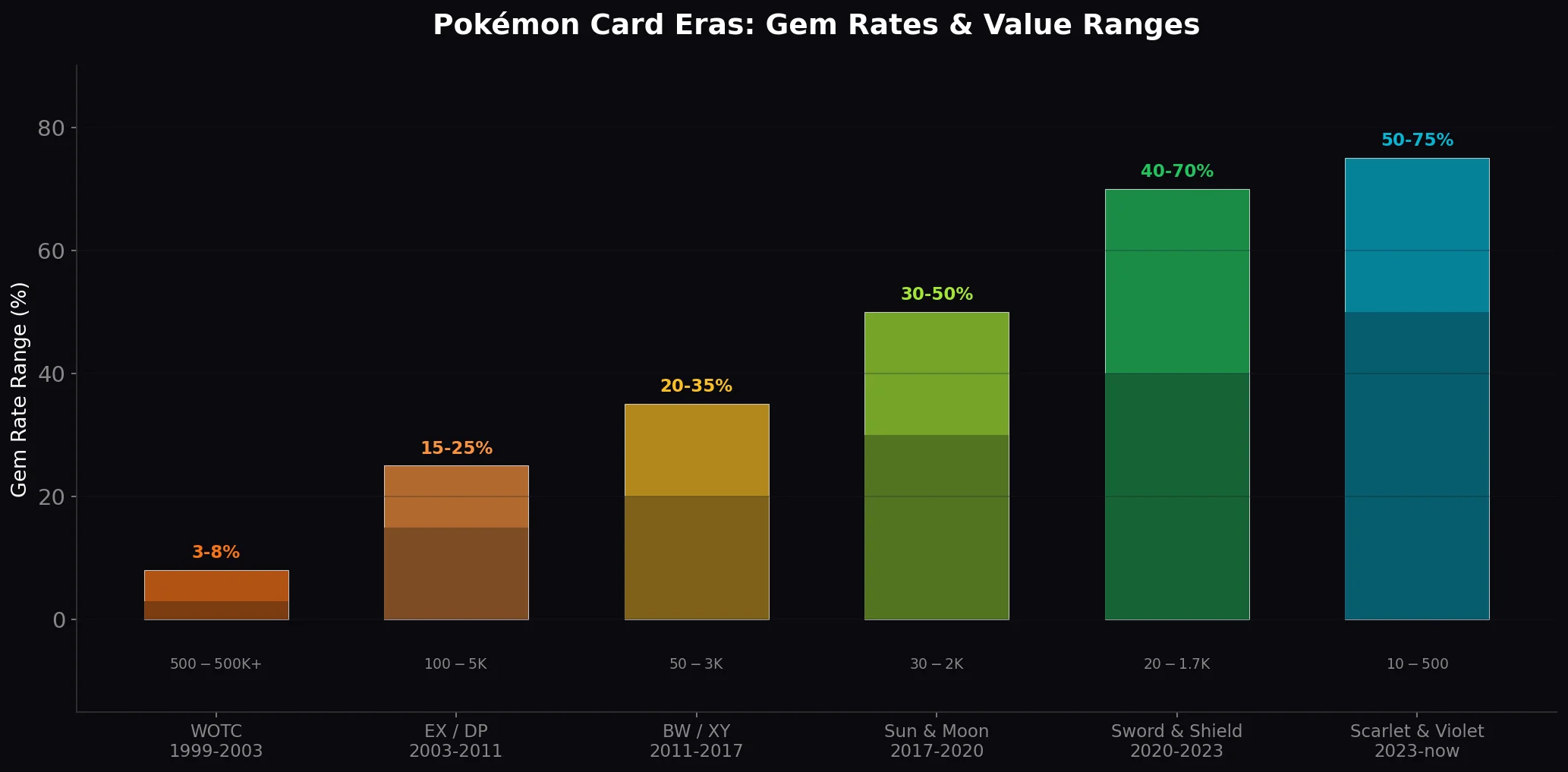
Era 1: WOTC (1999–2003) — The Foundation
Base Set, Jungle, Fossil, Team Rocket, Gym Heroes/Challenge, Neo Genesis through Neo Destiny, e-Series (Expedition, Aquapolis, Skyridge). This is where Pokémon cards began, and it's where the most extreme scarcity lives.
Why WOTC cards are expensive in PSA 10: Print quality was terrible. Wizards of the Coast used printing processes that produced inconsistent centering, surface texture issues, and edge whitening straight out of the pack. A 5% gem rate on Base Set holos means 95 out of every 100 submitted copies don't make PSA 10. That's not artificial scarcity — that's manufacturing scarcity, and it's permanent.
We don't have Base Set Charizard PSA 10 in our pricing database — those cards trade at auction in the five-to-six figure range and don't show up in normal marketplace flow (see our ranked best Pokémon cards to invest in list, and we break down every WOTC Charizard holo on real PSA 10 auction comps in the Charizard investing guide). But the principle applies to every WOTC holo: low gem rates create genuine rarity at the top grade, and nostalgia from the generation that grew up with these cards ensures demand never dies.
Key insight: Skyridge and Aquapolis are the sleepers of this era. They were the last WOTC sets with extremely limited print runs. Crystal-type holos from Skyridge have sub-3% gem rates and tiny populations.
Era 2: EX / Diamond & Pearl (2003–2011) — The Forgotten Middle
ex series, Diamond & Pearl, Platinum, HeartGold SoulSilver. This is the transition era — Pokémon card collecting was at its lowest cultural relevance. Fewer people were buying, fewer were preserving, and far fewer were submitting to PSA.
Why this era matters: Low collector interest at the time means fewer mint copies exist today. ex cards (lowercase "ex") introduced a power tier that foreshadowed modern chase cards. Gold Star cards from this era — Umbreon, Charizard, Rayquaza — are now five-figure cards in PSA 10 with populations under 100.
Gem rates sit around 15-25%, better than WOTC but still punishing enough to create scarcity. The Zekrom EX from Black Bolt shows how cards from neighboring eras can command serious premiums:
Era 3: Black & White / XY (2011–2017) — Full Art Revolution
This era introduced Full Art cards and changed Pokémon collecting forever. Before Full Arts, holos were the premium tier. After Full Arts, there was suddenly a card type that looked like actual artwork — edge-to-edge illustration, textured surfaces, premium feel.
Japanese Full Art EX cards from this era are particularly interesting. A Japanese Mewtwo EX Full Art from Psycho Drive currently sits at $1,283 FMV in PSA 10 in our database. Japanese cards often have lower populations than English equivalents because the grading culture in Japan developed later.
Investment thesis: Full Art EX cards from BW/XY are the most undervalued segment of the Pokémon market. They're old enough to have limited supply, new enough to have modern art quality, and priced like the market hasn't realized the supply is drying up.
Era 4: Sun & Moon (2017–2020) — The Tag Team Era
GX cards, Tag Team GX, Rainbow Rares, and the very first alternate art cards. Tag Team GX started the "premium card" trend — two Pokémon on one card, full art treatment, and prices that reflected the perceived exclusivity.
Gengar & Mimikyu GX from Tag Bolt is a perfect example — a Beckett 10 trades around $350. Tag Team cards created the psychological framework that Sword & Shield alt arts would later exploit: "this card is special, it's worth more."
Pikachu V-Union from Celebrations (technically a Sword & Shield product celebrating 25 years) bridges this era's nostalgia appeal with modern chase mechanics — PSA 10 FMV around $400.
Era 5: Sword & Shield (2020–2023) — The Golden Age
VMAX, V, VSTAR, Alt Art explosion, Trainer Gallery, Character Rares. This is the era that turned Pokémon cards from a hobby into an asset class. COVID lockdowns drove collecting demand through the roof, and The Pokémon Company responded with the best card designs in the game's history.
This is where our data gets really interesting. We have extensive pricing and population data for Sword & Shield cards, and the patterns are clear:
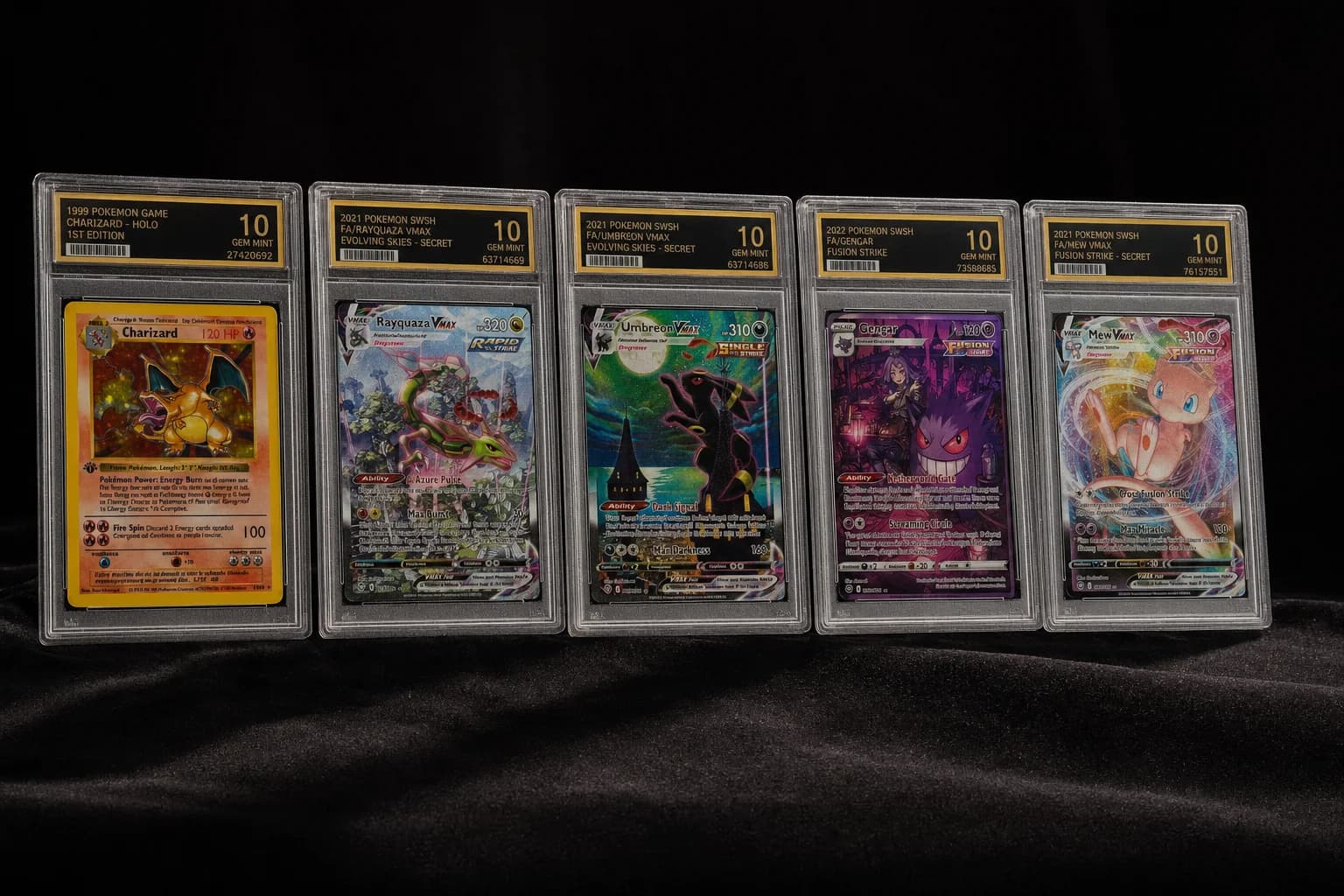
Rayquaza VMAX Alt Art #218 — The $1,653 Blue Chip
Evolving Skies. The set that created more wealth (and more heartbreak) than any other modern Pokémon product. Rayquaza VMAX Alt Art — depicting Rayquaza soaring through thunderclouds — is the crown jewel.
Here's what makes this card fascinating from a data perspective: the gem rate is 69%. That's not low. Nearly 7 out of 10 submitted copies get a PSA 10. With 20,000+ total submissions, that means there are roughly 14,000 PSA 10 copies in existence.
So why is it $1,653? Because demand is insane. Rayquaza is a top-3 Pokémon in global popularity. The alt art treatment is objectively stunning. And Evolving Skies has become the de facto "blue chip set" of modern Pokémon — the Sword & Shield equivalent of Base Set. When demand outstrips supply even at high population, prices stay elevated. This card proves that population alone doesn't determine price — the ratio of demand to supply does.
Mew VMAX Secret #269 — The $425 Fusion Strike Anchor
Fusion Strike was a massive set (264 cards in the main set) and Mew VMAX Secret was the chase. At 63% gem rate, it's slightly harder to gem than Rayquaza, but the price differential ($425 vs $1,653) tells you everything about the demand gap. Mew is popular but not Rayquaza-popular. Set desirability matters — Evolving Skies > Fusion Strike in the market's eyes.
Gengar TG06 — The Gem Rate Multiplier in Action
Now this is where the data gets spicy. Gengar TG06 from Lost Origin's Trainer Gallery has a 25% gem rate. Only 1 in 4 submitted copies makes the cut. On roughly 19,752 total submissions, that's approximately 5,000 PSA 10 copies — compared to Rayquaza's ~14,000.
The result? $400 FMV despite Gengar having far less mainstream appeal than Rayquaza. This is the gem rate multiplier at work: when fewer copies achieve top grade, each surviving copy commands a premium. The Lost Origin Trainer Gallery cards had notoriously inconsistent print quality, and the market prices that scarcity in.
Charizard V Brilliant Stars #153 — The Entry Point
At $57 for a PSA 9, Charizard V is the most accessible Charizard in graded form. The 54% gem rate is moderate, and the Charizard name carries a permanent price floor. This is a good example of a "floor card" — it won't 10x, but it won't go to zero either.
The more interesting question: what's the PSA 10 worth? Our PSA 9 vs 10 analysis shows the typical multiplier is 2-4x for modern cards. At $57 for PSA 9, you're looking at $115-$230 for the PSA 10. That 54% gem rate means roughly half of submissions don't make it — a meaningful enough filter to create a real premium.
Era 6: Scarlet & Violet (2023–Present) — The New Frontier
ex cards return (lowercase again), Special Art Rares, Illustration Rares, and a new visual identity. Sets like Obsidian Flames, Paldea Evolved, 151, Prismatic Evolutions, Journey Together, and the upcoming Mega Evolution sets are creating new chase cards.
It's early for this era. Prices are still volatile as supply enters the market. But Japanese promos from the SV era are already showing strength:
Detective Pikachu Returns pre-order promo — a Japanese exclusive — sits at $300 FMV in PSA 10 with an 87% gem rate. That high gem rate should suppress the price, but the card is a Japanese-only promo with limited initial distribution. Geographic scarcity (you had to be in Japan) trumps grading scarcity here.
Charmander Obsidian Flames promo at $95 PSA 9 shows the Scarlet & Violet era is already producing investable cards — especially promos with limited distribution windows.
Why Gem Rate Is the #1 Value Driver
If you take one thing from this guide, make it this: gem rate is the most reliable predictor of PSA 10 premium. Not the Pokémon name. Not the set. Not the YouTube hype. The gem rate.
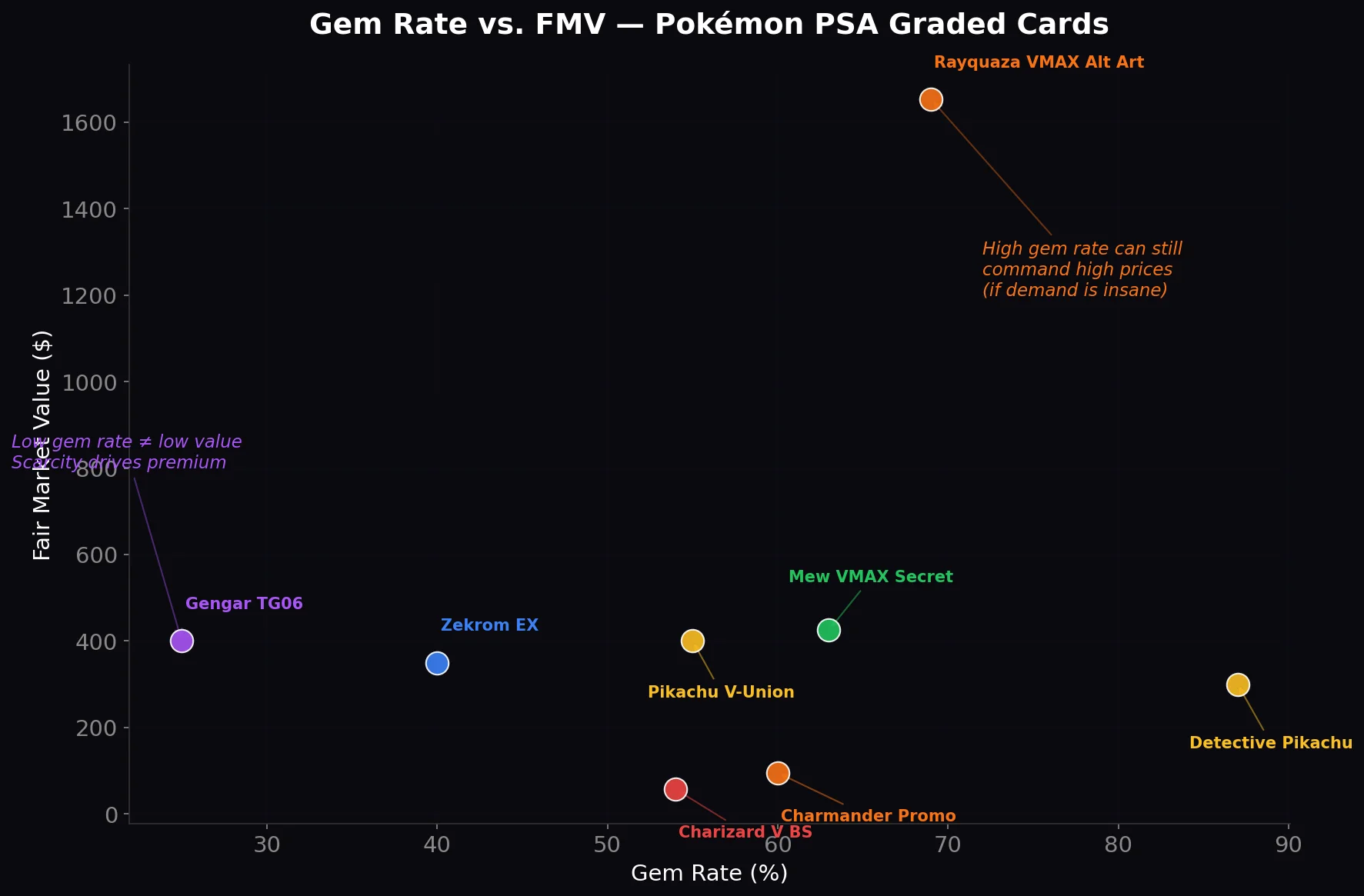
Look at the data:
- Gengar TG06: 25% gem rate → $400 FMV. Only ~5,000 of ~20,000 submissions made PSA 10. That's a brutal filter, and buyers pay for surviving it.
- Detective Pikachu: 87% gem rate → $300 FMV. Almost everyone who submits gets a 10. Price is driven entirely by distribution scarcity (Japan-only promo), not grading scarcity.
- Rayquaza VMAX: 69% gem rate → $1,653 FMV. The outlier that proves demand can override everything. When a card is iconic enough, even high population doesn't matter.
The takeaway for investors: find cards with low gem rates AND strong character appeal. That's the intersection where the biggest premiums live. High gem rate + high price means you're betting purely on sustained demand — a riskier position.
The Alt Art Premium
Evolving Skies alt arts trade at 3-10x the price of their regular counterparts. Why?
- Art quality: Alt arts are commissioned from premium artists and feature unique compositions — not just the Pokémon, but full scenes with narrative and emotion.
- Pull rates: Alt arts appear at roughly 1 per 2-3 booster boxes. Regular VMAX cards are significantly more common.
- Cultural status: Owning the alt art version signals "I got the real one." It's the difference between a print and an original.
Rayquaza VMAX regular (#111) trades for ~$50-80 in PSA 10. The alt art (#218) is $1,653. That's a 20-30x premium for the same Pokémon in the same set, just with different art. The alt art premium is the single most powerful price driver in modern Pokémon.
Population vs. Demand: Why High Pop Doesn't Mean Low Price
Conventional wisdom says "high population = low value." The Pokémon market says otherwise.
Rayquaza VMAX Alt Art has 20,000+ total submissions to PSA. That's enormous — most WOTC cards have a few thousand total. And yet it's worth $1,653. Why?
Because demand scales faster than supply for iconic cards. Every new collector who enters the hobby wants a Rayquaza VMAX alt art. The addressable market of "people who want this card" is growing faster than PSA can grade them. The population is big in absolute terms but small relative to global demand.
Compare this to a random GX card from Sun & Moon with a similar population but no character appeal — those trade under $20. Population matters, but only as a ratio to demand.
The PSA 10 vs. PSA 9 Gap
Our Charizard V data illustrates this perfectly. At $57 for a PSA 9 with a 54% gem rate, the PSA 10 likely trades at $115-$230. That's a 2-4x multiplier — standard for modern cards with moderate gem rates.
But for vintage WOTC cards with 5% gem rates? The PSA 10 can be 10-50x the PSA 9. When 95% of copies can't achieve the top grade, the ones that do become trophies. Read our full PSA 9 vs PSA 10 price analysis for the complete breakdown with more examples.
How to Use This Data
This guide is a snapshot. Prices move. Populations grow. New sets drop. Here's how to stay ahead:
- Track your cards: Use Graded.World to monitor live FMV on every card in your collection. Prices update automatically from verified sold listings.
- Check any cert: Our PSA 10 value calculator gives you instant pricing on any PSA cert number — including gem rate, population, and the value multiplier.
- Learn the pop report: The pop report guide teaches you to read PSA population data like a quant reads a balance sheet.
- Diversify across eras: Don't go all-in on modern. WOTC cards are the ultimate store of value. Modern alt arts have higher upside but more volatility. Mix both.
- Watch other markets: The One Piece graded card market is following the same pattern Pokémon did in 2020-2021. Cross-market awareness gives you an edge.
The Bottom Line
Pokémon PSA 10 prices aren't random. They're a function of gem rate, population, character demand, era scarcity, and art quality. Every card in this guide demonstrates at least one of those drivers — and the best cards (Rayquaza VMAX Alt Art, WOTC holos) combine all five.
The market is getting smarter. Tools like Graded.World are making population data and live pricing accessible to everyone, which means the era of "hidden gems" is shrinking. The best time to buy was when nobody had the data. The second best time is now — while most people still don't know how to read it.
Cards are assets. Treat them like it.