Pokémon Graded Card Prices: The 50 Most Valuable Cards (2026)
Pokémon is the most valuable trading card market on earth, and the only one with a 25-year graded track record to prove it. A single 1st Edition Base Set Charizard in PSA 10 trades for more than a house. But under the trophy cards is a deep, liquid market with decades of sold comps, real population data, and price trends you can actually read instead of guess at.
This guide covers what those cards are actually worth right now — the 50 most valuable by PSA 10 value, every major vintage set, the variants that separate a $200 card from a $200,000 one, and how to think about grading a market where a single grade bump can 10x the price. Every number here is grounded in real recent sales — auction results for the grails, sold comps for the rest — not a listing or a hope.
The 50 Most Valuable Pokémon Cards
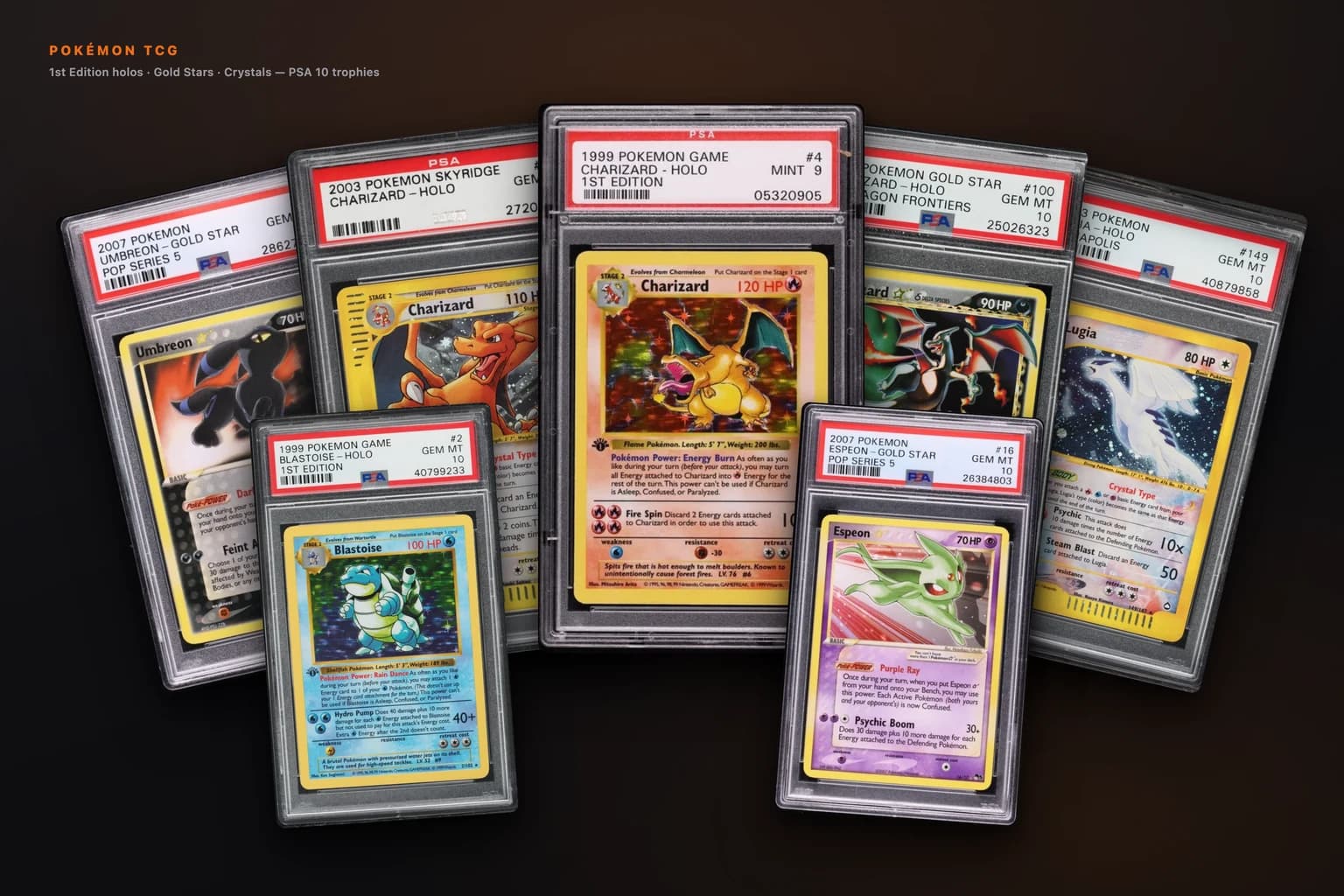
This is the leaderboard: the 50 most valuable Pokémon cards ranked by PSA 10 fair market value. The grail tier — 1st Edition Base holos, Gold Stars, Crystals — trades at auction (ALT, Goldin, PWCC), so those figures are recent hammer prices; the rest are median sold comps from our marketplace data. These are gem-mint (PSA 10) values, and the vintage market moves in cycles, so treat them as recent estimates rather than fixed quotes.
The 50 Most Valuable Pokémon Cards
Ranked by PSA 10 fair market value. Trophy-tier prices are recent public auction results; the rest are median sold comps from our marketplace data. Estimates move with the market. Updated 2026-07-16.
| # | Card | Variant | Set | PSA 10 FMV |
|---|---|---|---|---|
| 1 | Pikachu Illustrator Promo · Promo (1998) | Promo | Promo (1998) | $5.28M |
| 2 | Charizard 1st Edition · Base Set | 1st Edition | Base Set | $350,000 |
| 3 | Umbreon Gold Star · POP Series 5 | Gold Star | POP Series 5 | $75,000 |
| 4 | Charizard Gold Star · EX Dragon Frontiers | Gold Star | EX Dragon Frontiers | $50,000 |
| 5 | Pikachu Gold Star · EX Holon Phantoms | Gold Star | EX Holon Phantoms | $48,000 |
| 6 | Blastoise 1st Edition · Base Set | 1st Edition | Base Set | $46,000 |
| 7 | Espeon Gold Star · POP Series 5 | Gold Star | POP Series 5 | $45,000 |
| 8 | Charizard Crystal · Skyridge | Crystal | Skyridge | $42,000 |
| 9 | Lugia Crystal · Aquapolis | Crystal | Aquapolis | $38,000 |
| 10 | Lugia 1st Edition · Neo Genesis | 1st Edition | Neo Genesis | $33,000 |
| 11 | Charizard Reverse Holo · Legendary Collection | Reverse Holo | Legendary Collection | $33,000 |
| 12 | Rayquaza Gold Star · EX Deoxys | Gold Star | EX Deoxys | $32,000 |
| 13 | Charizard Shadowless · Base Set | Shadowless | Base Set | $28,000 |
| 14 | Venusaur 1st Edition · Base Set | 1st Edition | Base Set | $24,000 |
| 15 | Shining Charizard 1st Edition · Neo Destiny | 1st Edition | Neo Destiny | $22,500 |
| 16 | Ho-Oh Crystal · Skyridge | Crystal | Skyridge | $20,000 |
| 17 | Dark Charizard 1st Edition · Team Rocket | 1st Edition | Team Rocket | $18,000 |
| 18 | Gengar 1st Edition · Fossil | 1st Edition | Fossil | $17,500 |
| 19 | Kabutops Crystal · Skyridge | Crystal | Skyridge | $13,000 |
| 20 | Kingdra Crystal · Aquapolis | Crystal | Aquapolis | $12,000 |
| 21 | Mewtwo 1st Edition · Base Set | 1st Edition | Base Set | $12,000 |
| 22 | Shining Mewtwo 1st Edition · Neo Destiny | 1st Edition | Neo Destiny | $10,500 |
| 23 | Charizard 1st Edition · Gym Challenge | 1st Edition | Gym Challenge | $10,000 |
| 24 | Blastoise Shadowless · Base Set | Shadowless | Base Set | $9,000 |
| 25 | Nidoking Crystal · Aquapolis | Crystal | Aquapolis | $8,500 |
| 26 | Zapdos 1st Edition · Base Set | 1st Edition | Base Set | $8,000 |
| 27 | Ninetales 1st Edition · Base Set | 1st Edition | Base Set | $7,500 |
| 28 | Venusaur Shadowless · Base Set | Shadowless | Base Set | $7,000 |
| 29 | Raichu 1st Edition · Base Set | 1st Edition | Base Set | $6,500 |
| 30 | Dark Raichu Secret · Team Rocket | Secret | Team Rocket | $6,500 |
| 31 | Gyarados 1st Edition · Base Set | 1st Edition | Base Set | $6,000 |
| 32 | Alakazam 1st Edition · Base Set | 1st Edition | Base Set | $6,000 |
| 33 | Dragonite 1st Edition · Fossil | 1st Edition | Fossil | $5,500 |
| 34 | Chansey 1st Edition · Base Set | 1st Edition | Base Set | $5,000 |
| 35 | Snorlax 1st Edition · Jungle | 1st Edition | Jungle | $5,000 |
| 36 | Shining Gyarados 1st Edition · Neo Revelation | 1st Edition | Neo Revelation | $4,500 |
| 37 | Poliwrath 1st Edition · Base Set | 1st Edition | Base Set | $4,500 |
| 38 | Lapras 1st Edition · Fossil | 1st Edition | Fossil | $4,000 |
| 39 | Hitmonchan 1st Edition · Base Set | 1st Edition | Base Set | $4,000 |
| 40 | Scyther 1st Edition · Jungle | 1st Edition | Jungle | $3,800 |
| 41 | Dark Dragonite 1st Edition · Team Rocket | 1st Edition | Team Rocket | $3,500 |
| 42 | Shining Magikarp 1st Edition · Neo Revelation | 1st Edition | Neo Revelation | $3,500 |
| 43 | Typhlosion 1st Edition · Neo Genesis | 1st Edition | Neo Genesis | $3,500 |
| 44 | Machamp 1st Edition · Base Set | 1st Edition | Base Set | $3,200 |
| 45 | Vaporeon 1st Edition · Jungle | 1st Edition | Jungle | $3,000 |
| 46 | Flareon 1st Edition · Jungle | 1st Edition | Jungle | $3,000 |
| 47 | Jolteon 1st Edition · Jungle | 1st Edition | Jungle | $3,000 |
| 48 | Feraligatr 1st Edition · Neo Genesis | 1st Edition | Neo Genesis | $2,800 |
| 49 | Espeon 1st Edition · Neo Discovery | 1st Edition | Neo Discovery | $2,600 |
| 50 | Umbreon (Moonbreon) VMAX Alt Art · Evolving Skies | VMAX Alt Art | Evolving Skies | $2,500 |
Why Pokémon Graded Cards Are Different
If you're coming from a modern TCG like One Piece, the Pokémon market plays by different rules:
- 25 years of graded history. Vintage Pokémon has been graded since the early 2000s. The population reports are mature — you know almost exactly how many PSA 10 1st Edition Charizards exist (around 120), and that number barely moves. Scarcity here is a known quantity, not a moving target.
- Condition, not just rarity, sets the price. Vintage cards were mass-produced, but surviving in gem-mint condition after 25 years is brutally rare. Base Set holos are notorious for poor centering, holo scratches, and print lines. That's why gem rates on vintage are low — often under 20% — and why the jump from PSA 9 to PSA 10 can multiply the price 5-15x.
- Print run is everything. The same card can exist as 1st Edition, Shadowless, and Unlimited — three completely different cards to a collector, sometimes with a 20x price gap between them. Knowing which print you're holding is the whole game.
- PSA dominates. For vintage Pokémon, PSA holds the overwhelming majority of the graded market and commands a clear price premium over CGC and BGS on the same card. The population data everyone quotes is PSA's.
- It has survived every cycle. Unlike younger TCGs, vintage Pokémon has been through multiple boom-and-bust cycles (2016, 2020-21, 2024) and the blue chips have made new highs each time. That track record is itself part of the value.
Print Runs & Variants: What Actually Drives Value
The single most important skill in vintage Pokémon is telling the print runs apart. Here's the hierarchy, from most to least valuable, for the WOTC era:
- 1st Edition. Stamped with the "Edition 1" symbol, printed in small quantities before the general release. Always the most valuable print of a given card — often 5-20x the Unlimited version.
- Shadowless. Base Set only. Early Unlimited cards printed without the drop shadow on the art box, before WOTC added it. Rarer than Unlimited, cheaper than 1st Edition — the collector's sweet spot.
- Unlimited. The mass-market print run. Most affordable, but Unlimited holos of iconic cards (Base Charizard, Blastoise, Venusaur) still carry real value in PSA 10.
- Reverse Holo. From Legendary Collection onward, a parallel where the whole card (not the art) is foil. Legendary Collection reverse holos are genuinely scarce and command large premiums.
- Crystal. The e-Card era (Aquapolis, Skyridge) "Crystal Type" secret rares — an alternate holo treatment. Crystal Charizard and Lugia are among the most valuable non-1st-Edition vintage cards.
- Gold Star. The EX era (2005-2007) chase — a shiny-Pokémon alternate art marked with a gold star. Umbreon, Espeon, Rayquaza, and Charizard Gold Stars are trophy cards.
- Secret Rare. Cards numbered beyond the set's stated size (e.g. #146/144). Always chase cards.
The rule of thumb: 1st Edition holos and the alternate-treatment secret rares (Crystal, Gold Star) are the investment-grade cards. Unlimited commons are for the binder.
Set-by-Set: The WOTC Vintage Era (1999-2003)
Base Set (1999)
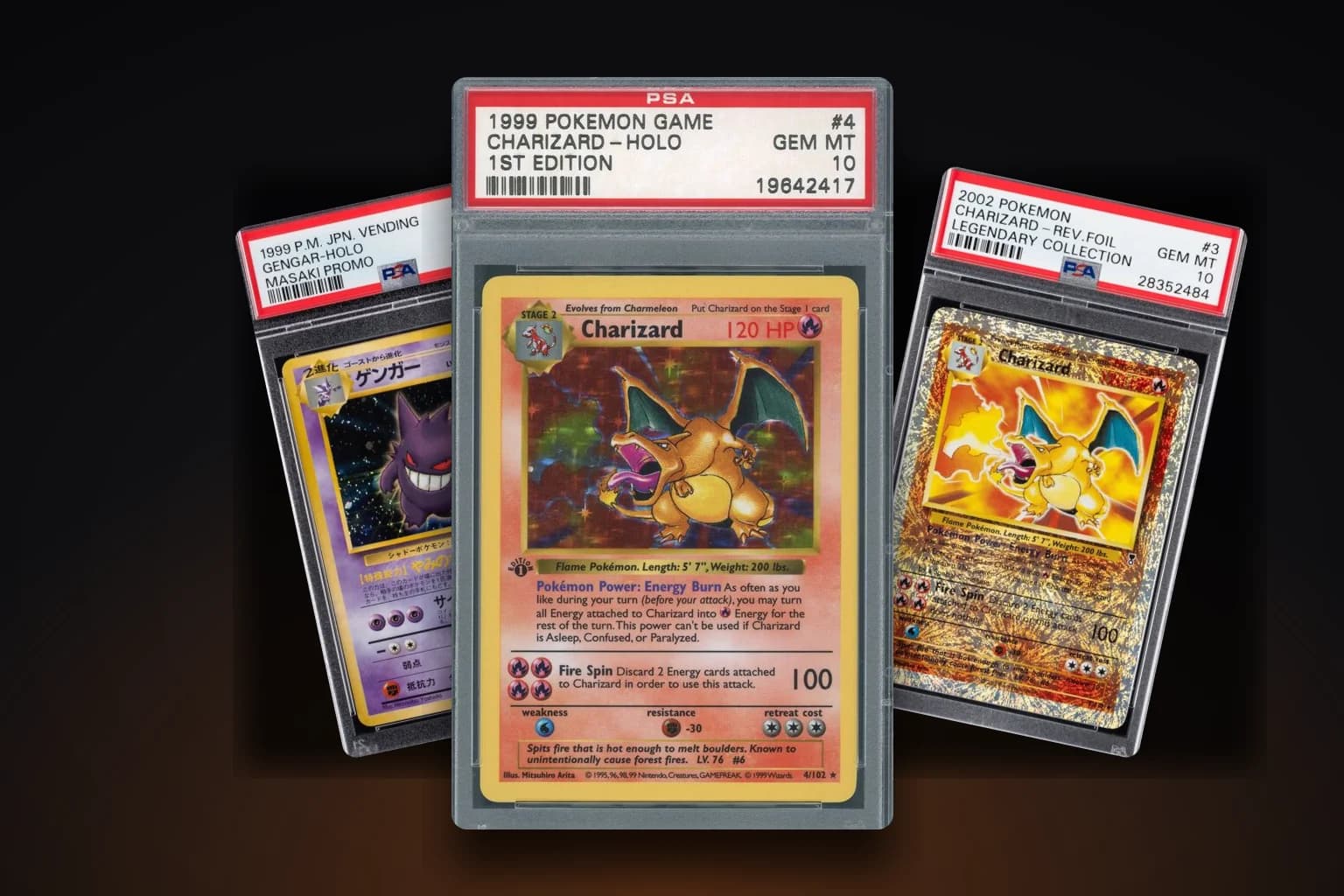
The one that started it all — and still the most valuable set in the hobby. The 1st Edition Base Set Charizard (#4) is the single most important card in Pokémon: the grail, the benchmark, the card every other card is measured against. Its PSA 10 population sits around 120 and its price leads the entire market. Blastoise and Venusaur 1st Edition holos are the supporting blue chips. The three print runs — 1st Edition, Shadowless, Unlimited — each trade as separate markets, and the gap between them is enormous.
Jungle & Fossil (1999)
The first two expansions. Jungle's 1st Edition holos (Snorlax, Scyther, Vaporeon) and Fossil's 1st Edition Gengar, Dragonite, and Lapras are the chase cards. These are more attainable than Base Set but the 1st Edition holos in PSA 10 are still four- and five-figure cards. Fossil Gengar 1st Edition is a perennial favorite.
Team Rocket (2000)
The "Dark" Pokémon set. Dark Charizard (#4) is the marquee card — the first alternate Charizard, and a 1st Edition PSA 10 is a serious five-figure card. The set's villainous theme and the secret Dark Raichu (the first-ever secret rare in the TCG) give it lasting collector appeal.
Gym Heroes & Gym Challenge (2000)
The Gym Leader sets. These introduced "owner's Pokémon" — Blaine's Charizard, Giovanni's cards, Sabrina's Alakazam. Blaine's Charizard from Gym Challenge in 1st Edition PSA 10 is the standout, blending the Charizard premium with genuine scarcity.
The Neo Era: Genesis, Discovery, Revelation, Destiny (2000-2002)
Generation 2 Pokémon arrive. Neo Genesis 1st Edition Lugia (#9) is the crown jewel — one of the most iconic and valuable non-Base cards in the hobby, with a famously low PSA 10 population because the card is prone to edge wear and centering issues. Neo Destiny gave us Shining Charizard and Shining Tyranitar — the "Shining" Pokémon, precursors to the Gold Star chase. Neo Revelation Shining cards round out the era.
Legendary Collection (2002)
A reprint set with a twist that made it a collector favorite: the Reverse Holo parallel. Legendary Collection reverse holos are genuinely scarce — the reverse holo Charizard and the reverse holo Gyarados command enormous premiums relative to their non-reverse versions, precisely because so few survive in gem-mint condition.
The e-Card Era: Skyridge, Aquapolis & Crystals
The e-Card sets (Expedition, Aquapolis, Skyridge, 2002-2003) are the last WOTC-era sets and among the hardest to find in gem mint. Their claim to fame is the Crystal Type secret rares — an alternate-holo treatment reserved for a handful of Pokémon per set.
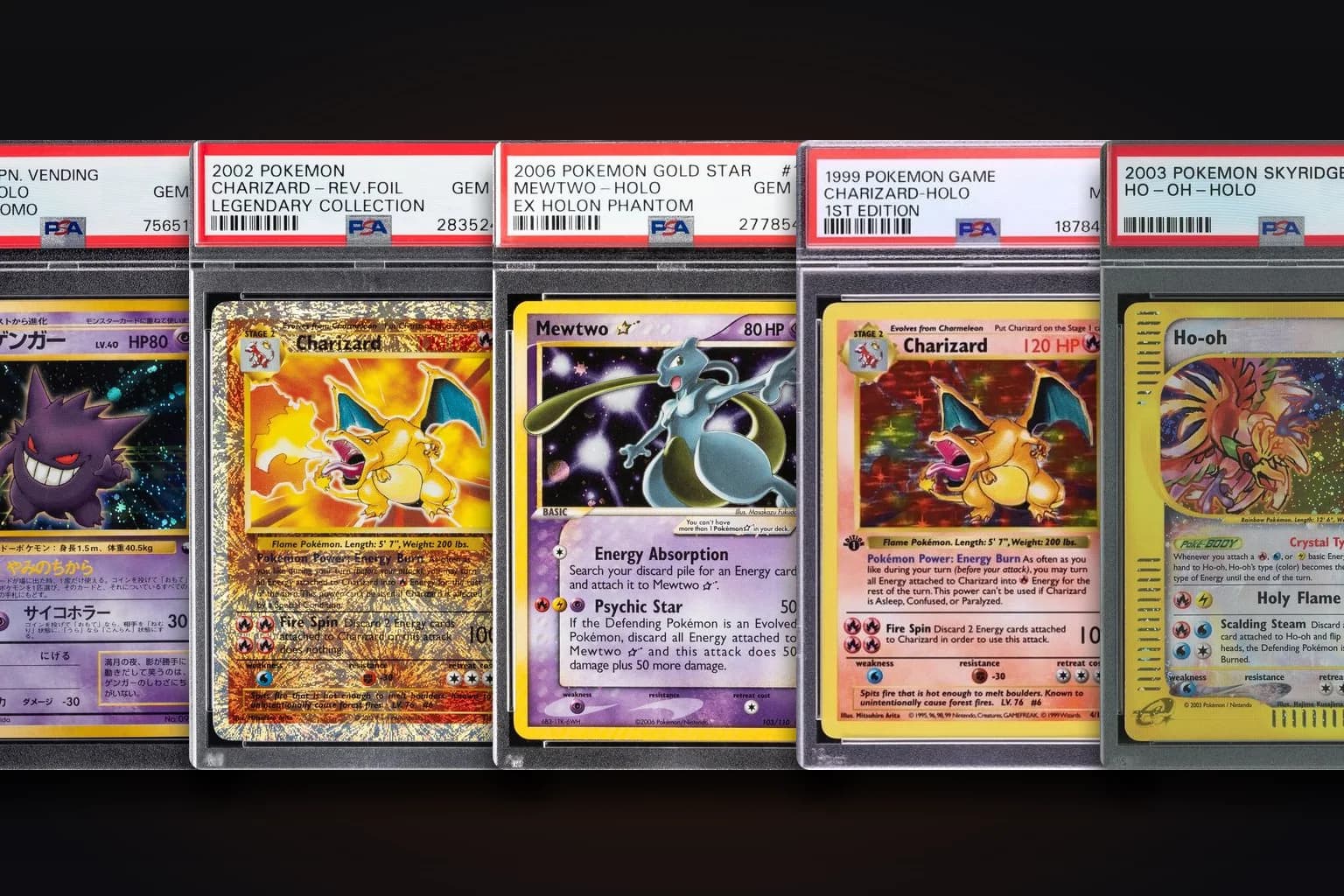
Crystal Charizard (Skyridge #146) and Crystal Lugia (Aquapolis) are the headliners — six-figure and five-figure PSA 10 cards respectively, with tiny gem populations. The e-Card era printing was rough, so PSA 10s are exceptionally scarce, which is exactly why these cards anchor the top of the leaderboard despite not being 1st Edition Base Set.
Gold Stars: The EX-Era Grails (2005-2007)
The EX era introduced Gold Star cards — shiny-Pokémon alternate arts marked with a gold star, pulled at roughly 1 per box. They are the modern collector's bridge between vintage and current chase cards, and several rank among the most valuable Pokémon cards ever printed.
- Umbreon & Espeon Gold Star (POP Series 5) — distributed only through the Pokémon Organized Play program, with tiny print runs. Umbreon Gold Star is a top-five most valuable Pokémon card, period.
- Charizard Gold Star (EX Dragon Frontiers) — the Gold Star every Charizard collector wants.
- Rayquaza Gold Star (EX Deoxys) and Mew Gold Star — perennial six-figure-adjacent trophies.
- Pikachu Gold Star (EX Holon Phantoms) — the mascot in the era's most coveted treatment.
Modern Chase Cards: SIRs & Alt Arts
Modern Pokémon (Sword & Shield onward) trades differently: print runs are enormous, so a $50k modern card is rare. The exceptions are the Special Illustration Rares (SIRs) and alternate arts — cards like the Moonbreon (Umbreon VMAX Alt Art from Evolving Skies), which became the defining modern chase card and trades for four figures in PSA 10 despite being a 2021 release. For a full modern breakdown, see our Modern Pokémon index.
Grading Intelligence: PSA, CGC or BGS?
For vintage Pokémon, the answer is almost always PSA. PSA holds the deepest population data, the most liquid market, and the clearest price premium on vintage. A PSA 10 vintage card routinely sells for more than the same card in a CGC or BGS 10, simply because that's where the buyers are.
The thing to understand about vintage grading is how hard a 10 actually is. Base Set holos have gem rates in the single digits to low teens — meaning out of every 100 submitted, only a handful come back PSA 10. That's why the PSA 9 to PSA 10 price gap is so violent on vintage (often 5-15x) and why the population numbers in the table above matter as much as the price. A card with 120 PSA 10s in existence has a hard ceiling on supply that no reprint can change.
CGC and BGS make more sense for modern cards, sub-grade transparency, or when you value the case aesthetics. But if your goal is maximum resale on a vintage card, PSA is the default.
Investment Analysis: Where the Smart Money Goes
Three theses drive the top of the vintage market:
- 1st Edition Base Set holos are the S&P 500 of the hobby. Charizard, Blastoise, Venusaur — fixed supply, permanent demand, survived every cycle at higher highs. Boring, expensive, and the safest hold in cards.
- Trophy secret rares are the concentrated bet. Umbreon Gold Star, Crystal Charizard, Neo Genesis Lugia — tiny populations, iconic Pokémon, and no possibility of new supply. Higher volatility, higher ceiling.
- Population is the tell. Two cards at the same price with wildly different PSA 10 populations are not the same bet. The lower-pop card has more room to run if demand rises, because supply physically cannot. Always read the pop column, not just the price.
The mistake most new buyers make is chasing raw "cheap" vintage. A raw Base Set holo is a coin flip on condition, and the value lives almost entirely in the PSA 10. Buy the grade, or buy a card whose PSA 9 already makes sense to you.
Frequently Asked Questions
What is the most valuable Pokémon card?
The Pikachu Illustrator promo is the most valuable Pokémon card in existence — only a few dozen were ever printed, as prizes in a 1998 illustration contest. Among mass-released cards, the 1st Edition Base Set Charizard in PSA 10 is the benchmark grail.
How do I tell if my Base Set card is 1st Edition, Shadowless, or Unlimited?
Look for the "Edition 1" stamp on the lower-left of the art (1st Edition). No stamp but no drop shadow to the right of the art box means Shadowless. A drop shadow means Unlimited. The price difference between them is often 10x or more, so this matters.
Why is the PSA 9 so much cheaper than the PSA 10?
Vintage cards are hard to find in perfect condition after 25 years, so PSA 10s are genuinely scarce — gem rates are often under 20%. That scarcity concentrates demand into the 10, creating the large 9-to-10 price gap you see across vintage.
Are vintage Pokémon cards still a good investment in 2026?
The blue chips (1st Edition Base holos, trophy secret rares) have made new highs across multiple market cycles and have fixed, known supply. As with any collectible, prices move in cycles — the table above is the real sold-comp data to make your own call, not a promise.
Where can I check live Pokémon graded card prices?
Right here. Every card in the table is tracked with live sold comps on Graded, and you can drill into any set with our market indexes.
Track Every Pokémon Card in Real Time
The prices above are a snapshot. On Graded, every set has a live index built from real PSA 10 sold comps, and every card has its own page with price history, population, and market data. Start with the Pokémon market indexes or search any card directly to see what it's worth right now.