How to Find the Best Price for a Graded Card Across eBay and Other Marketplaces
The same graded card can carry five different prices depending on where you look and when you look. A PSA 10 might show a $400 "Buy It Now" on eBay, a $320 sold comp from last Tuesday, a $290 accepted Best Offer nobody can see, and a tokenized listing trading at $275 on a marketplace most price tools have never indexed. Finding the best price isn't about trusting one site — it's about reading the whole market.
This is a complete, honest guide to doing exactly that. We'll cover every serious pricing tool collectors actually use — the free comp engines, the paid analytics platforms, the scanner apps, and the auction-house archives — what each one is good for, and where each one falls short. Then we'll cover the blind spot almost all of them share, and how to close it.
First: What "Best Price" Actually Means
Before you open a single tool, internalize five rules. Skip these and the fanciest price database in the world will still lead you wrong.
- Sold comps beat asking prices. A listing price is a hope. A sold price is a fact. Always work from recently sold data, not active listings — the gap between the two is where overpaying lives.
- Compare the same grade AND the same grader. A PSA 10 is not a CGC 10 is not a BGS 9.5. PSA 10s usually command a liquidity premium; CGC and SGC can offer better value at equivalent condition. If you mix graders in one average, the number is meaningless.
- Fees are baked into what you see. Sellers on eBay pay roughly 13–15% in final value fees, and that cost is priced into the listing. The "sticker" is rarely the real cost basis.
- Hidden Best Offers distort eBay. When a card sells via accepted Best Offer, eBay can mask the true final price. The visible sold number is often higher than what actually changed hands.
- Sample size and recency matter. One outlier sale can swing a thin market by hundreds of dollars. Trust prices with 5–10+ recent sales; treat a single comp as a rumor, not a quote.
Hold those in your head. Now here are the tools that surface the data — starting with the free ones that should be your foundation.
The Free Sold-Comp Tools (Start Here)
If you only ever use these, you'll already be ahead of most buyers. They're free, they run on real sold data, and they're where every smart collector begins a price check.
eBay Sold Listings & eBay Price Guide
eBay is the single largest pool of graded-card sales on earth, which makes its sold-listings filter the default comp source for the hobby. Filter any search to Sold Items and you see real transaction prices, not wishful asks.
eBay also built a dedicated Price Guide on top of up to two years of completed sales. It matches a card to the same card and grade where it can, folds in PSA and CGC population data for context, and even surfaces Card Ladder indexes to show trend direction. Scanning and pricing are free with no usage limits. The catch: it only sees eBay's own data, and the hidden-Best-Offer problem still applies.
130point
130point is the longest-running free comp tool in the hobby, and the one that fixes eBay's biggest weaknesses. It aggregates more than 15 million sold items across eBay (including the hidden Best-Offer final prices eBay tries to mask), plus Fanatics Collect (formerly PWCC), Goldin, Heritage, MySlabs, and Pristine Auctions — all in one search. The web tool and the mobile app are free, no subscription required, and a single lookup shows high, low, average, and total number of sales. For most quick price checks, this is the fastest accurate answer.
PSA Auction Prices Realized (APR)
PSA Auction Prices Realized is the official archive for PSA-graded cards: over 5 million auction results spanning more than ten years, pulled from eBay, Goldin, and major auction houses. Because it ties results to the PSA cert and reports per-grade averages alongside the most recent sales, it's the cleanest way to see how a specific grade has performed over any time window. If you're buying or selling a PSA slab, APR is non-negotiable.
PriceCharting
PriceCharting monitors essentially every eBay sale, uses proprietary matching to assign each sale to the right card and grade, and filters out junk data — then plots a clean price-history chart for PSA, BGS, and CGC copies. Its strength is the time-series view: you can instantly see whether a card is trending up, down, or flat. It's especially strong for Pokémon (and video games). The weakness: it averages eBay only, so "ungraded" prices lump all conditions together, and thin-volume cards skew easily.
VCP (Vintage Card Prices)
VCP prices any graded card off verified sales from eBay and respected auction platforms. It leans vintage and is a solid cross-check when you want a second opinion on an older slab's market value.
The Analytics Platforms (Paid, for Serious Tracking)
Free comp tools answer "what did this sell for?" Paid platforms answer "where is this market going, and how does my whole collection look?" If you track value seriously, one of these earns its subscription.
Card Ladder
Card Ladder bills itself as the ultimate card price guide: value estimates on millions of cards drawn from sales across roughly 15 marketplaces, plus population reports from PSA, BGS, and SGC, and proprietary market indexes (the same indexes eBay surfaces in its Price Guide). It runs a free tier and a Pro tier starting around $15/month. Best for collectors who want index-level trend data and clean per-card analytics.
Market Movers (Sports Card Investor)
Market Movers tracks comps on over 2 million cards with a focus on investors: price charts, market trends, a deal finder that flags cards selling below recent comps, collection management, and price alerts. Plans range from about $9.99 up to $35/month depending on features. Best for active buyers and flippers hunting mispriced inventory.
Card Hedge
Card Hedge offers a price guide across more than a million cards in every grade and grader — PSA, BGS, CGC, SGC, HGA, and raw — making it a handy one-stop reference when you need every grade's value at a glance.
Scanner & Collection Apps (Price + Manage in One)
These pair a phone-camera scanner with a price feed, so you can identify a slab and value it in seconds — handy at shows, in the wild, or when cataloging a collection.
- Collectr — tracks prices for Pokémon, Magic, Yu-Gi-Oh, and other TCGs across raw, sealed, and graded, with a clean portfolio view. Strong for TCG-heavy collections.
- CollX — visual search against a database of 17+ million cards returns an instant average market price, and you can set grade/condition for a tighter number. Great for fast bulk identification.
- Ludex — leans into portfolio management with sorting and analytics aimed at investors tracking value over time.
These are excellent for cataloging and ballpark values, but their averages are blended estimates — for a high-dollar purchase, confirm against a dedicated comp tool above.
Population Data: The Context Layer
Price without population is half the picture. How many of that exact card exist in that exact grade decides how much scarcity premium is real versus imagined.
GemRate runs the hobby's Universal Pop Report — a single search across PSA, BGS, SGC, and CGC populations — plus daily grading trends and gem-rate data (the share of submissions hitting the top grade). Pair it with PSA's own Population Report and you can tell whether a PSA 10 is genuinely scarce or one of fifty thousand. For the full method, see PSA Pop Report Explained: How to Use Population Data to Find Undervalued Cards.
High-End Auction Comps
For grails, vintage, and six-figure slabs, eBay comps won't capture the ceiling. The big auction houses set it. Their published results are free to browse and essential when you're pricing anything rare.
- Fanatics Collect (formerly PWCC) — weekly and premier auctions with a searchable sales history; the #2 venue for high-end cards.
- Goldin — the marquee auction house for record-setting cards; its realized prices are reference points for the top of the market.
- Heritage Auctions — deep archive of realized prices across vintage and modern, with a long public record.
The Pricing Tools at a Glance
| Tool | What it tracks | Cost | Best for |
|---|---|---|---|
| eBay Sold / Price Guide | eBay completed sales (2 yrs) + pop data | Free | The default first check |
| 130point | 15M+ sold across eBay (incl. hidden Best Offers), Fanatics, Goldin, Heritage, MySlabs | Free | Fastest accurate comp |
| PSA APR | 5M+ PSA results, 10+ yrs, by cert & grade | Free | Pricing PSA slabs |
| PriceCharting | Every eBay sale, grade-matched, with history | Free | Price trends, Pokémon |
| Card Ladder | ~15 marketplaces, indexes, pop reports | Free + ~$15/mo | Trend & index analytics |
| Market Movers | 2M+ cards, deal finder, price alerts | ~$9.99–$35/mo | Investors & flippers |
| GemRate | Universal pop report (PSA/BGS/SGC/CGC) | Free | Scarcity context |
| Collectr / CollX / Ludex | Scan-to-price + portfolio | Free + paid tiers | Cataloging on the go |
| Fanatics / Goldin / Heritage | High-end auction realized prices | Free to view | Grails & vintage ceilings |
| Graded World | Onchain + offchain: eBay, Courtyard, Collector Crypt, Phygitals | Free | The complete market in one search |
The Blind Spot Every Tool Above Shares
Look closely at that list and you'll notice something. eBay, 130point, PSA APR, PriceCharting, Card Ladder, Market Movers — every one of them scrapes the same universe of data: eBay and offchain auction houses. For decades that was the entire market, so it was enough.
It isn't anymore. A fast-growing share of graded slabs now trades onchain — real physical cards, vaulted and tokenized, changing hands on platforms like Collector Crypt, Courtyard, and Phygitals. These are genuine sales with genuine price discovery, and they are completely invisible to every tool above. None of them index onchain settlement.
That gap costs you money in both directions. You can overpay on eBay for a slab that's trading cheaper as a token on Collector Crypt. Or you can undersell a card whose tokenized comps are running higher than its eBay history. If your pricing data only sees offchain sales, you're valuing a card off half its market and calling it the whole thing.
Graded World: The Whole Market in One Search
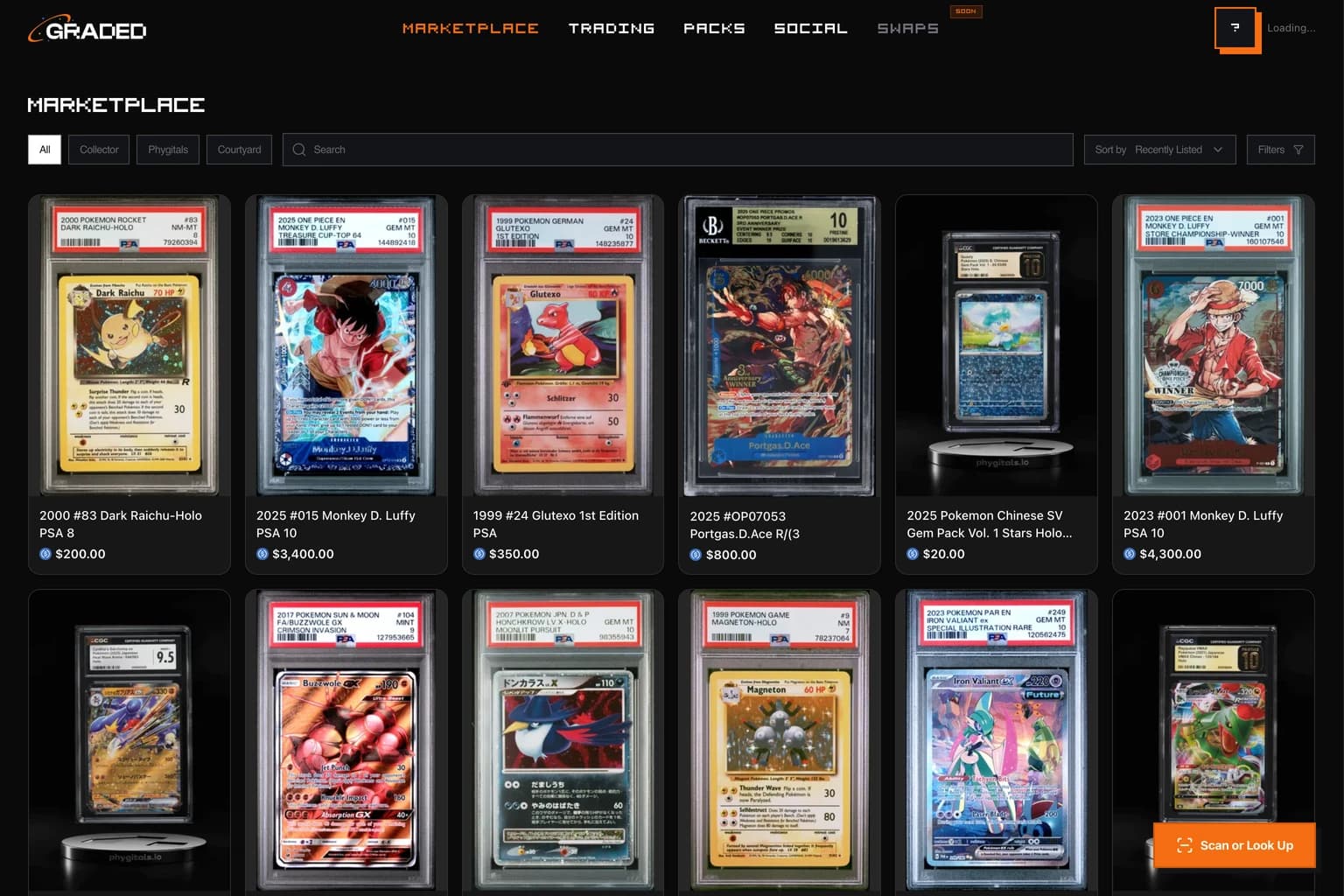
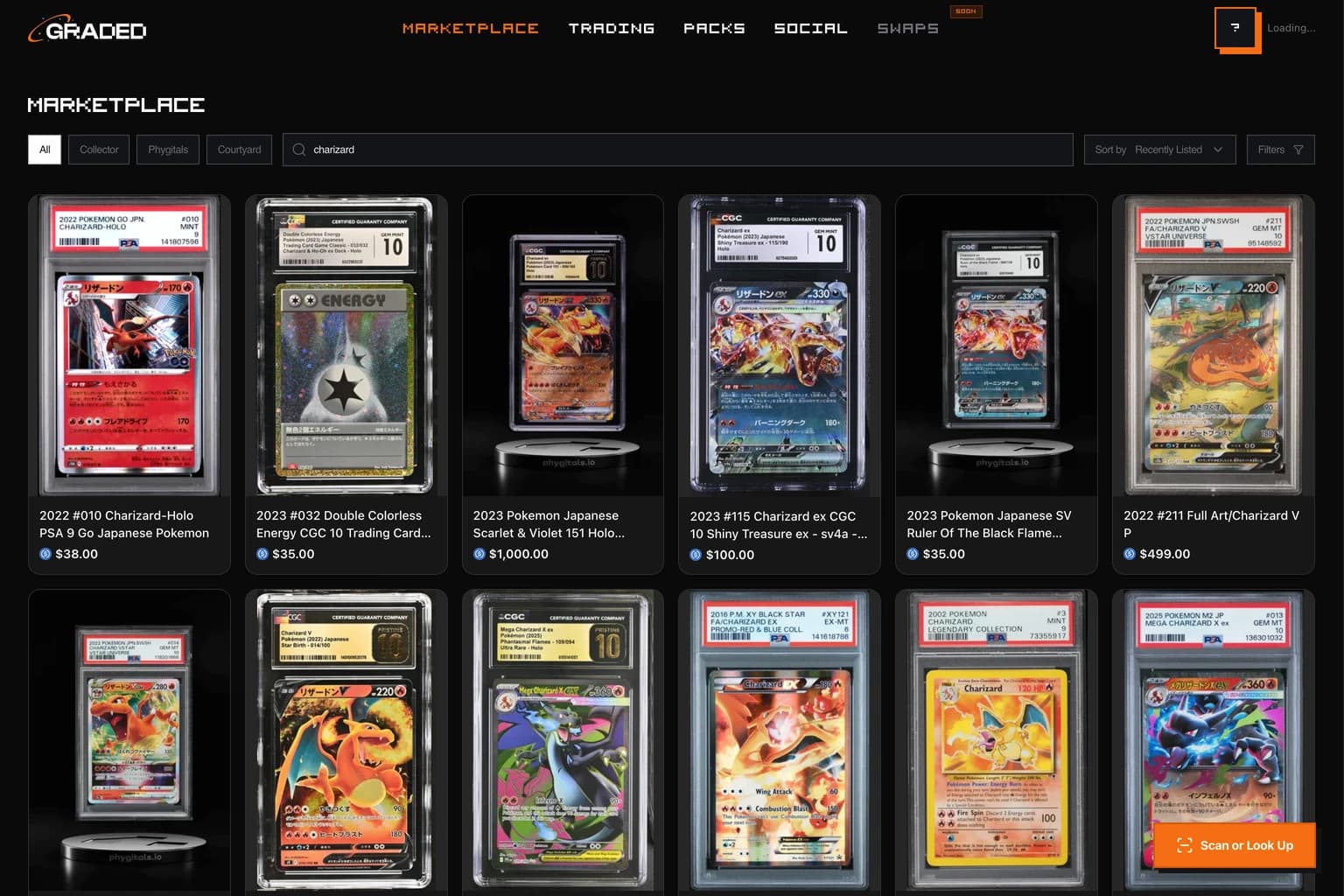
Graded World was built to close exactly that gap. It tracks sales both onchain and on eBay and other marketplaces, pulling live listings from eBay, Courtyard, Collector Crypt, and Phygitals into one searchable dashboard. Look up a card once and see what it's actually selling for across every platform — offchain comps and tokenized prices side by side, in the same place.
That's the difference in one sentence: the other tools know the offchain market very well. Graded World knows the whole market — because it's the one platform watching both halves at once.
And it does more than check prices. Graded World is where you can also act on what the data tells you:
- Trade directly. Peer-to-peer trading is live — swap slabs with another collector inside the same dashboard instead of routing through a marketplace and its fees.
- Tokenize a card. Turn a physical graded slab into a tradable token so it settles instantly and globally — and borrow against your collection without selling it. The slab stays vaulted and insured; the token is what moves.
- Pay in SOL or USDC. Buy tokenized inventory natively, or compare it dollar-for-dollar against traditional eBay listings.
- Track your whole portfolio. Manage every slab in one place — vaulted, listed, or physically in hand — with cross-platform pricing whenever you research a buy or size up a sale.
Graded World also hosts the largest listings of vaulted graded collectibles on any single platform, so if vaulted inventory is what you're after, the depth is there without hunting across marketplaces.
A Repeatable Workflow for the Best Price
Put it all together. Here's the five-step routine that reliably lands you the best price on a graded card:
- Pull sold comps, not asks. Start with 130point for a fast cross-marketplace read, then PSA APR if it's a PSA slab.
- Lock the grade and grader. Filter to the exact grade and grading company — PSA 10 only against PSA 10. No blending.
- Check the trend and the pop. Glance at PriceCharting or Card Ladder for direction, and GemRate for scarcity. A rising, low-pop card justifies paying up; a falling, high-pop one doesn't.
- See the onchain side. Run the card through Graded World to capture tokenized and vaulted prices the offchain tools can't — this is where the hidden deals (and the real ceiling) often are.
- Buy where it's cheapest, or trade for it. Whichever platform has the best price wins — and if another collector has the slab, a direct trade on Graded World may beat buying outright.
The free tools tell you what a card has done. Graded World tells you what the entire market — both halves of it — is doing right now. Start a search at gradedworld.com.
FAQs
What is the most accurate way to find a graded card's value?
Work from recently sold comps, filtered to the exact grade and grading company. Free tools like 130point and PSA Auction Prices Realized give you real transaction data; PriceCharting and Card Ladder add trend context. For the complete picture, also check onchain prices, which most tools miss entirely.
Are eBay sold listings reliable for graded card prices?
They're a strong starting point because of volume, but eBay can hide the true final price on accepted Best Offers, and active listings are just asking prices. Use a tool like 130point that surfaces hidden Best-Offer prices, and always work from sold data, not active listings.
What's the best free tool to check graded card prices?
130point is the most useful free comp tool — it aggregates 15M+ sold items across eBay (including hidden Best Offers), Fanatics Collect, Goldin, Heritage, and more. For PSA cards specifically, PSA Auction Prices Realized is the official free archive. Graded World adds the onchain market those tools don't see, also free to search.
Why do prices for the same graded card differ so much between sites?
Different platforms have different audiences, fees, and liquidity, and they often track different slices of the market. eBay-based tools see one slice; auction houses set the high end; onchain marketplaces are a slice most tools don't index at all. The "best" price is whichever platform happens to have it that day — which is why comparing across all of them matters.
Do any price tools track onchain or tokenized graded card sales?
Almost none. PSA APR, Card Ladder, 130point, and PriceCharting all track offchain sales — eBay and auction houses. Tokenized slabs trading on Collector Crypt, Courtyard, and Phygitals are invisible to them. Graded World is built to track both onchain and offchain sales in one place.
How do population reports help me find the best price?
Population data tells you how scarce a specific grade really is. A low-population PSA 10 supports a scarcity premium; a card with tens of thousands graded does not. Cross-referencing pop data from GemRate or the PSA Population Report against sold comps stops you from overpaying for fake scarcity. See our PSA Pop Report guide for the full method.
Can I compare graded card prices across all marketplaces at once?
Yes. Graded World aggregates live listings from eBay, Courtyard, Collector Crypt, and Phygitals into a single dashboard, so you can look up any card and see onchain and offchain prices side by side without switching between sites — and trade or tokenize from the same place.