How to Trade Your Cards and Collectibles Online (2026): The Complete Guide
On this page
- 01Three ways people trade online
- 02What makes trading good
- 03The benefits, at a glance
- 04Where Veriswap breaks
- 05The walled-garden problem
- 06Every market in one place
- 07Meet the Trading Floor
- 08How we stop scams & fraud
- 09Why tokenized = instant
- 10No crypto knowledge needed
- 11How to trade, step by step
- 12Bring your cards on
- 13Everything Graded does
- 14The 3 models compared
- 15Where should you trade?
- 16FAQs
Trading cards online should be the easiest thing in the hobby. You have a card someone wants, they have one you want, you both agree it's fair — done. Instead it's the part people quietly dread. You photograph the slab from six angles, argue about who ships first, mail a $2,000 card into the void and refresh the tracking number for four days, and pray the other person isn't a brand-new account that vanishes the moment your package lands. The trade itself takes thirty seconds to agree on. Everything around it is the problem.
This guide is about closing that gap. We'll walk through every real way to trade cards and collectibles online in 2026 — social posts and forums, middleman swap apps like Veriswap, single tokenized platforms like Collector Crypt and Courtyard, and the aggregated, escrow-backed approach we built at Graded. We'll be honest about what each one is good at and where it quietly costs you money, time, or sleep. And by the end you'll know exactly how to move a card from "I want to trade this" to "it's done" in seconds, safely, whether the card is already a token or sitting in a binder on your desk right now.
One promise up front: you do not need to know what a blockchain is to do any of this. If you can sign in to a website with your email, you already know enough. We'll come back to that — it matters more than anything else in this article.
The Three Ways People Trade Cards Online — and What Each One Costs You
Strip away the logos and there are really only three models for trading collectibles online. Almost every platform is a version of one of them, and each makes a different trade-off between safety, speed, and selection. Knowing which model you're using tells you exactly what's about to go wrong.
1. Social posts and forums (Reddit, Facebook groups, Discord)
This is where most trading still happens, and it works on pure reputation. On the big Pokémon and sports card trading subreddits you post a timestamped photo, list your "haves" and "wants," and negotiate in the comments. The culture has real guardrails — timestamp requirements, reference tracking, and a hard rule that any trade over about $100 should run through a trusted middleman.
The honest read: it's free, it's social, and it's a genuine community. But the safety is entirely on you. The two classic scams — the "ghost ship" (they receive your card and disappear) and the "pay me first" cash-balance trick — never go away, and the standing advice is to never trade with an account younger than a month or one with zero references. You are your own escrow, your own fraud department, and your own insurance. For a $20 card, fine. For anything that matters, the risk is the whole story.
2. Middleman swap apps (Veriswap, MyCardPost)
These exist to solve exactly that trust problem. You enter cert numbers, propose a trade, and both people ship their physical cards to the company's hub. Staff authenticate both sides, confirm the packages match the agreed terms, and only then ship the cards out to their new owners. Nobody can ghost you, because nobody gets anything until both packages arrive and pass inspection.
It's a real improvement on raw P2P — and it's also slow and expensive in ways that aren't obvious until you've done it. We'll take Veriswap apart in detail below, because it's the cleanest example of what the middleman model gets right and what it can't escape.
3. Single tokenized platforms (Collector Crypt, Courtyard, Phygitals)
The newest model, and the fastest. A real graded card is stored in an insured vault and represented one-to-one by a token, so ownership can change hands instantly without the card ever moving. Sell or trade in seconds, fees around 2% instead of eBay's ~13%, no shipping, no "who ships first." This is the half of the market that's exploded — Collector Crypt alone has pushed past a billion dollars in volume.
The catch isn't the technology. It's that each one is a walled garden. Pick Collector Crypt and you only see Collector Crypt's inventory and prices; pick Courtyard and you're on a different blockchain with a different vault and a different catalog that can't talk to the first one. You get speed, but you give up the ability to see the whole market — which, as any trader knows, is where the money actually is. More on that below too.
What Actually Makes Online Trading Good
Before we judge any platform, here's the scorecard. A great way to trade cards online has to win on five things at once — and the reason most platforms feel "almost right" is that they nail two or three and quietly fail the rest.
- Safety that isn't your problem. No ghost-shipping, no fakes, no chargebacks. The trade should be impossible to cheat by design, not because you vetted a stranger well enough.
- Speed. A trade you both agreed to should settle in seconds, not after a week of shipping each way and a manual inspection in the middle.
- Selection and real prices. You should be able to see — and trade against — the whole market, so you know a deal is actually fair instead of fair-for-this-one-app.
- Low, honest fees. The number on the screen should be close to the number you walk away with. No 13% haircut, no surprise buyer's premium, no double shipping label.
- Zero crypto homework. The best version of all of the above should feel like any normal app. If a platform makes you learn seed phrases and gas fees before you can trade a Charizard, it has failed a beginner — and beginners are most of the hobby.
Hold those five up against each model and the picture gets sharp fast. Social trading wins on selection and price but fails safety. Middleman apps win on safety but fail speed and fees. Single tokenized platforms win on speed and fees but fail selection. The whole point of what follows is that you don't have to pick.
The Benefits of Trading Online, at a Glance
Before we judge the venues one by one, here's the payoff — what you actually gain when trading works the way it should. These are the benefits the rest of this guide is measured against.
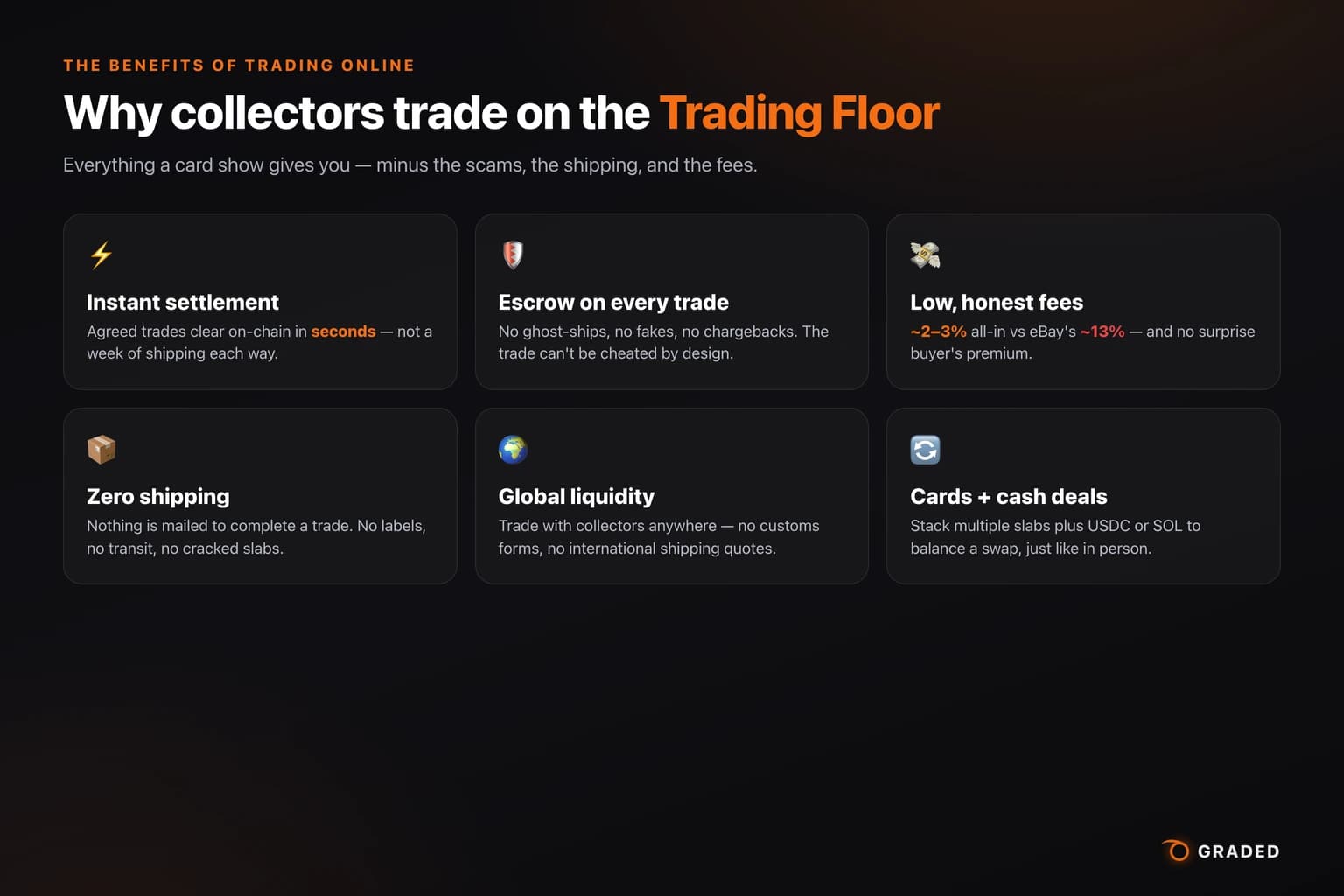
And when does trading online make the most sense? Three moments above all: when you want a specific card more than you want to sell the one you have — a straight swap dodges two sets of fees and two rounds of shipping; when you'd rather upgrade or rebalance your collection than cash out and re-buy; and any time the friction of shipping, fees, and waiting is the only thing that's been stopping you from moving a card at all. The lower the friction, the more freely your collection can actually work for you.
Where the Middleman Model Breaks: A Close Look at Veriswap
Veriswap deserves credit. It took the scariest part of trading — sending a valuable card to a stranger — and made it safe by standing in the middle. You enter cert numbers from PSA, BGS, SGC, CGC, or CSG, propose a trade (cash can be added to either side to balance it), and both parties ship to the Veriswap hub. The team verifies both packages are authentic and match the deal, then forwards them on. For high-value swaps between two people who don't know each other, that's genuinely valuable.
But look at what the model requires, and the cracks show:
- Everything still ships — twice. Both cards physically travel to a hub and then back out again. That's two shipping legs, two insurance costs, and days of transit before a trade you both already agreed to actually completes. The card you wanted is "yours" the moment you agree and not in your hands for a week.
- The fees climbed. The transaction fee started around 1.5% and has reportedly risen to as high as 4% — and that's before the mandatory shipping costs on top. On a high-value trade, that adds up to real money for what is, fundamentally, a swap you arranged yourselves.
- It's trades only. Veriswap is a platform for swaps, not cash sales. If what you actually want is to sell, or to do a part-card-part-cash deal that leans heavily toward cash, the model fights you.
- You're still moving fragile physical objects. Every leg is a chance for a slab to get cracked, lost, or held up. The middleman removes the counterparty risk but not the logistics risk — and not the wait.
The honest read: Veriswap solved trust by adding a referee. But the referee can only do their job by making both cards take a round trip through a warehouse. It's safe and slow and not-cheap — the best version of a model that's fundamentally limited by the fact that physical cards have to move. The question worth asking is: what if they didn't have to move at all?
Where the Single-Platform Model Breaks: The Walled Garden
Tokenized platforms answer that exact question. Put the real card in an insured vault, represent it with a token, and a trade settles in seconds with nothing shipped. Collector Crypt does this on Solana with PWCC vaulting; Courtyard does it on Polygon with Brink's; Phygitals runs a similar model on Solana. Between them they've done hundreds of millions in volume, and the experience is genuinely great — inside the walls.
That's the problem. Each one is its own island:
- You only see one catalog. The card you want might be cheaper on Courtyard while you're shopping Collector Crypt — and you'd never know, because the two don't share inventory or prices. You're price-discovering inside a single store and calling it the market.
- You're locked to one chain and one vault. Commit to a platform and you commit to its blockchain (Solana here, Polygon there), its custodian, and its liquidity. Your collection's fate is tied to one company's ecosystem.
- P2P trading is an afterthought. These platforms are built for buying and selling tokens, not for two collectors negotiating a multi-card-plus-cash swap the way the hobby actually trades at a card show.
- Half the market is invisible to the other half. Tokenized cards are real cards with real prices — but they're invisible to eBay and to anyone trading only there. And eBay's ocean of listings is invisible from inside a single tokenized app. Whichever wall you're behind, you're working with half the picture.
Here's the tell that this is the real problem: even the tokenized platforms know it. Phygitals recently broke ranks and started listing its tokenized cards alongside traditional listings inside Fanatics Collect, explicitly so collectors could buy them "without needing a crypto wallet or any blockchain knowledge." That's the right instinct — meet collectors where they are, hide the crypto, show more of the market. The limitation is that it's still one platform reaching into one other platform. The actual answer is to aggregate all of them.
The Fix: Every Market in One Place
This is the idea Graded is built around. Instead of being a ninth island, Graded aggregates the islands. It pulls live listings from eBay, Collector Crypt, Phygitals, and Courtyard into a single order book, so when you look up a card you see what it actually trades for everywhere at once — onchain and offchain, side by side, in plain dollars.
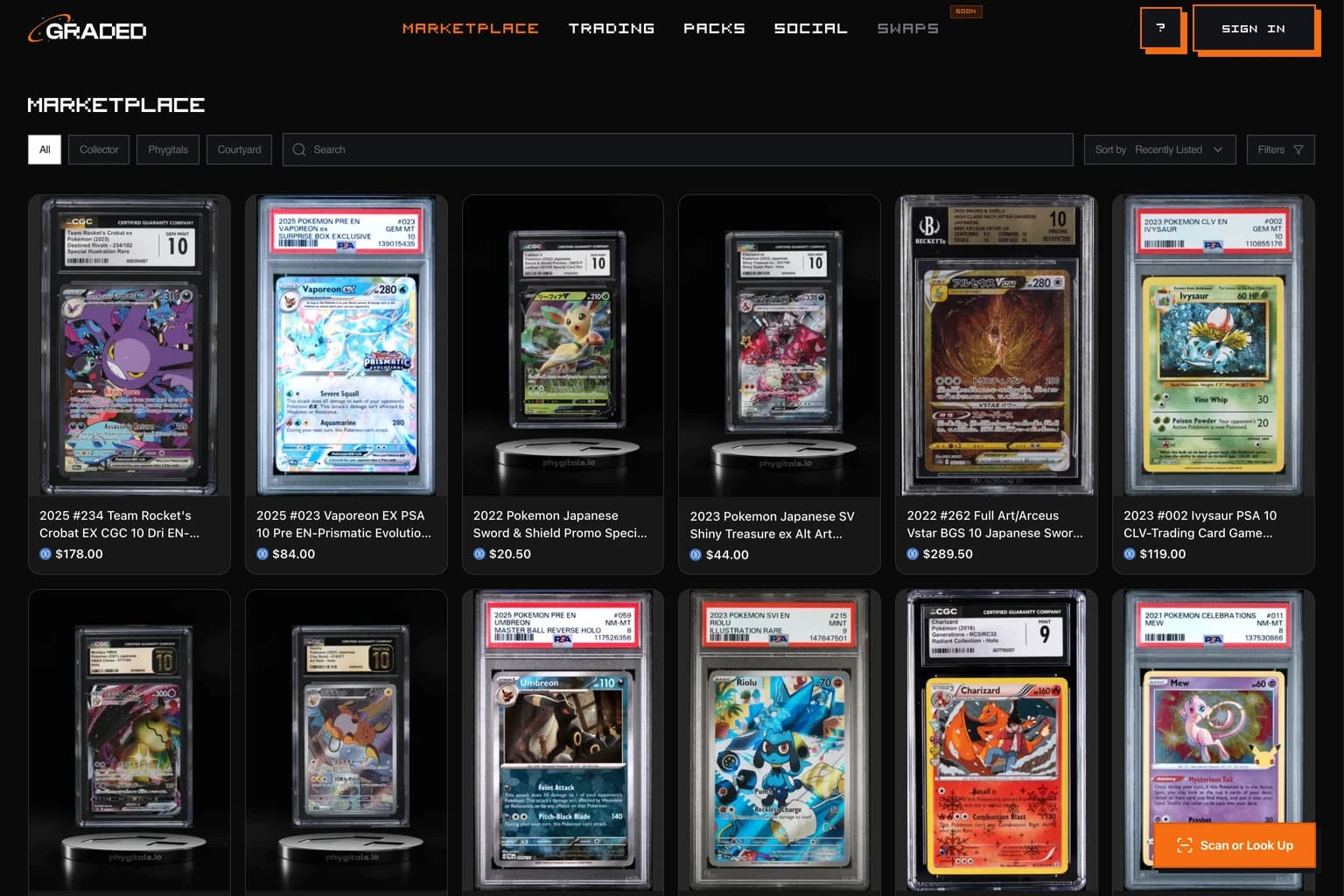
That single change fixes the walled-garden problem for everyone. As a buyer, you stop tab-hopping across eight sites and missing the sharp listing that sold while you were looking elsewhere — the cheapest copy of the card you want surfaces in one search. As a seller or trader, you're no longer forced to pick between the platform with the best fees and the platform with the most buyers, because they're all in the same view. And as a collector, you finally see true price discovery instead of one store's asking price dressed up as the market.
Graded hosts the largest listings of vaulted graded collectibles on any single platform — not by being a bigger walled garden, but by being the place that watches all of them. That aggregation is the foundation. The Trading Floor is what you do on top of it.
Meet the Trading Floor — The Best Place to Trade Cards Online
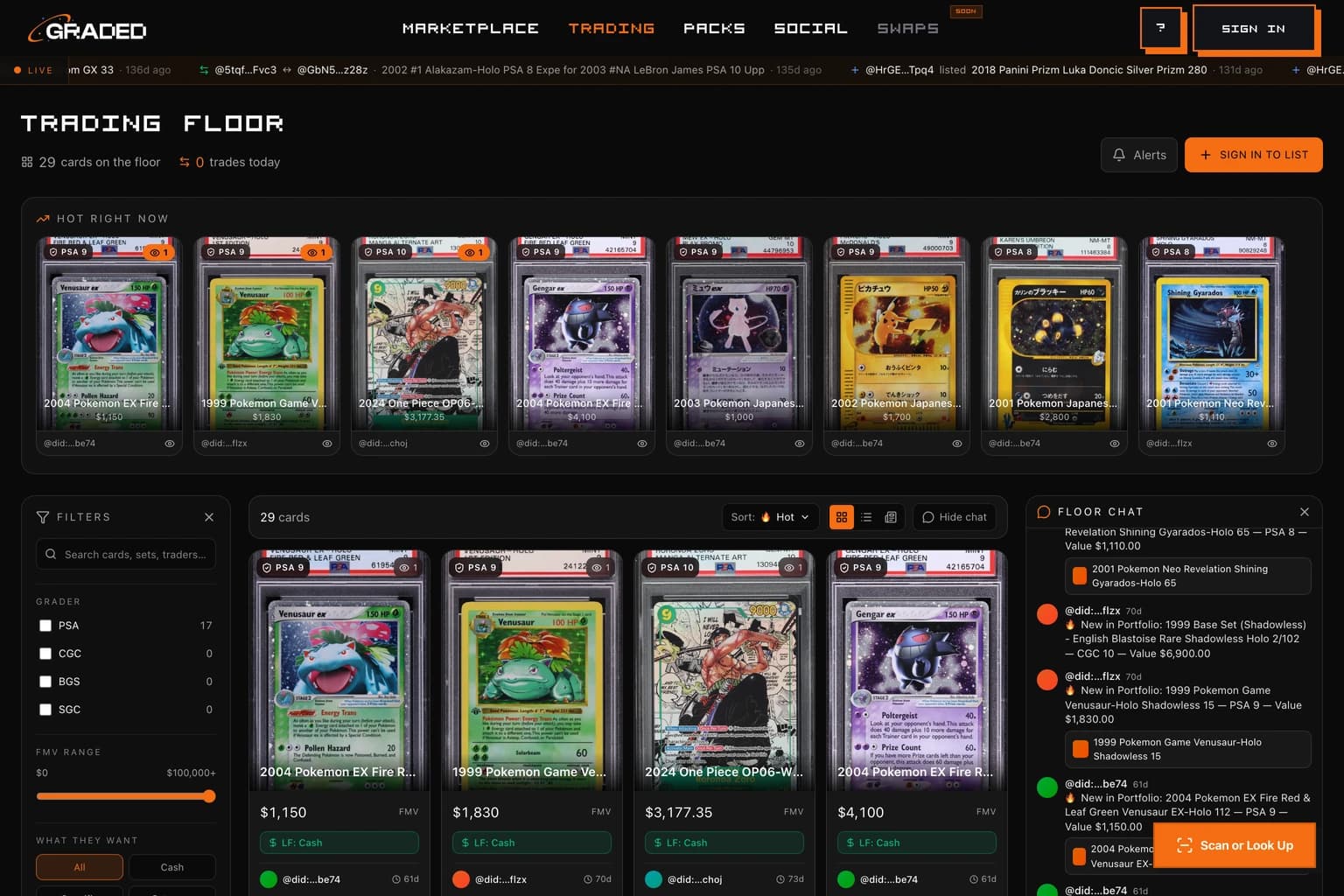
The Trading Floor is Graded's answer to "how do I actually trade a card with another collector, safely, right now?" It's the card-show trading table, rebuilt online: a live room where collectors post the cards they're willing to move, say what they're looking for, and make offers on each other directly — with on-chain escrow built into every trade.
Escrow is the whole magic, so it's worth being concrete about what it does. When two people agree to a trade, each side's cards (and any cash, in USDC or SOL) are locked into a neutral on-chain escrow. Neither party can touch the other's assets, and neither can back out and leave the other hanging. When both sides confirm, the swap executes atomically — everything moves at the exact same instant, or nothing moves at all. That single property quietly kills the entire family of trading scams, and the real slabs sitting in the vault take care of the rest — we break down exactly how just below.
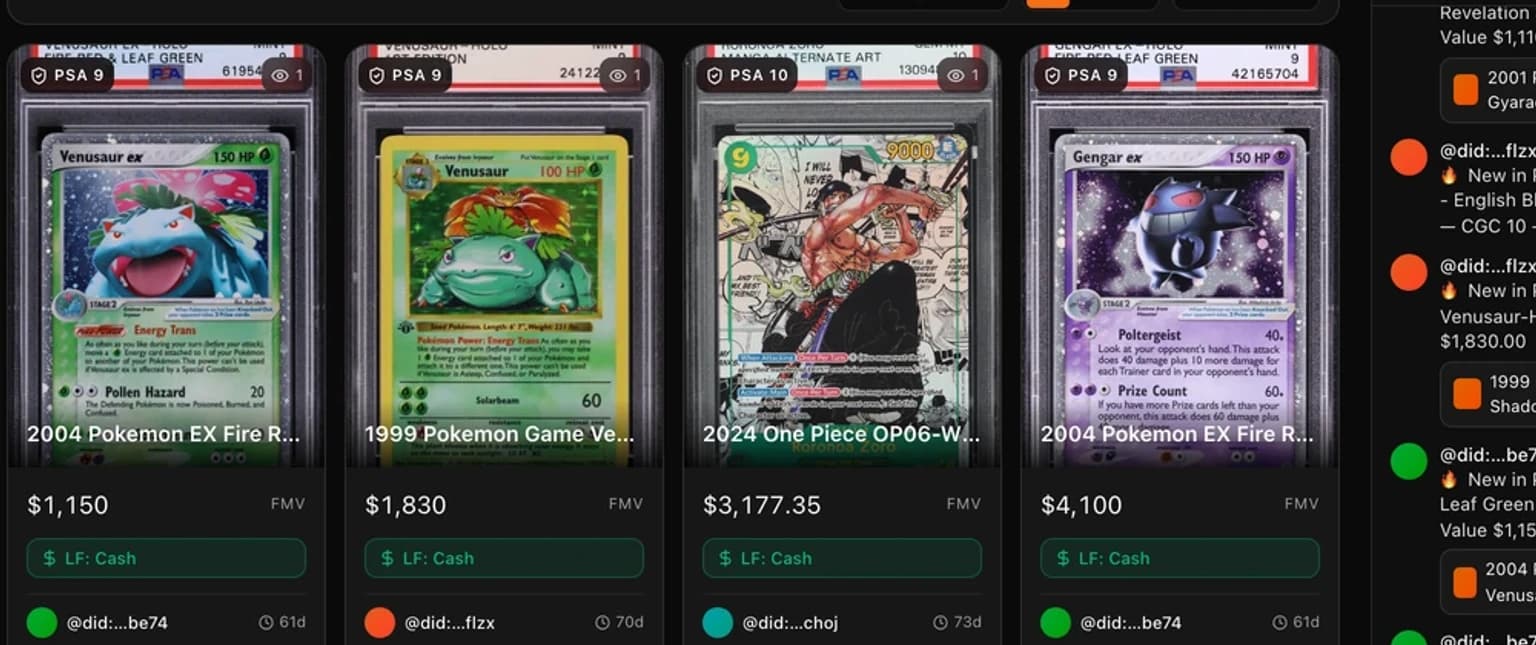
And it trades the way the hobby actually trades. A deal isn't limited to one card for one card — each side can stack multiple cards plus cash (USDC or SOL) to balance the value, exactly like sliding an extra card and a few bills across the table at a show. Filter the floor by grader, by value range, by what people are looking for; watch the live activity ticker of new listings, offers, and completed trades; and negotiate in the floor chat. It feels like a Sunday card show that never closes — except no one can rob you and nothing gets crushed in the mail.
How the Trading Floor Protects You From Scams and Fraud
Online trading has always been nerve-wracking for one reason: the safety was your job. You vetted the stranger, you decided who shipped first, and you ate the loss when it went wrong. The Trading Floor moves that burden off you and into the system — three of the oldest scams in the hobby simply stop being possible.
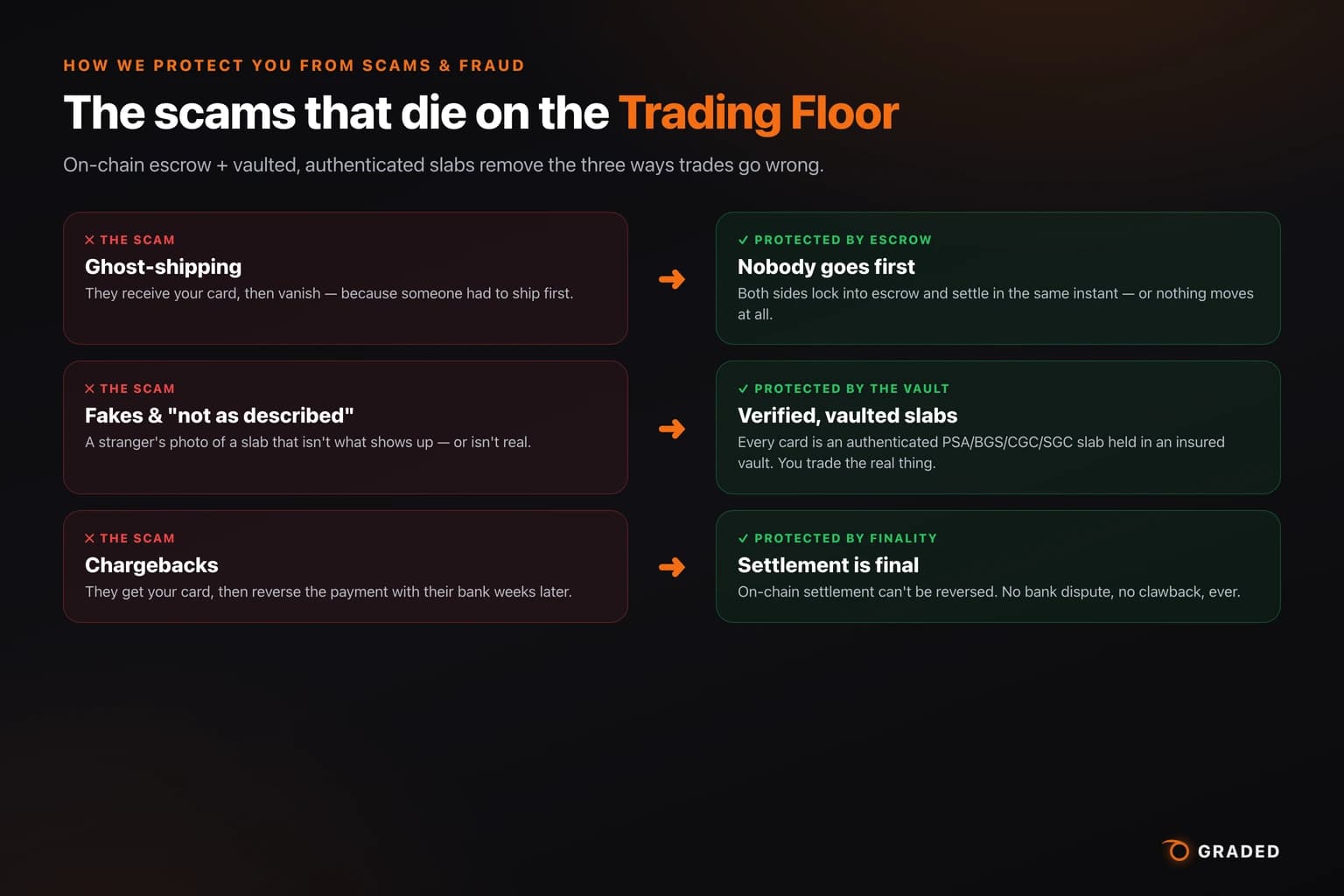
Ghost-shipping dies to escrow. On a forum, someone has to send first — and the scam is simply to take that card and vanish. In escrow there is no "first": both sides' cards and cash lock in and release in the same instant, or not at all. Fakes die to the vault. Every card on the floor is an authenticated, graded slab already held in an insured vault, so you trade a verified PSA/BGS/CGC/SGC card — never a stranger's photo that might not match what ships. Chargebacks die to finality. On-chain settlement can't be reversed, so no one can receive your card and then claw the payment back through their bank weeks later.
It's worth seeing what that replaces. The standard advice for trading online is a checklist of fear: never deal with an account under a month old, demand references, route anything over $100 through a paid middleman, never accept "Friends & Family" payments. That checklist exists because the venue can't protect you, so you have to protect yourself. When the trade settles atomically through escrow and every card is already authenticated and vaulted, most of it just evaporates — the protection is built into how the trade works, not into how well you screened the person across the table.
Why Tokenized Cards Settle Instantly — and Why That Changes Everything
Here's the single fact every advantage on this page traces back to: when you trade on the Trading Floor, the card is a token in a vault, not an object in the mail. The physical slab never moves. So the moment both sides confirm, ownership updates on-chain and the trade is simply done — in seconds. No packing, no label, no insurance, no week of transit, no "arrived cracked" nightmare, no warehouse inspecting a box. This is the part that makes tokenized cards so good, and it's genuinely new: settlement on trades is now instant.
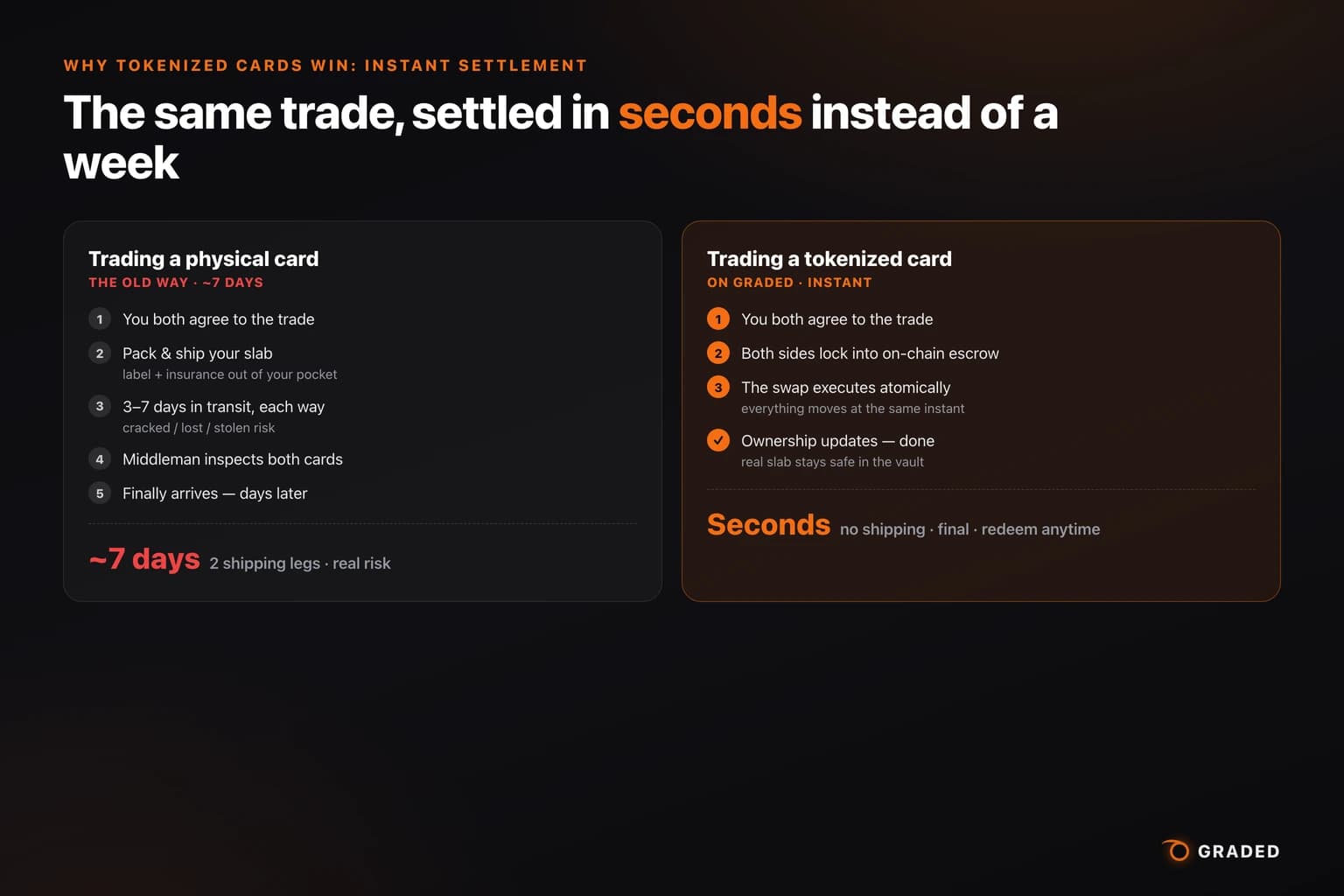
Pull on that one fact and everything else falls out of it. Settlement is instant because ownership is a record that updates, not a box that crosses the country. Fees fall toward 2–3% instead of ~13%, because there is no shipping and no logistics to pay for. The market goes global — a collector in Tokyo is as easy to trade with as one across town, with no customs forms. And settlement is final: no reversed payments, no disputes weeks later.
The piece that makes all of this safe to lean on is redemption. A tokenized card isn't a digital copy or a substitute — it's a deed to a specific real slab held in an insured vault, and you can redeem the physical card and have it shipped to you whenever you want. The blockchain is what turns "the physical is always yours" from a marketing line into an enforceable promise. That's the whole case for tokenized cards: you keep everything good about owning the real thing and bolt on instant, global, low-fee, un-scammable trading on top. Crypto is just the engine that makes it run — and, as the next section shows, you never have to touch it.
You Don't Need to Know What Crypto Is
Here's the part that scares people off tokenized trading, and the part Graded deliberately erased. Every advantage above — instant settlement, on-chain escrow, no chargebacks, a card that's a verifiable deed — comes from blockchain technology running underneath. But you never have to touch it.
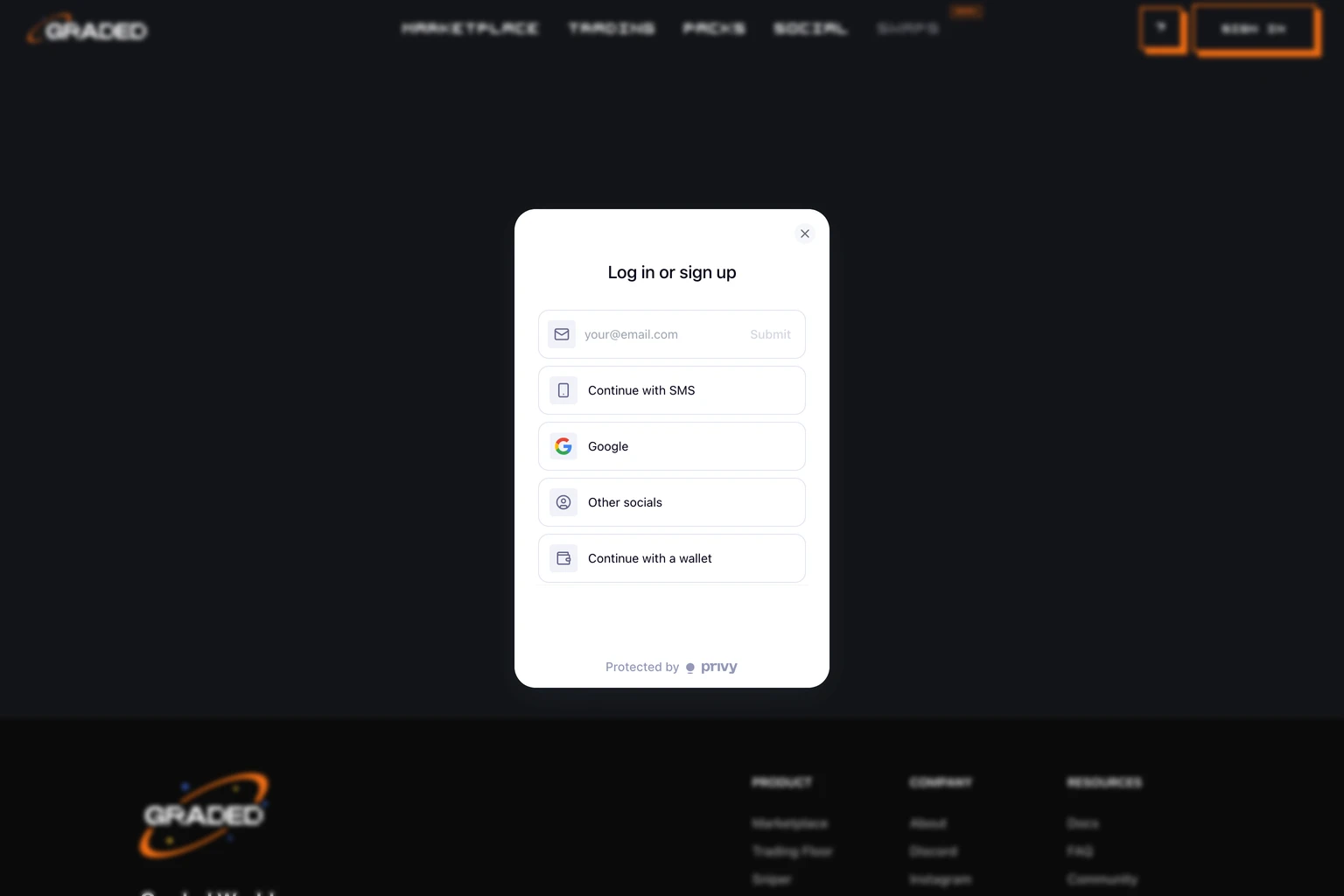
You sign in with your email or Google account, exactly like any normal website. Behind the scenes, a secure wallet is created for you automatically — no seed phrase to write down, no browser extension to install, no twelve secret words to lose. You can fund and trade with everyday dollars (USDC) without ever thinking about "gas" or chains or which network anything is on. The blockchain does its job — proving ownership, escrowing trades, settling instantly — silently, in the background, the way the internet's plumbing does its job every time you send an email.
This is the thing single-purpose crypto platforms get backwards. They treat the blockchain as the product and make you climb a learning curve to use it. Graded treats the blockchain as infrastructure — the reason the experience is better — and treats you, the collector, as the product's whole reason for existing. Crypto isn't the thing you're here for. A safe, instant trade is. Crypto is just what makes that possible. If you never learn a single thing about how it works, you'll still get every benefit.
How to Trade Your Cards and Collectibles Online, Step by Step
Here's the whole flow, start to finish. Most people are trading within a few minutes of signing up, and listing a card you already hold takes seconds.
- Sign in. Go to gradedworld.com and log in with your email or Google account. A secure wallet is created for you automatically — there's nothing to set up and nothing to memorize.
- Bring your cards in. Already own tokenized cards from Collector Crypt, Courtyard, Phygitals, or Graded? They show up ready to trade. Holding physical slabs in person? Send them in to be vaulted and tokenized, or list directly — both paths are covered in the next section.
- List a card in seconds. Use the listing flow: look up the card by its cert number or name, confirm the grade and details we pull automatically, set what you're looking for (cash, a specific card, a category, or open to offers), and publish. Because the card is already graded and verified, there's no photographing six angles and no approval queue — it's live on the floor in seconds.
- Browse the floor or wait for offers. Scan the Trading Floor for cards you want and make an offer, or let collectors come to you. Filter by grader, value, or what people want; watch the live ticker for fresh listings.
- Build the trade. Stack cards and cash on each side until both parties think it's fair — multiple cards plus USDC or SOL to even it out, just like a real-life swap.
- Both sides lock into escrow. Each party confirms, and the assets lock into neutral on-chain escrow. Nobody can ghost, nobody goes first.
- Settle in seconds. When both confirm, the swap executes atomically and ownership updates instantly. No shipping, no waiting, no chargeback window. Done.
- Redeem the physical whenever you want. The token is a deed, not a substitute. Any card you own you can redeem — we ship the real slab from the insured vault to your door.
Bringing Your Cards On: Tokenized or Physical-in-Hand
There are two kinds of collector reading this, and Graded has a path for both.
If your cards are already tokenized
If you hold tokenized cards from Collector Crypt, Courtyard, Phygitals, or Graded itself, you're a step ahead — they're already vaulted and represented on-chain, so they appear in your account ready to list and trade immediately. This is the aggregation advantage in action: cards that lived in separate walled gardens can finally meet on one floor and trade against each other and against everything else.
If your cards are physical and in your hands right now
This is the part people don't realize they can do. You don't need to already be "in crypto" to trade on the Trading Floor — you can bring in the slabs sitting on your desk. You send your graded cards to be stored in a world-class insured vault (Brink's, PSA Vault, or PWCC), and each one is tokenized one-to-one: the real card stays safe in the vault while you get a verifiable on-chain deed you can trade, sell, or borrow against instantly.
From that moment your physical card behaves like any other asset — it settles in seconds, reaches a global pool of collectors with no shipping per trade, and carries fees closer to 2% than eBay's 13%. And it's never a one-way door: redeem any time and the physical slab ships back to you. You're not giving up your card. You're giving it superpowers and keeping the right to take it back. See Vaulted Cards Explained for the full walkthrough of how vaulting and redemption work.
How to upload a card and list it, step by step
Start to finish, here's how a card you own — physical or already tokenized — goes live on the Trading Floor. The whole thing takes about thirty seconds:
- Sign in with email or Google. A secure wallet is created for you automatically — nothing to install, no seed phrase to write down.
- Look it up. Type the cert number or card name, or snap a photo of the label with cert lookup, and Graded auto-fills the grade, population, and full card details for you. No typing out a description, no photographing the slab from six angles.
- Confirm and pick your path. An already-tokenized card is ready instantly; a physical slab gets sent in to be vaulted (Brink's, PSA Vault, or PWCC) and tokenized one-to-one, so the real card is safe while you trade the deed.
- Say what you want. Cash, a specific card, a whole category, or open to offers — this is what other collectors see on your listing.
- Publish. It's live on the floor in seconds and can take trade offers immediately — and you can redeem the physical slab to your door anytime you change your mind.
That's the whole point: the listing itself is the easy part. Because the card is already graded and the details are pulled for you, turning a card — tokenized or freshly vaulted — into a live listing is a matter of seconds, not an afternoon of photography and form-filling.
Everything Graded Does for You, in One Place
Trading is the headline, but the reason the Trading Floor works as well as it does is that it sits on top of a full exchange. Here's everything working for you the moment you sign in — the whole toolkit, not just the trade button:
- One aggregated market. Live listings from eBay, Collector Crypt, Phygitals, and Courtyard in a single marketplace, so you always see the true market price, not one platform's ask.
- Peer-to-peer trading with on-chain escrow. The Trading Floor — direct collector-to-collector swaps, multi-card and cash deals, no middleman, no fakes, no chargebacks.
- Authenticity you don't have to trust. Every card is professionally vaulted and insured by Brink's, PSA Vault, or PWCC. You're never trading a photo — only verified, graded, real slabs.
- Settlement in seconds. On-chain trades clear the instant both sides confirm. No shipping leg, no clearing period, no waiting on a warehouse to inspect a package.
- The physical is always yours. Redeem any card whenever you want and we ship the real slab to your door. The token is a deed, not a replacement.
- List in seconds. Cert lookup auto-fills the grade and details, so a card goes from your collection to live on the floor almost instantly.
- Tokenize the cards you own. Bring physical slabs into the vault and turn them into tradable, borrowable, instantly-settling assets — without giving up the right to redeem them.
- Portfolio tracking with live prices. Watch your whole collection's value move in real time with cross-platform pricing — see how the portfolio tracker works.
- Cert lookup and verification. Check any PSA, BGS, SGC, CGC, or CSG cert for grade, population, and full details before you trade — look up a card here.
- Provably-fair packs. Open packs of real graded cards with verifiable, on-chain randomness — the gacha experience without the "trust us" — explained in the gacha protocol guide.
- Low, honest fees. 2% on purchases and 3% on trades — a fraction of the ~13% you lose on traditional marketplaces, with no surprise buyer's premium and no shipping tax on every deal.
That's the difference between a trading app and an exchange. The Trading Floor isn't a feature bolted onto a marketplace; it's the social heart of a system where authentication, custody, pricing, settlement, and redemption are all already handled for you.
Veriswap vs. a Single Platform vs. the Graded Trading Floor
Same trade, three models. Here's how they stack up on the things that actually decide whether a trade is good.
| What matters | Middleman app (Veriswap) | Single tokenized platform | Graded Trading Floor |
|---|---|---|---|
| How it stays safe | Staff inspect both shipped cards | Vaulted tokens | On-chain escrow + vaulted tokens |
| Does anything ship to trade? | Yes — both cards, both ways | No | No |
| Settlement speed | Days (ship + inspect + ship) | Seconds | Seconds |
| Typical fees | ~4% + shipping both ways | ~2% | 3% on trades, 2% on buys |
| Sees the whole market? | No — its own users only | No — one walled garden | Yes — eBay + CC + Phygitals + Courtyard |
| Cash + multi-card deals | Trades only (cash to balance) | Limited | Yes — stack cards + USDC/SOL |
| Crypto knowledge needed | None | Usually yes (wallet, chain) | None — email/Google login |
| Get the physical back? | You hold it already | Redeem from that vault | Redeem anytime, shipped to you |
The Trading Floor is the only column that wins the whole row. It takes the safety of a middleman without the shipping and the wait, the speed of a tokenized platform without the walled garden, and the easy-onboarding of a normal app without making you learn crypto.
So, Where Should You Trade?
The honest, use-case answer:
- Trading a sub-$50 card with someone you trust: a forum or Discord is fine — just keep to the reference and timestamp rules.
- Swapping physical cards you'll never tokenize, with a stranger: a middleman like Veriswap is safer than going it alone — accept the fees and the wait as the price of that safety.
- Buying or selling inside one tokenized ecosystem you already live in: the single platforms are fast and cheap — just know you're seeing one store, not the market.
- Trading cards online the best way — safely, instantly, against the whole market, with no shipping and no crypto homework: the Graded Trading Floor. It's the only option that wins on safety, speed, selection, fees, and ease all at once.
Trading cards online doesn't have to mean mailing a $2,000 slab into the void and hoping. It can be as simple as signing in, listing a card in seconds, agreeing to a deal, and watching it settle on the spot — with the real card safe in a vault and yours to reclaim whenever you like. Step onto the Trading Floor and make your first trade.
FAQs
What is the best way to trade cards and collectibles online?
The best way is a platform that makes the trade impossible to cheat, settles it instantly, lets you see the whole market, charges low fees, and doesn't require any crypto knowledge. The Graded Trading Floor is built to do all five: you trade graded cards peer-to-peer with on-chain escrow (so no one can ghost-ship you), trades settle in seconds with nothing to mail, and you sign in with just an email — no wallet setup, no seed phrase, no shipping a card across the country and hoping.
How do I trade cards online without getting scammed?
Scams like ghost-shipping and chargebacks only exist when one party has to act first or when payments can be reversed. On-chain escrow removes both: both sides' cards and cash lock into a neutral escrow and release at the same instant, so there is no "first," and settlement is final. On the Graded Trading Floor every card is also an authenticated, vaulted graded slab, so you're never trading against a stranger's photo of a card. For physical, off-platform swaps, use a trusted middleman and never trade with brand-new, reference-less accounts.
Is Graded better than Veriswap?
For most trades, yes — and for a specific reason. Veriswap keeps you safe by having both people ship their physical cards to a hub for inspection, which means two shipping legs, insurance costs, fees that have climbed toward 4%, and days of waiting on a trade you already agreed to. Graded's Trading Floor gets the same safety from on-chain escrow without any of the shipping or the wait — trades settle in seconds, nothing is mailed to complete them, and you can still redeem the physical slab whenever you want. Veriswap is also trades-only; Graded supports trades, sales, and cash-balanced multi-card deals.
Why use Graded instead of a single platform like Collector Crypt or Courtyard?
Single tokenized platforms are fast and cheap, but each is a walled garden — you only see its own inventory and prices, on its own blockchain, with its own vault. Graded aggregates eBay, Collector Crypt, Phygitals, and Courtyard into one market, so you see the true price across all of them and can trade cards that used to be stuck in separate ecosystems against each other. You get the speed and low fees of tokenization plus the full market view none of the individual platforms can give you.
Do I need to know about crypto or own a crypto wallet to trade on Graded?
No. You sign in with your email or Google account, and a secure wallet is created for you automatically — no seed phrase, no browser extension, no prior crypto experience. You can trade and pay with everyday dollars (USDC). The blockchain runs in the background to make trades instant and escrow-protected; you never have to think about it.
Can I trade physical cards I own in person, or only tokenized ones?
Both. If you already hold tokenized cards from Collector Crypt, Courtyard, Phygitals, or Graded, they're ready to trade right away. If you have physical graded slabs in hand, you can send them in to be stored in an insured vault (Brink's, PSA Vault, or PWCC) and tokenized one-to-one — the real card stays safe while you trade an on-chain deed, and you can redeem the physical slab back to your door anytime.
How long does it take to list a card for trade?
Seconds. Because your card is already graded and verified, you look it up by cert number or name, confirm the details Graded auto-fills, set what you're looking for, and publish — it's live on the Trading Floor immediately. There's no photographing the slab from every angle and no approval queue.
What are the fees to trade cards on Graded?
Graded charges 3% on trades and 2% on purchases. There are no shipping costs to complete a trade (nothing is mailed), and no surprise buyer's premiums — so the all-in cost is far below the ~13% you lose on traditional marketplaces, and below a middleman app's fee-plus-double-shipping.
Is it safe — what actually backs the token I'm trading?
Each token is backed one-to-one by a specific physical graded card held in an insured, professional vault (Brink's, PSA Vault, or PWCC), with its grade and provenance recorded on-chain. The ultimate proof the backing is real is redemption: you can claim the physical slab and have it shipped to you whenever you choose. The token is a deed to a real card, not a substitute for one.