Best Marketplace to Buy and Sell Graded Trading Cards Online
Here's the moment that turns a casual collector into a careful one. You sell a PSA 9 you're proud of for $300, feel great about it — then the money lands and it's $247. eBay took its cut, the shipping label came out of your pocket, and the "$300 sale" quietly became a $247 deposit. Or you win a card at auction for $1,000 and the invoice says $1,220, because nobody told you about the buyer's premium until it was already yours.
That gap — between the number on the screen and the number in your bank account — is the whole game. The best marketplace to buy and sell graded cards isn't the one with the nicest homepage. It's the one that leaves the most money on your side of the table for the specific card you're moving.
This guide is the version we wish someone had handed us when we started: every major marketplace in 2026, what it actually costs on both sides, the fees that hide below the fold, and exactly how to choose. No platform pays us to recommend it. Let's get into it.
Buying and Selling Are Two Different Jobs
The first mistake is treating "where to buy" and "where to sell" as the same question. They reward opposite things, and the platform that's great at one is often mediocre at the other.
When you're buying, you want depth and a fair price — the card actually in stock, and a number that reflects what it really trades for, not what one optimistic seller hopes. When you're selling, you want three things that pull against each other: low fees, a big enough pool of buyers to actually move it, and your money fast and intact. A 2% fee means nothing if the card sits for a month. A huge audience means nothing if it skims 15% off the top.
And the right answer changes with the price tag. A $40 common and a $14,000 trophy card belong on completely different platforms — the venue that's perfect for one will quietly cost you money on the other. Keep both lenses up as we go: which side of the trade you're on, and what the card is worth.
The Fees Nobody Puts on the Homepage
Every platform advertises one number. Your wallet experiences a different one. Before we compare venues, learn the four fees that turn a headline rate into an all-in cost — because this is where the money actually goes.
- The buyer's premium. This is the big one buyers miss. At auction houses, the winning bid is not what you pay. Goldin adds a 22% buyer's premium (minimum $19); Heritage and most traditional houses add around 20%. Win a card at $1,000 and you owe $1,220 before shipping. It's how "low seller fee" auction houses make their money — they charge the other side of the table.
- Payment processing. The platforms with the lowest commissions usually run on Stripe or PayPal, which take their own ~2.9% + $0.30 on top. A "2% marketplace" is really closer to 5% all-in once the processor is paid. Still cheap — just not 2%.
- Cash-out fees. Some platforms pay you in store credit and charge to convert it to real money (COMC takes 10% to cash out). Read how you actually get paid, not just how the sale is priced.
- Shipping and insurance. On physical sales this comes out of your margin. A graded slab is too heavy for a bubble mailer — it needs a small box, doubled bubble wrap, tracked Priority Mail, and insurance over $50 (signature confirmation over ~$250). Call it $6–$12 a card, every card. It looks small until you're moving twenty a month.
Hold those four in your head and the "best marketplace" conversation gets a lot more honest. Now the venues.
eBay — The Liquidity King
eBay is the largest card marketplace on earth, and scale is its whole pitch. Whatever you're hunting is probably listed right now; whatever you're selling, the buyer pool is enormous. For cards listed or sold at $250 or more, its Authenticity Guarantee routes the slab through PSA to verify the case and label before it reaches the buyer — real protection that's closed much of the old trust gap.
The cost of that reach is fees: sellers pay roughly 13–13.25% in final value fees, and that expense is quietly baked into every list price you see as a buyer. Two things worth knowing. First, that Authenticity Guarantee only covers single cards over $250 graded by the Big Four (PSA, SGC, CGC, Beckett) — under $250, or in any other holder, you're on your own, so read the seller's feedback like it matters, because it does. Second, eBay rewards homework: prices for the same card and grade swing wildly, so always pull sold comps before you bid or buy.
The honest read: the default for a reason, and the right call when selection or speed beats squeezing the last few percent. Just never forget you're paying for that audience.
Fanatics Collect — The High-End Auction House
Fanatics Collect (formerly PWCC) invented the weekly card auction and is still the liquidity leader for premium modern and vintage slabs. It runs weekly and premier auctions alongside a fixed-price Buy Now marketplace and a vault, so high-dollar cards can change hands without shipping every time.
The seller economics are genuinely good at the top end. Auctions charge no seller fee — you keep the full hammer price plus a seller's bonus starting at 2% on anything that sells for $50+. On Buy Now, list under 120% of Card Ladder market value and you pay a 6% seller fee; price aggressively above market and it jumps to 12%. As a buyer, remember the auction side adds a buyer's premium, so factor that into your max bid.
The honest read: the place to send a genuinely nice card into a room of people who will fight over it — and a strong Buy Now option if you price fairly.
Goldin — Trophy Cards and Records
Goldin is where the records get set — the marquee house for the very top of the hobby. Its realized prices double as the reference comps for grail-tier cards. Seller terms are negotiated by consignment and tend to be friendly on high-value pieces; the number to internalize is the 22% buyer's premium (minimum $19). If you're bidding, that's real money on top of your bid. If you're selling, it's the engine that pulls competitive bidders into the room.
The honest read: for four-, five-, and six-figure cards, a live Goldin auction extracts the maximum. Overkill — and slow — for a $200 slab.
MySlabs — Lowest Fees, Slab-Only
MySlabs is built only for graded cards, and it owns the lowest-fee lane in the hobby: 2% to the seller, 1% to the buyer on slabs (raw is 3%). Because everything listed is a slab, fraud risk is low and the people who show up usually know exactly what they want.
The fine print: payments run through Stripe and PayPal, so the processor's ~2.9% + $0.30 stacks on top of that 2% — your real take is closer to 95% of the sale, still far ahead of eBay's ~86%. The real trade-off is reach. Traffic is a fraction of eBay's, so liquidity is thinner; it rewards sellers who already have a following or a slab that's in genuine demand. List a generic card here and it may just sit.
The honest read: the margin play. Best when you have buyers or a card people are actively looking for — not a place to dump volume and hope.
Whatnot — Live Selling as Entertainment
Whatnot turned selling into a show. Hosts run live streams where buyers bid in real time, and graded cards and sealed product ride that energy to prices a static listing wouldn't reach. Fees are among the lowest of the majors: an 8% commission plus processing (~2.9% + $0.30), landing most sellers around 9.5% all-in, with prepaid shipping built in.
The catch is that the platform isn't the product — you are. Selling well means building a following and performing, week after week. It's a real channel and a real time commitment, and new graded-card sellers face tighter approval than they used to.
The honest read: phenomenal if you enjoy being on camera and want to build something. Not a passive listing tool.
COMC — Set-and-Forget Consignment
COMC (Check Out My Cards) is a consignment store. You ship cards in, they scan, identify, and list them, and the cards sit in a searchable storefront until they sell. It's the tool for offloading a pile without photographing and listing each one yourself.
Just go in clear-eyed about the stacked fees: a per-card processing fee to intake and list, a 5% transaction fee when it sells, and a 10% cash-out fee if you want real money instead of spending your balance as site credit. Standard-service listings also cap at a $100 price. Convenient — but the layers add up, and turnaround can be slow.
The honest read: great for clearing volume of mid-value cards you don't want to babysit. A poor choice for one nice card you'd rather sell well.
Courtyard — Vaulted, with Pack Ripping
Courtyard sells vaulted graded cards: the physical slab stays in an insured facility (custodied by Brink's) while you hold a token representing it, issued on Polygon. It pairs that with popular digital pack ripping and a 90% fair-market instant sell-back, which takes some of the fear out of buying in.
Selling is fast because nothing ships — you sell the token, settlement is near-instant, or you take the instant sell-back. The downside is that it's a walled garden: you can't easily benchmark Courtyard's prices against eBay or other onchain markets without leaving.
The honest read: a polished, no-shipping experience that's a joy if you like pack ripping — just don't price in a vacuum.
Collector Crypt — Tokenized and Onchain
Collector Crypt tokenizes real, vaulted graded cards as tradable assets on Solana, so a slab changes hands instantly without ever moving. It skews heavily toward Pokémon and has pushed past a billion dollars in volume as tokenized cards have caught fire.
The seller math is the headline: roughly a 2% fee (about 1% platform plus 1% royalty) versus eBay's ~13.25%, near-instant settlement, and an instant buyback around 85–90% of market if you want out fast. The barrier is the on-ramp — you need a Solana wallet before you can buy or sell a single card, and if you've never used one, that's a real first step. (Phygitals runs a similar tokenized model worth knowing.)
The honest read: the cheapest, fastest way to move a slab once you're set up. The wallet is the price of admission.
The Marketplaces at a Glance
| Marketplace | Best for | Seller fee | Buyer pays extra | Speed |
|---|---|---|---|---|
| eBay | Selection & reach | ~13–13.25% | — | Ship + clear |
| Fanatics Collect | Premium auctions + Buy Now | 0% auction (+2% bonus) / 6–12% Buy Now | Buyer's premium (auction) | Vault or ship |
| Goldin | Trophy cards | Negotiated | ~22% premium | Auction cycle |
| MySlabs | Low-fee slab P2P | 2% + processing | 1% | Ship + clear |
| Whatnot | Live selling | ~9.5% all-in | — | Ship + clear |
| COMC | Bulk consignment | 5% sale + 10% cash-out + intake | — | Store credit / slow |
| Courtyard | Vaulted + pack ripping | Platform fee | — | Near-instant (token) |
| Collector Crypt | Tokenized, onchain | ~2% | — | Near-instant (token) |
| Graded World | Buy, sell, trade & tokenize — onchain + offchain | Low (tokenized) | — | Instant for tokenized |
The Fee Math, in Real Dollars
Percentages are easy to wave off. Dollars aren't. Here's what the same sale nets you across venues — fees, processing, and shipping included — at three price points.
A $75 card
On eBay (~13% + a ~$5 label) you pocket around $60. On MySlabs, the low fee gets eaten by the flat processing charge and shipping, landing near $64. Tokenized/onchain (~2%, no shipping) nets about $73. At this level, shipping is the silent killer — the flat-cost fees hurt small cards most.
A $1,000 card
eBay (~13% + ~$15 tracked, insured) leaves you around $855. MySlabs (2% + processing + shipping) nets roughly $935. Onchain (~2%, instant, no shipping) is about $980. That's a $125 swing on one card — and the cheap venues are also the fast ones.
A $10,000 card
Now the buy side flips the math. Win it at a Goldin-style auction and you, the buyer, pay about $12,200 after the 22% premium — so a seller weighing "auction vs. fixed price" has to account for the premium scaring off some bidders. At this tier the question isn't just fees; it's which venue's audience will actually pay up. A live auction often wins despite the premium, precisely because competition pushes the hammer higher.
The takeaway: there is no single cheapest venue. The best net outcome is fees × speed × the right audience for that exact card — which is exactly why serious collectors run more than one platform.
How to Actually Buy Well
If buying is the job, here's the short list that keeps you from overpaying:
- Price off sold comps, never active listings. An asking price is a wish. Pull recent sold prices for the exact card, grade, and grader before you commit.
- Add the buyer's premium to your max bid. At auction houses, mentally cap your bid ~18–22% lower so the all-in lands where you actually want it.
- Use Best Offer. On eBay and elsewhere, a polite offer 10–15% under ask works more often than people expect — especially on cards that have been listed a while.
- Mind the $250 line on eBay. Above it you get Authenticity Guarantee on Big-Four slabs; below it you don't, so lean harder on seller reputation.
- Check the onchain price before you buy offchain. The cheaper copy of a popular slab is increasingly on a tokenized marketplace — and most buyers never look.
How to Actually Sell Well
And if selling is the job:
- Match the card to the venue. Trophy card → auction. In-demand slab where you want margin → MySlabs or onchain. Volume → COMC or Whatnot. Don't default everything to eBay out of habit.
- Photograph the real slab. Sharp, well-lit photos of the actual card and label — front and back — beat stock images every time and cut "not as described" disputes.
- Ship it like it's fragile, because it is. Slab sleeve, doubled bubble wrap, small box (not a mailer), tracked Priority Mail, insurance over $50, signature over ~$250. Budget $6–$12 and don't cheap out — a cracked slab in transit is a grading-and-resale headache.
- Know your payout timing. eBay deposits net of fees on a daily or weekly schedule; auction houses pay after the sale settles; tokenized sales clear in seconds. If you need the cash fast, that matters.
- Keep your tax paperwork. For 2026, eBay and similar platforms issue a 1099-K only if you clear both $20,000 and 200 transactions — but the form reports gross (including shipping and tax), and you can offset it with your cost basis. Save your purchase receipts; they're what keep you from being taxed on money you never made.
The Part Everyone Forgets: Shipping, Risk, and Time
Spreadsheet the fees all you want — the hidden tax on physical cards is everything that happens after the sale. You pack it, you pay for the label and insurance, you hope it survives USPS, and you both wait days for it to arrive and clear. Multiply that by every card you move and the friction is the real cost, not the 2% line item.
This is the quiet reason vaulted and tokenized cards keep gaining ground. When the physical slab lives in an insured vault and ownership is a token, a sale settles in seconds, nothing ships, and nothing gets crushed in a mailer. You trade the "hold it in your hand today" feeling for speed, safety, and a fee closer to 2% than 13% — and you can redeem the physical card whenever you actually want it in hand.
The Real Problem: The Market Is Split in Half
Step back and the actual problem isn't any one platform's fees — it's that the market is fragmented, and now split clean down the middle. As a buyer, the cheapest copy of the card you want could be on any of eight platforms on any given day, so you tab-hop across eBay, Courtyard, and Collector Crypt and still miss the sharp listing that sold while you were looking elsewhere. As a seller, the venue with the best fees often isn't the one with the buyers, so you're forced to pick between margin and liquidity.
And there's a deeper divide most people haven't caught up to: an entire half of the market now trades onchain. Tokenized slabs on Collector Crypt, Courtyard, and Phygitals are real cards with real price discovery — invisible to eBay and to the tools built only around it. Shop and sell only offchain and you're working with half the market while believing it's the whole thing.
Graded World: Buy, Sell, Trade, and Tokenize — In One Place
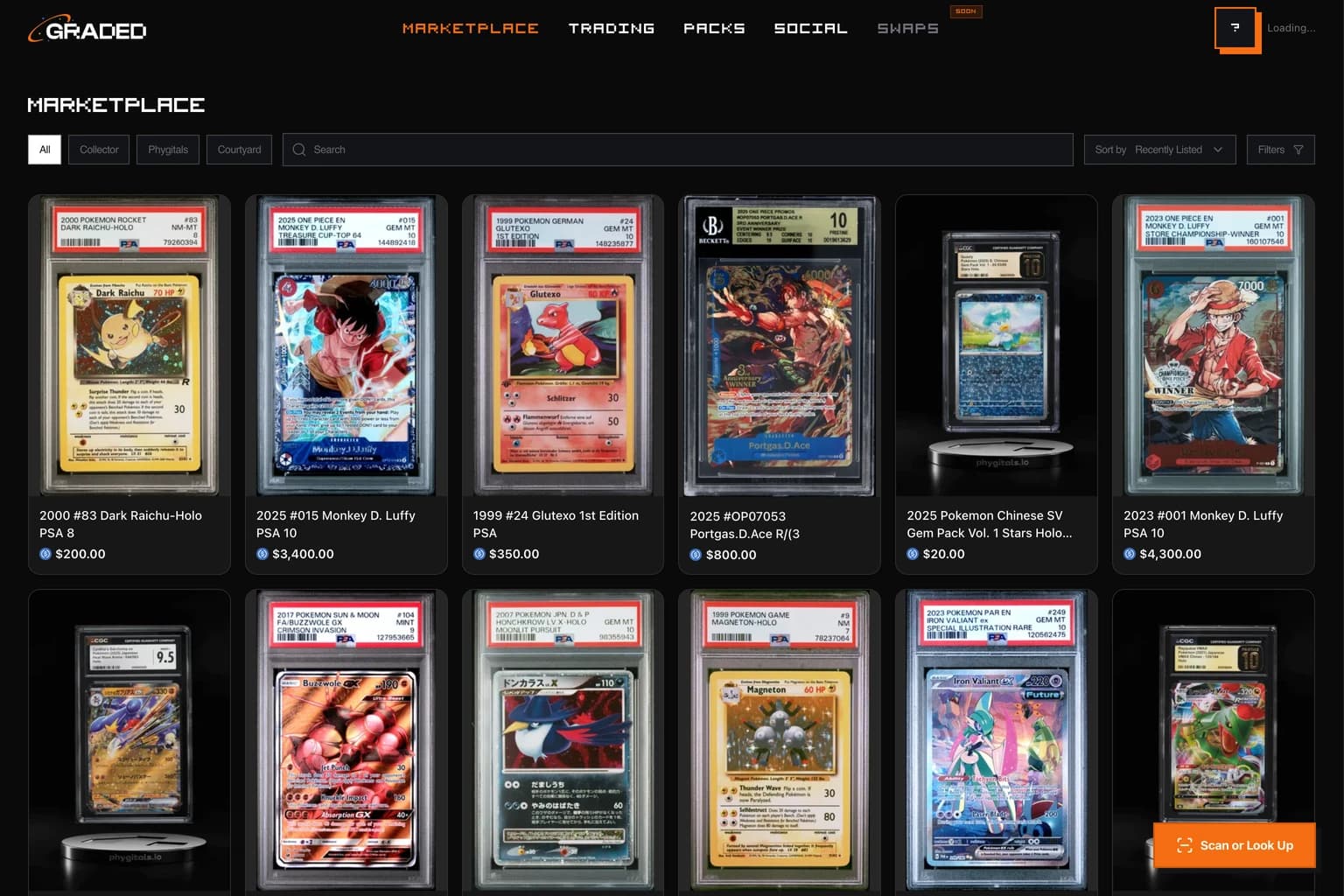
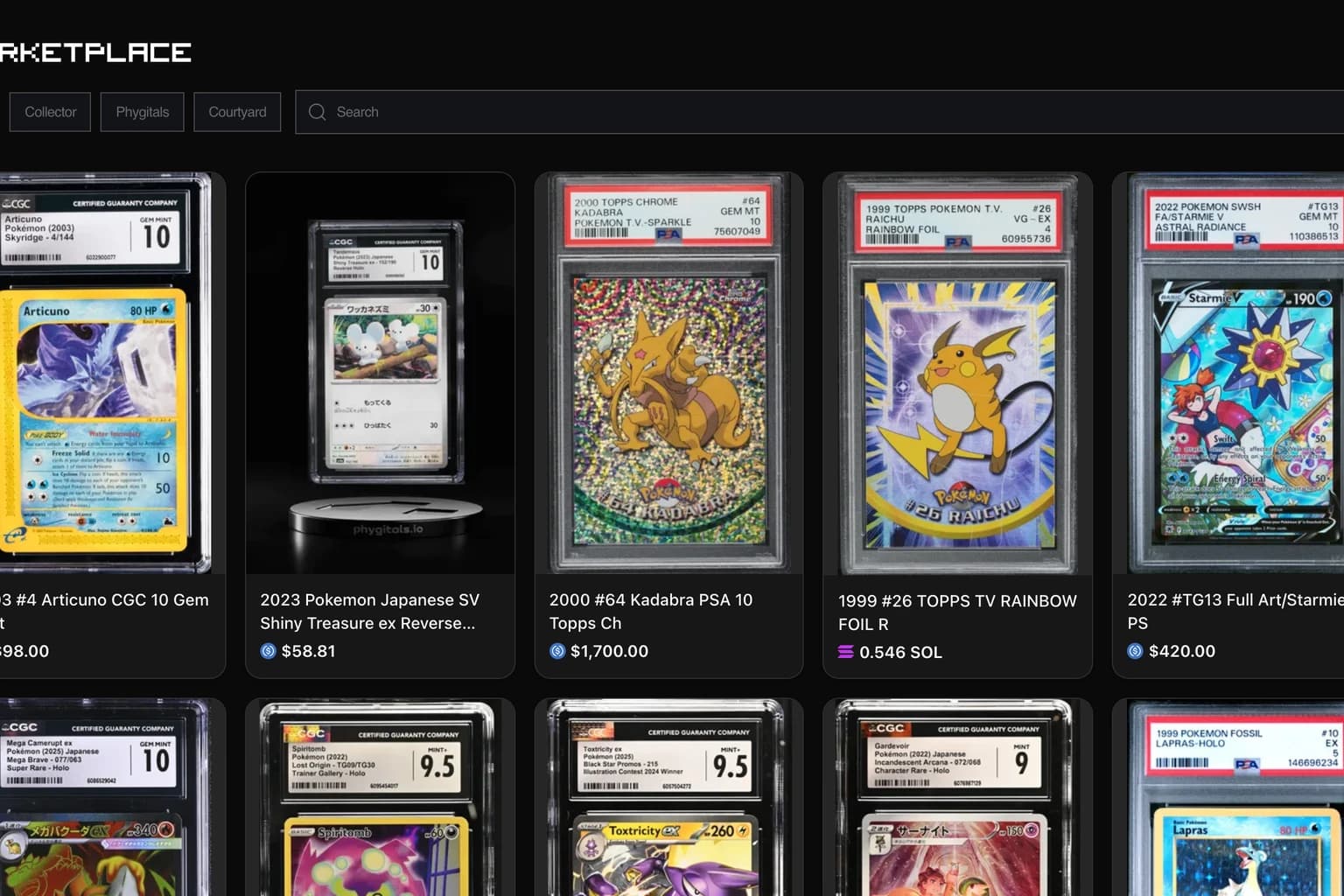
Graded World exists to close that gap. It pulls live listings from eBay, Courtyard, Collector Crypt, and Phygitals into one searchable dashboard, so you can look up any card once and see what it's actually selling for everywhere — onchain and offchain, side by side. It's the one place watching both halves of the market at the same time.
But it's not just a place to look. It's a place to act:
- Buy across every platform at once. One search surfaces the best available price on a slab, wherever it lives. Pay in SOL or USDC, and compare tokenized inventory dollar-for-dollar against traditional eBay listings.
- Sell or trade peer-to-peer. List into the aggregated market, or swap slabs directly with another collector inside the dashboard — no marketplace middleman, no shipping a card across the country and praying. A straight trade also dodges two sets of fees and two rounds of shipping.
- Tokenize a physical card. Turn a graded slab into a tradable token so it settles instantly and globally at a low fee — closer to that 2% lane than eBay's 13% — while the real card stays vaulted and insured. You can even borrow against your collection without selling it.
- Track the whole portfolio. Manage every slab from one dashboard — vaulted, listed, or physically in hand — with cross-platform pricing whenever you research a buy or size up a sale.
Graded World also hosts the largest listings of vaulted graded collectibles on any single platform, so the depth is there whether you're buying, selling, or just watching the market move.
So Which Marketplace Should You Use?
The honest, use-case answer:
- Buying, want max selection: start on eBay — but check the onchain price before you commit, because the cheaper copy is often there.
- Selling a trophy card: a Fanatics Collect or Goldin auction puts it in front of bidders who will compete (just price in the buyer's premium).
- Selling in-demand slabs, protecting margin: MySlabs or tokenized/onchain for the lowest all-in fees.
- Clearing volume: COMC consignment or Whatnot live shows.
- Want speed, low fees, and zero shipping: tokenized inventory settles in seconds.
- Want all of it in one view — and the ability to trade and tokenize: Graded World.
There is no single best marketplace for every card and every trade. There is one place to see them all at once, and to buy, sell, trade, and tokenize from a single dashboard. Start at gradedworld.com.
FAQs
What is the best marketplace to sell graded trading cards online?
It depends on the card. eBay has the most buyers but ~13% fees; MySlabs charges just 2% but has a smaller audience; Fanatics Collect and Goldin auctions are best for premium slabs; and tokenized marketplaces settle instantly at around 2%. Most serious sellers use several. Graded World lets you sell, trade, and tokenize across onchain and offchain markets from one dashboard.
What is the cheapest way to sell graded cards?
On all-in cost, MySlabs (2% + payment processing) and tokenized/onchain marketplaces like Collector Crypt (~2%, no shipping) beat eBay's ~13.25% by a wide margin. But the lowest fee only matters if buyers are there — thin liquidity, or a card sitting unsold, can cost you more than a higher fee on a fast sale. Weigh fee, speed, and audience together.
What is a buyer's premium and which marketplaces charge it?
A buyer's premium is an extra percentage added to your winning bid at auction houses. Goldin charges about 22% (minimum $19) and Heritage around 20%, so a $1,000 winning bid can cost roughly $1,200 before shipping. Fixed-price marketplaces like eBay Buy It Now and MySlabs don't add one. Always factor the premium into your maximum bid.
Do I have to pay taxes when I sell graded cards?
Profit from selling collectibles is generally taxable. For 2026, platforms like eBay issue a 1099-K only if you exceed both $20,000 in gross sales and 200 transactions, but you may owe tax on gains even without a form. The 1099-K reports gross sales (including shipping and tax), so keep your purchase receipts — your cost basis offsets the gross so you're taxed on actual profit, not total sales. This isn't tax advice; check with a professional for your situation.
Where can I buy graded cards with the most selection?
eBay has the largest raw inventory, but the best price on a specific slab can be on Courtyard, Collector Crypt, or Phygitals on any given day. Graded World aggregates listings from all of them into one search so you don't have to check each site individually.
How do I ship a graded card safely when I sell one?
Slide the slab into a sleeve, wrap it in at least two layers of bubble wrap, and place it in a small corrugated box — not a bubble mailer, which is too thin for a heavy slab. Use a tracked service like USPS Priority Mail, add insurance for anything over $50, and require signature confirmation over about $250. Budget $6–$12 per card. Tokenized cards skip all of this, since nothing physically ships.
Are onchain marketplaces safe for buying and selling graded cards?
Reputable tokenized platforms hold the real, physical slab in an insured vault and represent it one-to-one with a token, so the asset is fully backed. The main requirement is a crypto wallet (Solana for Collector Crypt). The upside is instant settlement, fees near 2%, and no shipping risk.
Can I trade graded cards directly with another collector instead of selling?
Yes. Graded World supports peer-to-peer trading, so you can swap slabs directly with another collector inside the dashboard rather than selling one card and buying another — avoiding two sets of marketplace fees and two rounds of shipping.
What does it mean to tokenize a graded card, and why would I?
Tokenizing turns a physical graded slab into a blockchain token backed one-to-one by the real card, which stays vaulted and insured. It lets the card settle instantly and globally at a low fee, sell without shipping, and even be borrowed against. See Vaulted Cards Explained for the full walkthrough.