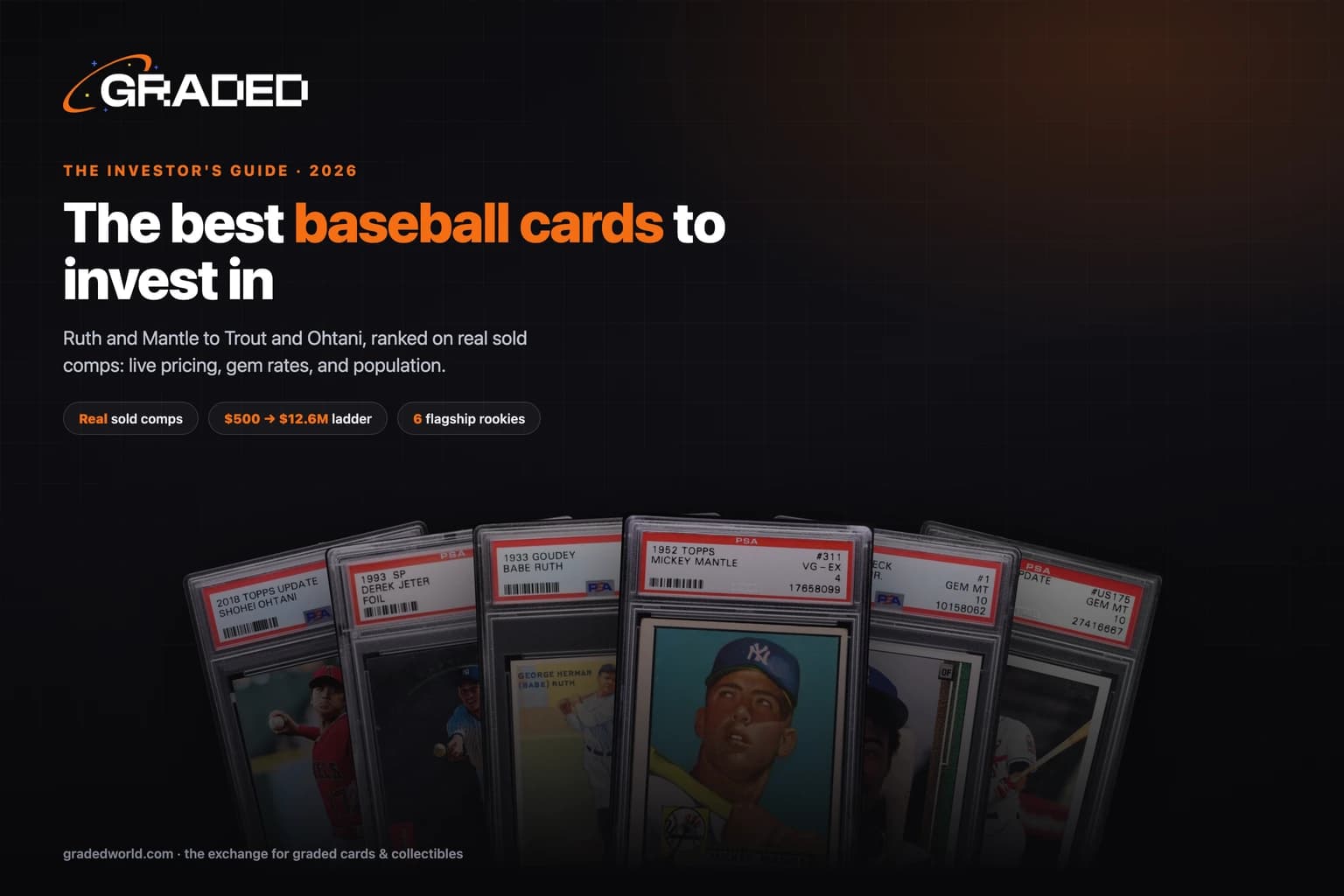
The Best Baseball Cards to Invest In (2026): Ruth and Mantle to Trout and Ohtani, With Real Pricing
On this page
Baseball is where card collecting was invented, and it still holds the crown: the most valuable sports card ever sold is a baseball card, the 1952 Topps Mickey Mantle that brought $12.6 million at auction. A century of printed history gives baseball something no other sport can offer investors: true pre-war scarcity at the top, a deep blue-chip middle, and a modern market with global demand engines like Shohei Ohtani at the bottom of the ladder.
This guide is baseball only, built the same way as our flagship card-investing guide and our basketball edition: on real numbers. Every chart below is drawn from actual sold comps in Graded's pricing engine, not asking prices. We'll cover the framework, the specific cards worth owning from $500 to six figures, live sales charts for each, and how to buy them safely.
Nothing here is financial advice. Cards are a real but volatile asset class, and you should never put in money you can't afford to lose. Here's what the data shows.
- The best baseball cards to invest in are flagship rookies at proven grades: the 1952 Topps Mantle and 1933 Goudey Ruth at the top, the 1993 SP Jeter and 1989 Upper Deck Griffey in the middle, and the Topps Update rookies of Trout and Ohtani as the modern tier.
- Vintage baseball holds value across the whole grade ladder. A PSA 4 Mantle is a six-figure card and a PSA 4 Ruth trades near $22,000, because the supply is fixed at every grade.
- Gem rate is the modern moat. The 1993 SP Jeter gems so rarely (about 0.2%) that the PSA 10 has sold for $324,000 while the PSA 9 trades near $8,100. Condition sensitivity creates the scarcity that print runs no longer do.
- From Griffey onward, refractors, numbered parallels, and Bowman Chrome 1st autos are the investment. The base rookie is the liquid entry ticket; the scarce versions are where modern money concentrates.
- Baseball's demand is going global. Ohtani made the hobby bilingual, and every new international star bids on the same fixed vintage supply.
The Framework: What Makes a Baseball Card an Investment
Every card in this guide passes the same five-part filter we use across the hobby. Buy on these and you're investing; buy on anything else and you're speculating on a hot streak.
- The flagship rookie, not just any rookie. Baseball's reference sets are clear: Topps flagship defined 1952 to 1988, Upper Deck redefined premium in 1989, and Topps Update plus Bowman Chrome define the modern era. The market prices a player off one card. Mantle means 1952 Topps, Griffey means 1989 Upper Deck, Trout means 2011 Topps Update.
- Scarcity you can measure. For vintage, that's the population report on 70-year-old cardboard. For modern, it's the gem rate: the 1993 SP Jeter's foil surface gems about 0.2% of the time, which is why its PSA 10 is a six-figure card while high-pop modern gems trade in the hundreds.
- A settled career narrative. Baseball punishes speculation harder than any sport. Prospects bust at enormous rates and pitchers carry injury risk that position players don't. The legends in this guide are settled facts; price anything unproven as a lottery ticket.
- Durable, multi-generational demand. Ruth and Mantle have outlived everyone who watched them play. That's the demand test: the card has to matter to people born after the career ended.
- Liquidity. The icons in this guide trade weekly. A Trout Update PSA 10 sells any day of the week at a knowable price; an obscure serial-numbered insert might sit for a year. Own what you can exit.
The Baseball Card Ladder
"Best baseball cards to invest in" spans four orders of magnitude, from a $500 Ohtani gem to a seven-figure Mantle. Here's where the marquee cards actually sit, at the grades they really trade in:
Bars use a logarithmic scale so every rung is visible. Vintage is quoted at its liquid collector grades; a PSA 8 Mantle runs seven figures, and the finest known example sold for $12.6M.
Read it as three tiers. The modern gems (Ohtani, Trout, Griffey) are liquid and affordable, with supply capped by gem populations. The middle is the condition-sensitive grail (Jeter SP) and pre-war vintage (Ruth), where scarcity is physical, not printed. The top is the Mantle: the sports card against which every other card on earth is priced. Where you buy is budget and risk tolerance, not which card is "better."
1952 Topps Mickey Mantle #311: The Card Everything Else Is Priced Against
The 1952 Topps Mantle is to sports cards what gold is to metals. It anchors the entire market: the finest known copy sold for $12.6 million in 2022, the record for any sports collectible, and only three PSA 10s exist. A PSA 9 brought $5.2 million. But here's what most articles miss, and what makes it investable rather than just famous: the card holds serious value at every grade. Real sales of PSA 4 copies, from Graded's pricing engine:
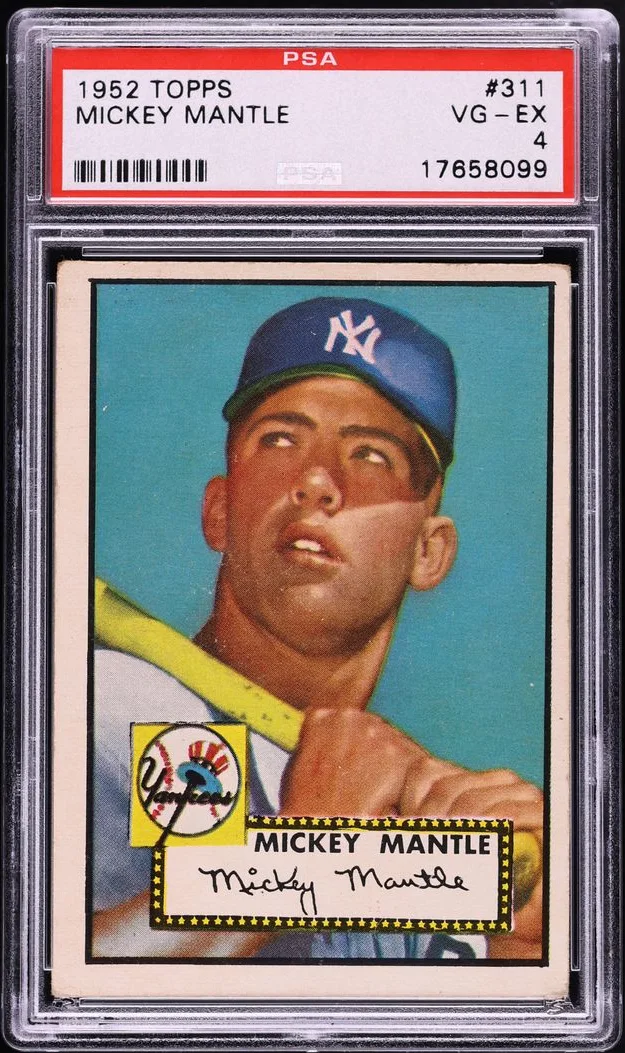
Real sold comps from Graded's pricing engine · 13 sales (eBay & Fanatics).
View live data on Graded →A PSA 4, a visibly worn 74-year-old card, trades around $100,000, and even PSA 1s and 2s bring five figures. That grade ladder is the vintage advantage: the supply is fixed at every rung, so you can own the hobby's ultimate blue-chip at whatever level your budget reaches. The record book tells the long-term story:
From $50,000 for the finest copy in 1991 to $12.6 million in 2022. Not a straight line, and the whole market corrected after the 2021-2022 peak, but the documented trajectory of the hobby's benchmark asset over three decades is the cleanest long-term evidence baseball cards have.
1933 Goudey Babe Ruth #144: The Pre-War Pillar
The oldest asset in this guide is also the most culturally permanent. The 1933 Goudey Babe Ruth (four Ruths exist in the set; #144 is the most traded) is a true pre-war card of the most famous athlete in American history. Ninety-three years of attrition means survivors in any grade are genuinely scarce, and demand has outlived every generation that watched him play. Real PSA 4 sales:
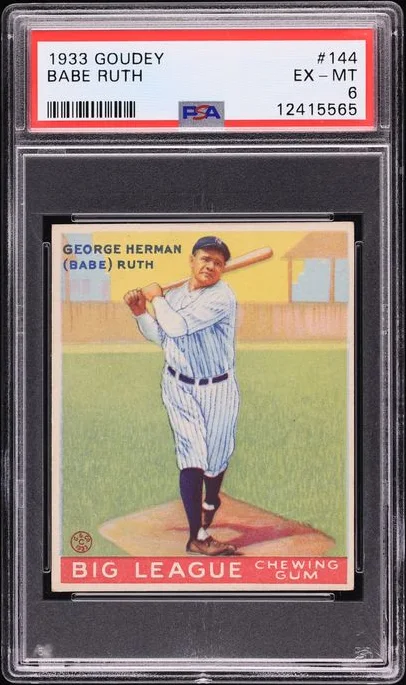
Real sold comps from Graded's pricing engine · 8 sales (eBay & Fanatics).
View live data on Graded →A mid-grade PSA 4 trades around $22,000, low-grade copies run five figures, and high-grade examples are six-figure auction events. The investment logic mirrors the Mantle: fixed pre-war supply, a name that will never need explaining, and value that holds across the entire grade ladder. If the Mantle is baseball's gold, the Ruth is its oldest bond.
1993 SP Foil Derek Jeter #279: The Gem-Rate Grail
Baseball's version of the condition-sensitivity story is the 1993 SP Foil Jeter, and it's the most extreme example in the entire hobby. The SP foil surface scratches if you breathe on it, so out of more than 20,000 graded copies, PSA has awarded roughly 21 gems. That's a gem rate around 0.2%, and it's why the PSA 10 trades like a vintage grail: real sales of $468,000 in 2022 and $324,000 in 2025. The investable grade for most collectors is the PSA 9, and here are its real comps:
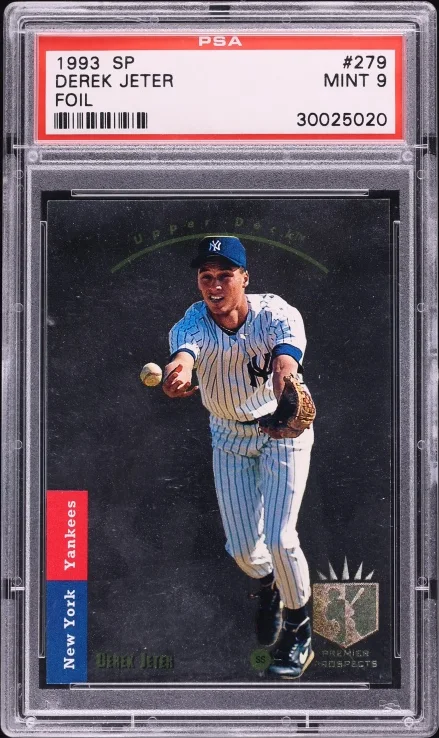
Real sold comps from Graded's pricing engine · 25 sales (eBay & Fanatics).
View live data on Graded →The PSA 9 trades around $8,100 with steady volume: the Yankees' captain, a first-ballot Hall of Famer, and a card whose top grade is mathematically out of reach. That last part is the moat. Modern print runs can't be un-printed, but a 0.2% gem rate is a physical fact that no grading submission wave can dilute. Among 1990s cards, nothing else combines this much demand with this little top-grade supply.
1989 Upper Deck Ken Griffey Jr. #1: The Modern Icon
The most famous modern baseball card is the 1989 Upper Deck Griffey #1: the card that launched Upper Deck, card #1 of its first set, and the face of an entire collecting generation. Real PSA 10 sales:
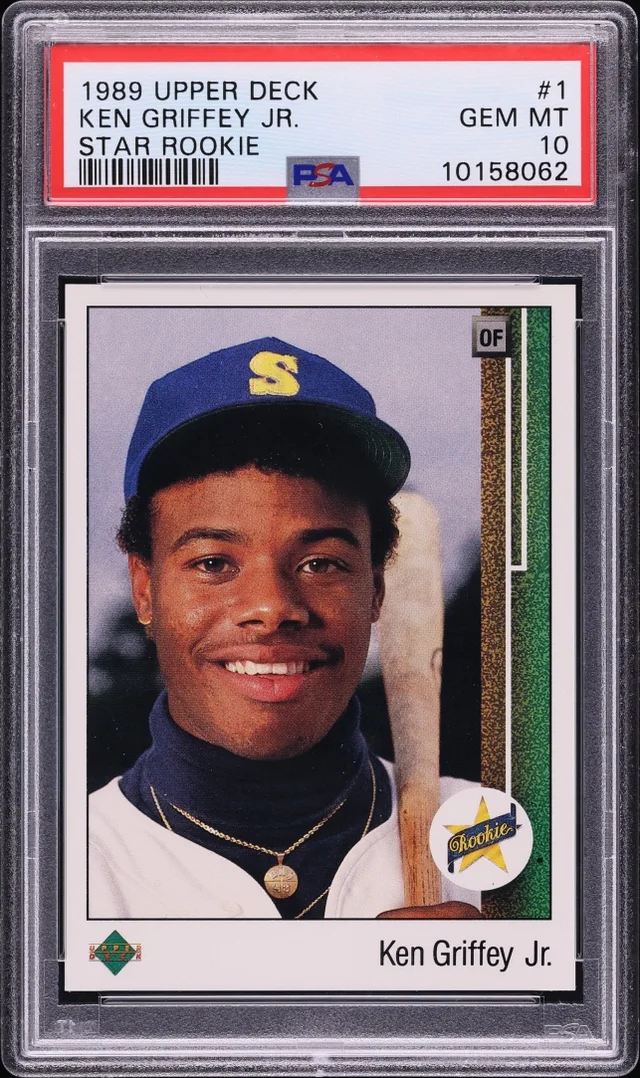
Real sold comps from Graded's pricing engine · 42 sales (eBay & Fanatics).
View live data on Graded →The PSA 10 trades around $5,200 on constant volume. Supply is real (thousands of gems exist), so this is not a scarcity asset; it's the most liquid icon in baseball, the card every lapsed collector rebuys first. Demand has proven itself for 37 years, which is why the gem has kept climbing despite the population. It's the Griffey rule: when a card is iconic enough, demand can outrun even a big supply.
2011 Topps Update Mike Trout #US175: The Modern Blue-Chip
The reference card of modern baseball is the 2011 Topps Update Trout: the flagship rookie of the best player of his generation, with a career narrative that closed itself (three MVPs, eleven All-Star selections). Real PSA 10 sales:
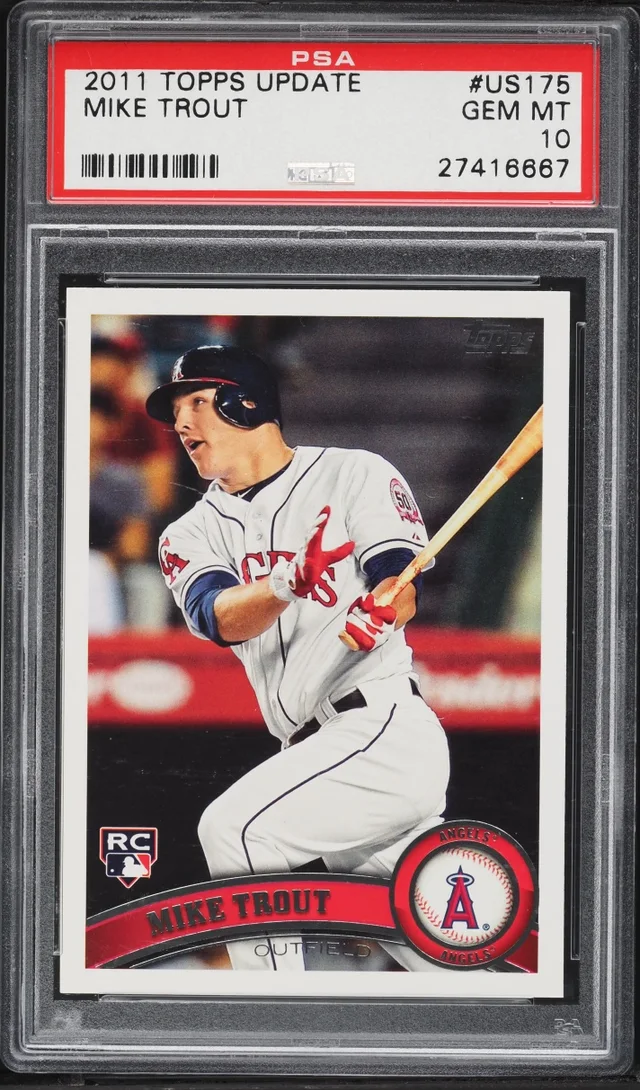
Real sold comps from Graded's pricing engine · 60 sales (eBay & Fanatics).
View live data on Graded →The PSA 10 trades around $1,200 with weekly liquidity. The gem population is large, which caps the base card's ceiling, and that makes Trout the clearest example of the modern playbook: the base gem is the liquid position, and the chase versions carry the upside. His 2011 Topps Update Gold /2011 and the Bowman Chrome Draft autographs from 2009 are where the serious Trout money concentrates; his Bowman Chrome Superfractor auto famously sold for almost $4 million.
2018 Topps Update Shohei Ohtani #US1: The Global Demand Engine
Every era adds one card that expands the market itself. Ohtani's 2018 Topps Update rookie is that card: the two-way unicorn who made baseball collecting a genuinely global hobby, with demand flowing from two continents at once. Real PSA 10 sales:
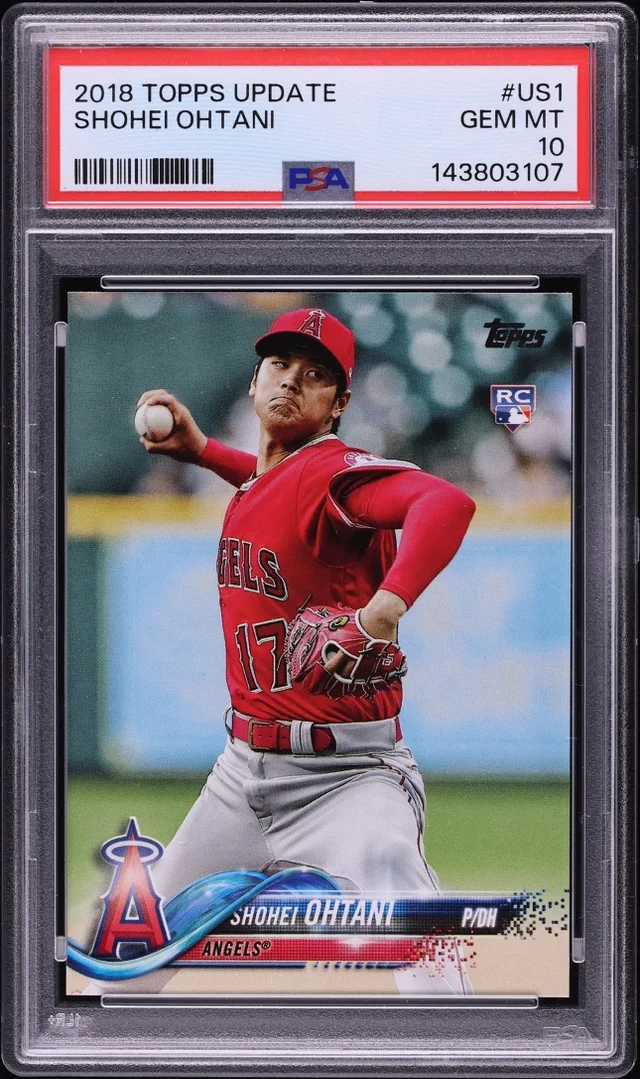
Real sold comps from Graded's pricing engine · 60 sales (eBay & Fanatics).
View live data on Graded →The PSA 10 trades around $500 with deep liquidity. Like the Trout, the base gem is the entry ticket, and the premium versions carry the thesis: his 2018 Topps Chrome Update refractors and on-card rookie autos are the cards that repriced hardest after the 50/50 season and the Dodgers move. The bet is simple: the most famous athlete in the world's second-biggest baseball market is still adding chapters, and his rookie supply is already fixed.
Refractors, Numbered Cards, and Bowman Chrome 1st Autos: Where Modern Money Goes
The same rule we established for basketball holds in baseball, and it matters even more here: from the junk-wax recovery onward, the base rookie is the liquidity and the parallels are the investment. It's the K-shaped economy inside a single player's checklist: base gems sit on the bottom leg, and the scarce versions keep setting records on the top one.
The hierarchy, bottom to top
- Base flagship rookie. Liquid, cheap, supply-capped. The Trout at $1,200 and the Ohtani at $500 are entry tickets and exit doors, not scarcity assets.
- Refractors and numbered parallels. Topps Chrome refractors, Gold /2011-style numbered flagship parallels, and low-numbered colors are where scarcity starts being real. They trade at multiples of the base gem, and the print-run number is public and fixed.
- Bowman Chrome 1st autographs (baseball's unique chase). Baseball is the only sport where the biggest modern card is usually printed before the player debuts: the Bowman Chrome 1st Prospect Autograph. For every star of the last 15 years, the on-card Bowman Chrome auto, and above it the colored refractor autos down to the Superfractor /1, is the trophy piece. Trout's Superfractor auto has traded near $4 million. The flip side: buying them on unproven prospects is the highest-risk bet in the entire hobby, because most prospects never become Trout.
The playbook: hold base gems for liquidity, make refractors and numbered parallels the core position on proven players, and treat Bowman Chrome 1st autos as either a trophy allocation (established stars) or strictly sized venture bets (prospects). Never pay parallel prices without that parallel's own sold comps.
How High Can Baseball Cards Go?
Zoom out and baseball's ceiling argument is the strongest in sports, because it's already been tested at the top: a single baseball card has sold for $12.6 million. The asset class those cards sit in is still tiny next to the markets it now trades like:
Total market value: collectibles as an asset class, next to gold, mega-cap tech, and crypto.
The right column is how many times bigger each one is than the entire collectibles market. Collectibles are already a real asset class, larger than a top-ten crypto like Dogecoin, yet still a fraction of a single mega-cap stock and barely a rounding error next to gold. That gap is the runway: as collectibles mature into a transparently priced, investable asset class, the best cards have room to re-rate that the giants no longer do.Figures approximate, 2026: gold = all above-ground gold; equities = market cap; crypto = network value; collectibles = estimated global market size. Bars use a log scale for visibility.
And the returns case is on the board. Indexed from 2010, blue-chip cards have out-compounded the S&P 500, with vintage baseball icons like the Mantle among the assets doing the pulling:
Baseball's specific edge is the two ends of its ladder. At the top, pre-war and 1950s vintage is the closest thing the hobby has to fine art: fixed supply, institutional buyers, and museum-grade trophy assets. At the bottom, Ohtani's generation is pulling in collectors from Japan, Korea, and Latin America who bid on the same fixed supply. Demand grows at both ends; the cardboard doesn't.
Matching Baseball Cards to Your Risk Tolerance
The tiers are not interchangeable. They sit in very different places on the risk map:
A sane baseball portfolio anchors in the settled legends (Mantle, Ruth, Jeter, Griffey at the best grades you can afford), holds proven-but-active stars (Trout, Ohtani) as the middle, and treats prospects, especially pitchers, as the small sleeve where you can afford a zero. Baseball's prospect bust rate is the highest in sports; invert the pyramid at your peril.
Why Every Card Here Is Graded
Every card in this guide is quoted at a PSA grade because, for investing, the grade is the asset. The same Jeter is a $100 card raw, $8,100 in a PSA 9, and $324,000 in a PSA 10. Grading authenticates, certifies condition, makes copies fungible at the same grade, and produces the population data this whole analysis runs on. For vintage it also settles the only question that matters on a 74-year-old card: is it real and unaltered. Our flagship guide covers grading in depth, and our PSA 10 vs. raw breakdown shows the premium card by card.
How to Buy Baseball Cards Safely
- Price off sold comps, never listings. Look up the exact card, set, and grade on Graded's value calculator before you bid.
- On vintage, authentication is everything. The 1952 Mantle is one of the most counterfeited and altered cards on earth: trimmed edges, recolored borders, rebuilt corners. Buy graded, verify the cert number, and be suspicious of any raw vintage "deal."
- Read the pop report before every purchase. Know whether you're buying a pop-21 asset (SP Jeter gem) or a pop-thousands liquid icon (Griffey gem). Both are fine; the price you pay should know the difference.
- Respect the prospect bust rate. Bowman 1st autos on unproven players are venture bets. Size them so a zero doesn't hurt.
- Trade without shipping risk. On Graded's Trading Floor, vaulted cards trade instantly with on-chain escrow, so a six-figure Mantle never rides in a mailer.
Investing in Baseball Cards on Graded
Everything this guide measures, Graded does live. Look up any baseball card's real fair-market value, population, and gem rate with the value calculator, browse authenticated, vaulted slabs across every major tokenization platform in the marketplace, and trade peer-to-peer with instant on-chain settlement on the Trading Floor. No shipping, no scam risk, and you don't need to know anything about crypto to use any of it.
FAQs
What is the best baseball card to invest in?
The 1952 Topps Mickey Mantle is the benchmark: the most valuable sports card ever sold ($12.6 million for the finest known copy), with real value at every grade, down to six figures for a PSA 4. For most budgets, the 1933 Goudey Ruth (~$22,000 in PSA 4), 1993 SP Jeter (~$8,100 in PSA 9), and 1989 Upper Deck Griffey (~$5,200 in PSA 10) are the blue-chip tier, with Trout (~$1,200) and Ohtani (~$500) covering the modern end.
Are baseball cards a good investment?
The blue-chip tier has the longest track record in the hobby: vintage baseball anchors the card indices that have out-compounded the S&P 500 since 2010, and the Mantle record book runs from $50,000 to $12.6 million over three decades. But it's a volatile market, and baseball punishes prospect speculation harder than any sport. The settled legends are the investment tier.
Why is vintage baseball different from modern cards?
Vintage holds value across the whole grade ladder because supply is physically fixed at every grade: a PSA 4 Mantle is a six-figure card. Modern cards concentrate almost all value in the top grade, because supply of lower grades is effectively unlimited. That's why vintage is bought at collector grades and modern is bought in PSA 10, or in scarce parallels where the print run replaces the grade as the moat.
What is a Bowman Chrome 1st auto and why does it matter?
It's baseball's unique chase: an on-card autographed card printed while the player is still a prospect, before his official rookie season. For established stars, the Bowman Chrome 1st auto and its colored refractors up to the Superfractor /1 are the trophy pieces (Trout's sold for nearly $4 million). On unproven prospects, they're the highest-risk bet in the hobby, because most prospects never pan out.