The Best Cards to Invest In (2026): A Data-Backed Guide With Real Pricing
On this page
A trading card is just cardboard until enough people agree it isn't. What turns a card into an investment is the same thing that turns anything into one: provable scarcity, durable demand, and a real market where you can find the price and actually get out. The best cards to invest in aren't the prettiest or the most hyped. They're the ones where the numbers hold up.
This guide is built on those numbers. We run Graded's pricing engine: live fair-market values, population counts, and gem rates pulled from real sold comps across eBay, Fanatics, and onchain markets. So everything below is measured, not vibes. We'll lay out the framework that separates a collectible from an asset, walk through the specific cards worth owning across every major category, show you the live and historical data behind each, and finish with the part most "top cards" lists skip entirely: how to actually invest in them safely.
Nothing here is financial advice. Cards are a real but volatile asset class, and you should never put in money you can't afford to lose. With that said, let's get into what the data actually shows.
- The best cards to invest in are blue-chip, PSA 10 graded slabs where provable scarcity meets durable demand: led by the 1st Edition WOTC Charizard, the 1986 Fleer Jordan and 2000 Bowman Chrome Brady rookies, Blue-Eyes White Dragon LOB 1st Edition, the 2003 Topps Chrome LeBron, and English One Piece manga rares.
- Value = scarcity × demand. Population sets supply, but demand decides price. A low-population card nobody wants is an illiquid trap, not an investment.
- The grade is the asset. The same card in PSA 10 vs. raw can be worth multiples more, which is why every investment-grade card is, by definition, graded and authenticated.
- Cards are a K-shaped market. The top tier keeps setting records while commons stagnate, so buy the best example of the most-wanted card, not just anything "rare."
- Cards have out-returned the S&P 500. Since 2010, blue-chip cards compounded ~15–16% a year versus the index's ~13%, with bigger swings and near-zero correlation.
- The runway is huge. The entire collectibles market (~$500B) is a fraction of a single mega-cap stock. As the category matures, the best cards have room the giants no longer do.
The Framework: What Makes a Card an Investment, Not Just a Collectible
Before a single pick, here's the filter every card below has to pass. Buy on these five and you're investing; buy on anything else and you're gambling on hype.
- Scarcity you can measure (gem rate). Gem rate is the share of graded copies that come back a perfect PSA 10. A low gem rate means the grade is genuinely hard to hit, so the PSA 10 commands a real premium. See our guide to PSA pop reports for why this matters most.
- Low absolute population. A low gem rate is meaningless if 50,000 PSA 10s exist. You want a small total PSA 10 population (ideally in the hundreds, not the tens of thousands) so demand has something to fight over.
- Durable, multi-generational demand. Scarcity without demand is an unsellable card. The safest assets are tied to icons that won't fade: the GOAT of a sport, the card that started a hobby, a character with a 25-year fanbase.
- Liquidity. An investment you can't sell isn't one. Blue-chip cards trade constantly, so there's always a real bid. Thinly-traded cards can strand you.
- Authentication you can trust. The entire value rests on the card being real and the grade being honest. That's why graded, vaulted slabs (not raw cards from a stranger's photo) are the only sane way to invest at these prices.
Population: The Number That Actually Sets the Price
If you learn one concept before buying a card as an investment, make it this one. A card's price isn't set by how famous it is. Plenty of iconic cards are cheap because millions exist. It's set by how many copies survive in the grade you own. That number is the population, and it's the closest thing the hobby has to a share count.
Every graded card has a public population report from PSA showing exactly how many copies exist at each grade. A 1999 1st Edition Charizard has been graded over 5,000 times, but only 124 have ever come back a perfect PSA 10. That scarcity at the top grade, not the card itself, is what makes a PSA 10 worth ~$550,000 while a PSA 8 of the identical card is a small fraction of it. Same picture, same set, same year: a different population, an order-of-magnitude different price.
Why low population compounds
Vintage populations are effectively fixed. No more 1999 Charizards are being printed, and the supply of PSA 10s barely grows: most surviving copies have already been graded, and cracking and regrading rarely nets a new gem. So when a new generation of collectors arrives with fresh money, they're bidding on a supply that can't expand. Fixed supply meeting rising demand is the entire engine of appreciation: it's why the best vintage cards behave like scarce real assets rather than collectibles.
Population is also the risk warning
The flip side matters just as much. A modern card with a growing population is a moving target: every new submission that gems adds supply and can erode the premium. That's the real difference between a Brady rookie (PSA 10 pop ~1,240 and climbing) and a 1st Edition Charizard (pop 124 and effectively frozen). Both are great cards; only one has a supply that can't be diluted. Always read the pop report before you buy. See our guide to PSA pop reports.
Market cap: population × price
Put population and price together and you get a card's market cap, the same metric you'd use for a stock or a token, and the one we show on every card component in this guide. Multiply the PSA 10 population by the PSA 10 value and you can see the total value of every gem-mint copy in existence: the 1st Edition Charizard is a ~$68M market, the 1986 Fleer Jordan nearly $100M, the Blue-Eyes White Dragon under $3M. It's the cleanest way to compare cards to each other, and, as we'll see, to other asset classes entirely.
Demand: Why Scarcity Alone Isn't Enough
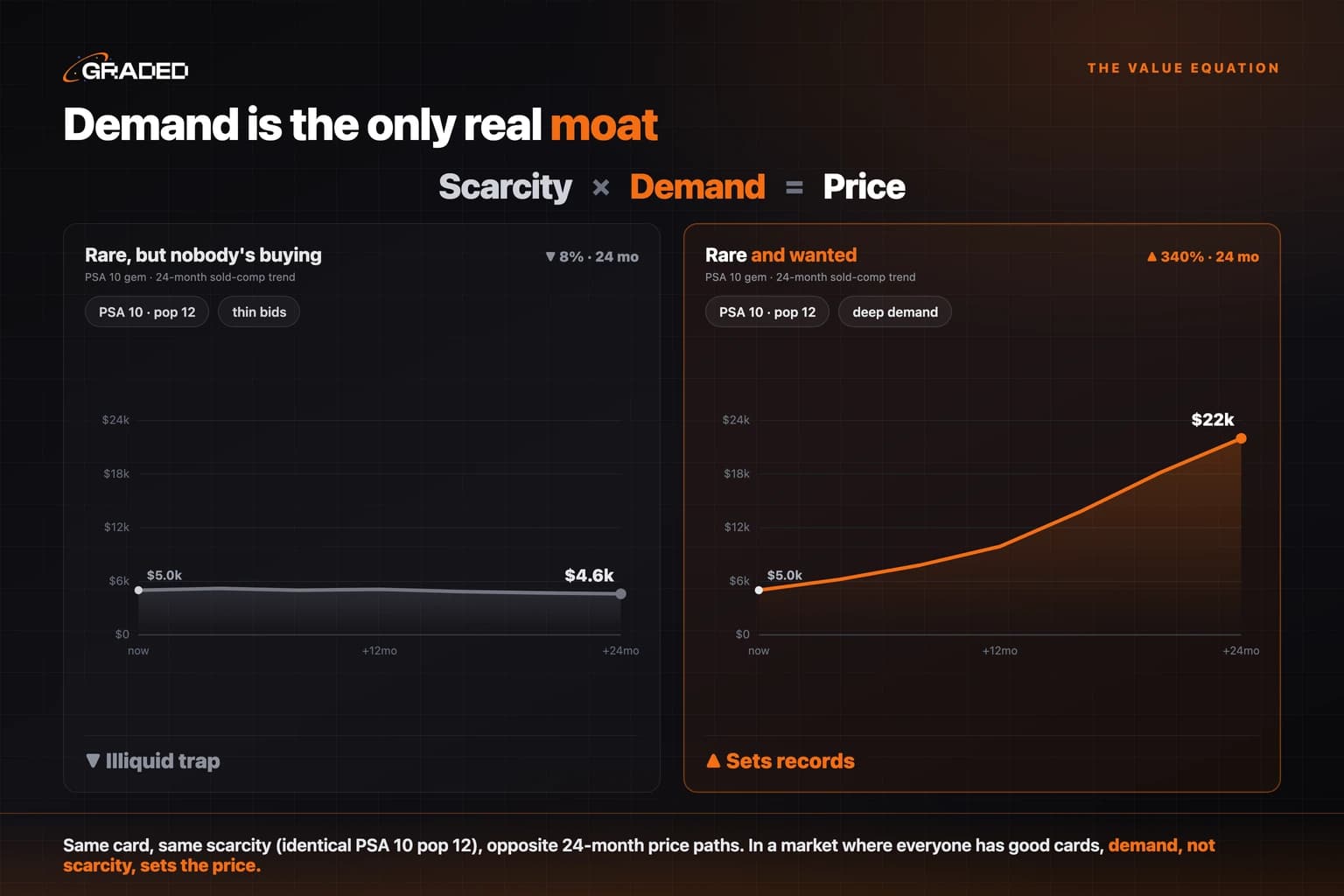
Population is only half the equation, and it's the half people fixate on, because it's a tidy number on a page. The other half, the one that actually decides whether a scarce card is worth anything, is demand. And here's the uncomfortable truth about a hot market: a lot of people own a lot of genuinely great, genuinely scarce cards. The hobby is full of low-population slabs that barely trade, because scarcity with no one on the other side of the table is just an expensive way to own cardboard.
Price is what happens where fixed supply meets real demand. Take the demand away and the rarest card in the world is worth whatever the single interested buyer feels like paying, which is to say, not much, and not reliably. That's the trap countless "rare" cards fall into: pop 12, and a bid to match.
What actually creates durable demand
- Multi-generational relevance. The card has to matter to people who weren't alive when it was printed. Charizard, Jordan, Blue-Eyes, and the GOAT rookies clear that bar; a role player's serial-numbered auto usually doesn't.
- An expanding audience. Demand grows when the fanbase grows: new Pokémon generations, a global One Piece boom, a sport reaching new countries. A shrinking niche is a shrinking bid.
- Iconic status within its world. The single most recognizable card of a set or character concentrates demand. There is one Base Set Charizard; there are a hundred forgettable holos from the same era.
- Liquidity: the demand you can actually feel. A card with real demand has a constant bid: you can sell it this week at a knowable price. That's the practical test: if you can't picture who buys it from you, the demand isn't there.
So the model is simple: scarcity × demand = price, and you need both. Low pop with thin demand is an illiquid trap. Deep demand with a bloated population is expensive but capped: the supply keeps a lid on it. The cards worth real money live in the narrow corner where genuine scarcity meets deep, durable, multi-generational demand. That's not most cards. It's exactly why this guide keeps circling a short list of icons rather than a long list of "rare" ones. In a market where everyone has good cards, demand is the only real moat.
And that demand has room to run, because the whole category is still tiny. Zoom out from any single card to collectibles as an asset class, and you see how early this really is, measured against the markets it's starting to trade like:
Total market value: collectibles as an asset class, next to gold, mega-cap tech, and crypto.
The right column is how many times bigger each one is than the entire collectibles market. Collectibles are already a real asset class, larger than a top-ten crypto like Dogecoin, yet still a fraction of a single mega-cap stock and barely a rounding error next to gold. That gap is the runway: as collectibles mature into a transparently priced, investable asset class, the best cards have room to re-rate that the giants no longer do.Figures approximate, 2026: gold = all above-ground gold; equities = market cap; crypto = network value; collectibles = estimated global market size. Bars use a log scale for visibility.
Cards Are a K-Shaped Economy
Zoom out on the whole hobby and you don't see one market. You see two, moving in opposite directions. That's a K-shaped economy: after every boom, the two legs of the "K" split apart. The top leg (grails, iconic rookies, low-population vintage) keeps setting records. The bottom leg (bulk commons, over-printed modern, mid-grade filler) flattens out or quietly bleeds. Same hobby, opposite trajectories.
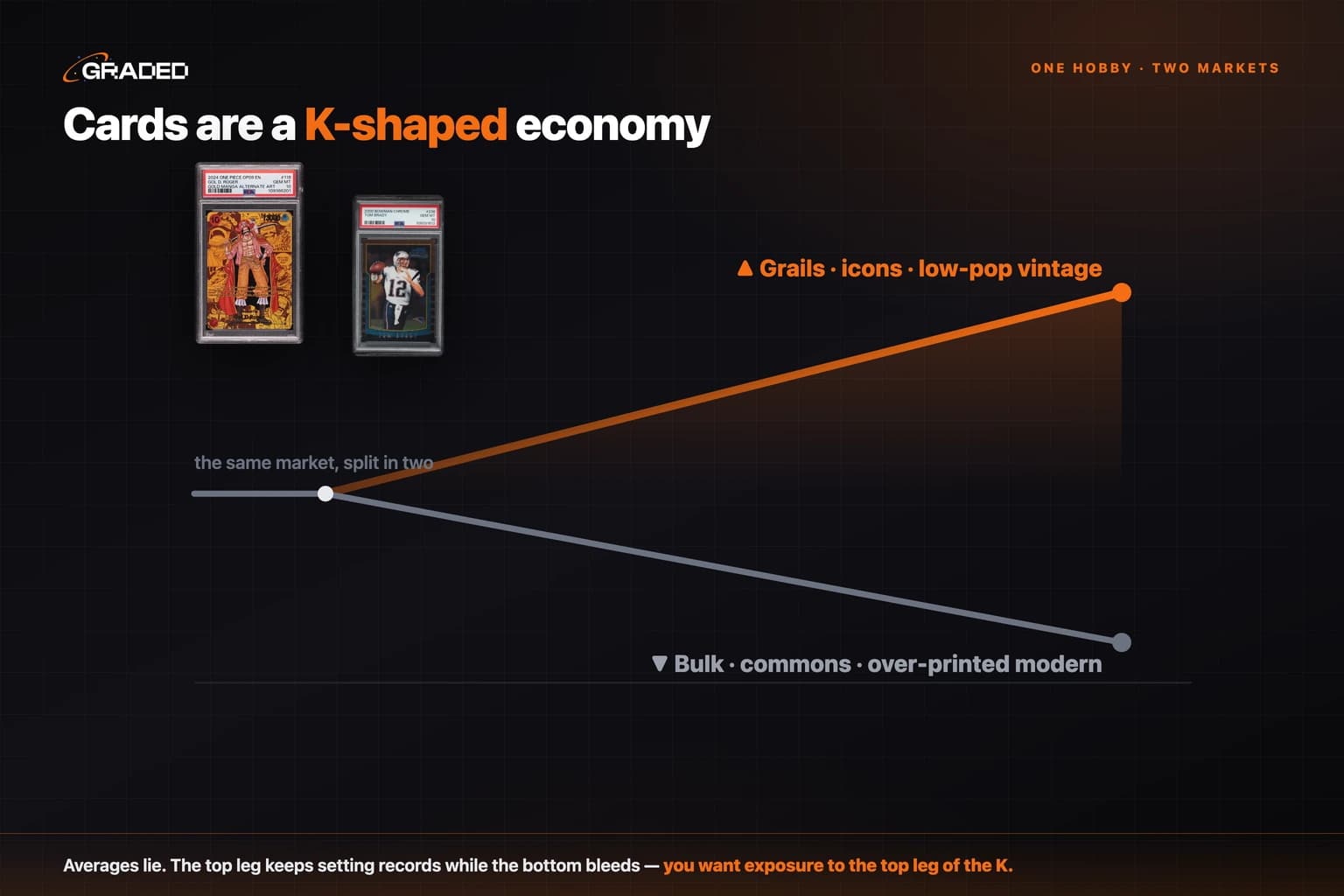
This is why averages lie in this hobby. "The card market is up X%" blends two opposite realities into one meaningless number. A basket of icons and a basket of commons are barely the same asset anymore. New money doesn't spread evenly across cardboard; it concentrates in trophies and liquidity. The two forces from the last sections draw the K directly: fixed supply meeting compounding demand pulls the top leg up, while ever-growing modern print runs and a "grade everything" culture push the bottom leg down.
The investing takeaway is blunt: you don't want exposure to cards. You want exposure to the top leg of the K. Buy the best example of the most-wanted thing (the icon, the flagship rookie, the grail in the grade that matters) and let the bottom leg be someone else's inventory. Every card in this guide was chosen because it sits on the upper stroke.
The Card Investment Ladder
"Best cards to invest in" doesn't mean one price point. It's a ladder, from cards you can own for four figures to grails that trade for the price of a house. Here's where the marquee cards in this guide actually sit, by PSA 10 market value.
Bars use a logarithmic scale so every rung is visible. Each gridline up is roughly a 10× jump in value.
Two things jump out. First, the spread is enormous: a One Piece manga rare and a 1st Edition Charizard are both "blue-chip cards," but one is a $1,000 position and the other is nearly half a million. Second, the rungs map cleanly onto categories: modern TCG at the bottom, modern sports rookies in the middle, vintage TCG and vintage sports up top, and vintage Pokémon at the summit. Where you start on the ladder is a function of budget and risk tolerance, not which card is "better."
Vintage WOTC Pokémon: The Blue-Chip at the Top
If there's a single blue-chip in the entire hobby, it's a 1st Edition card from the WOTC era (Wizards of the Coast, 1999–2003), the original English Pokémon sets. And the king is the 1999 Base Set 1st Edition Charizard #4: the most recognized trading card on earth, with a tiny PSA 10 population and 25 years of unbroken demand.
The long-term chart is the whole argument. A 1st Edition Base Charizard PSA 10 traded for a few hundred dollars in the early 2000s, low five figures through the 2010s, roughly $35,000–$40,000 by 2019, and into the hundreds of thousands today, with a documented sale near $954,800 in February 2026 and recent comps around $462,500. That's the blue-chip pattern: not a straight line, but a relentless one.
The blue-chip of the entire hobby: 124 PSA 10s of 5,325 graded, a ~$68M market cap. Up from a few hundred dollars in the early 2000s to a record $550k.
Market cap = PSA 10 population × fair-market value. Sources: Card Ladder · PSA APR · PriceCharting.
The grail is out of reach for most, and that's fine. The thesis is what matters, and it extends down the WOTC ladder to far more attainable cards. 1st Edition Blastoise and Venusaur, 1st Edition holos from Jungle, Fossil, and Team Rocket, and shadowless Base Set cards all share the same DNA: fixed vintage supply, low PSA 10 populations, and demand that compounds with every new generation of collectors. The rule of thumb: in WOTC, 1st Edition > Shadowless > Unlimited, and the holos lead. If you want one position in the whole hobby that you can hold for a decade, it lives in this set. See our Pokémon PSA 10 price guide for the full breakdown.
Why Rookies (and Only the Best Hit) in Sports
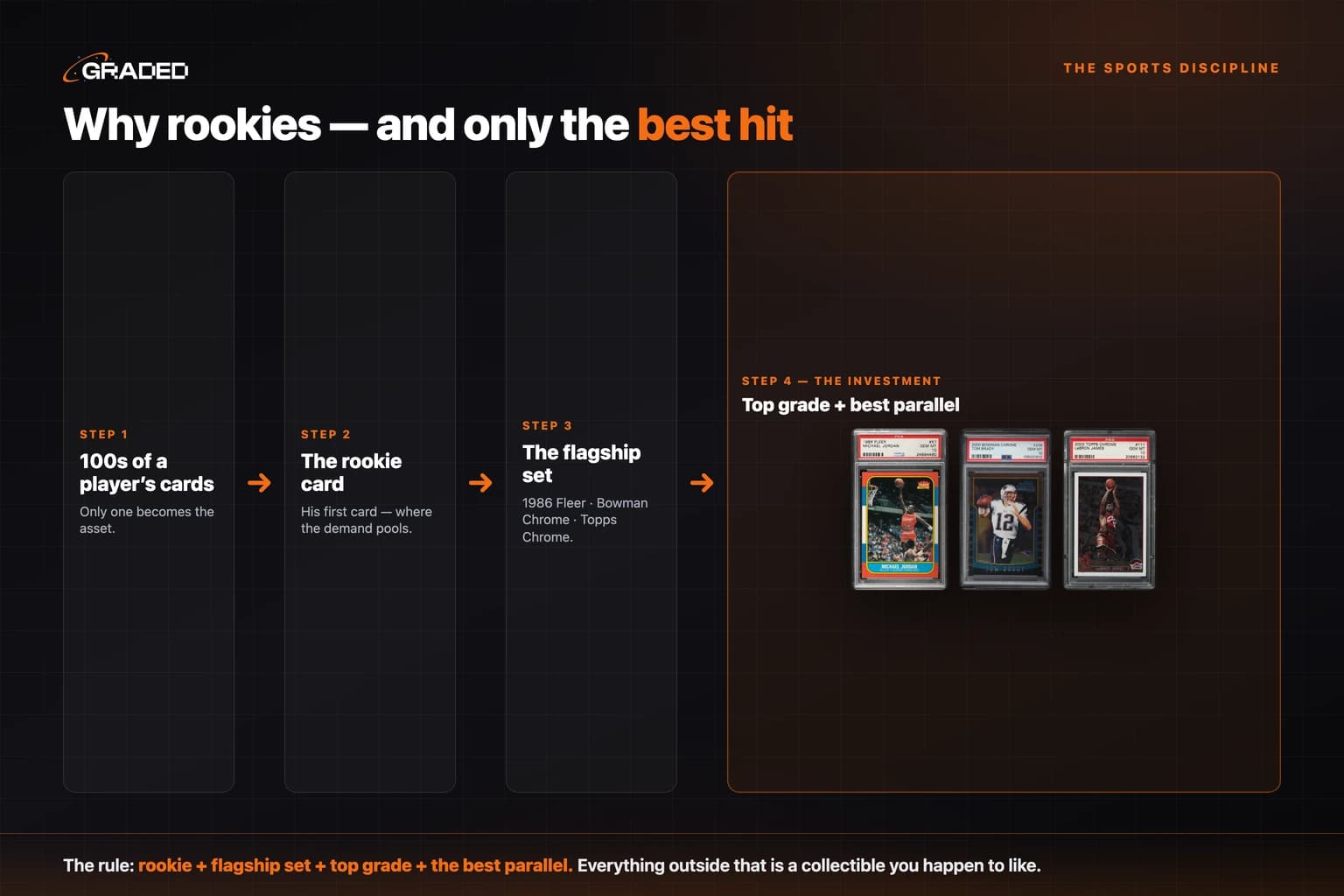
You'll notice every sports card in this guide is a rookie card, and usually the single best version of it. That's not an accident. It's the discipline that separates sports investing from sports collecting.
Rookies carry the demand
A player's rookie card is his origin story (the first officially licensed card of his career) and the market anchors almost all of a player's collectible value to it. Brady has hundreds of cards; the 2000 Bowman Chrome rookie is the one. It's where the nostalgia, the "I was there from the start" premium, and the deepest bid all pool. A gorgeous card of a legend from his third season is, to the market, just another card. Demand collects at the rookie.
The flagship set, not the obscure one
Not all rookies are equal, either. Investors chase the flagship rookie: the one from the set collectors actually care about (Topps Chrome, Bowman Chrome, Prizm), not a random regional or food-issue card from the same year. That's why LeBron means 2003 Topps Chrome and Jordan means 1986 Fleer: those are the reference cards the entire market prices around.
And within the set, the top hit
Here's the part beginners miss: even inside the right rookie set, the base card is common: a GOAT's base rookie can carry a five-figure population. The real scarcity, and the real appreciation, lives in the best hit of the set: the low-numbered parallel, the top refractor, the color /10, the on-card auto. That's where a tiny fixed supply meets the same enormous demand, the exact combination this guide is built on. A base rookie is a fine hold; the chase parallel of that same rookie is the investment.
So the rule of thumb for sports is simple: rookie card + flagship set + top grade, and where you can afford it, the best parallel of that rookie. Everything outside that is a collectible you happen to like, which is completely fine, just don't confuse it with an asset.
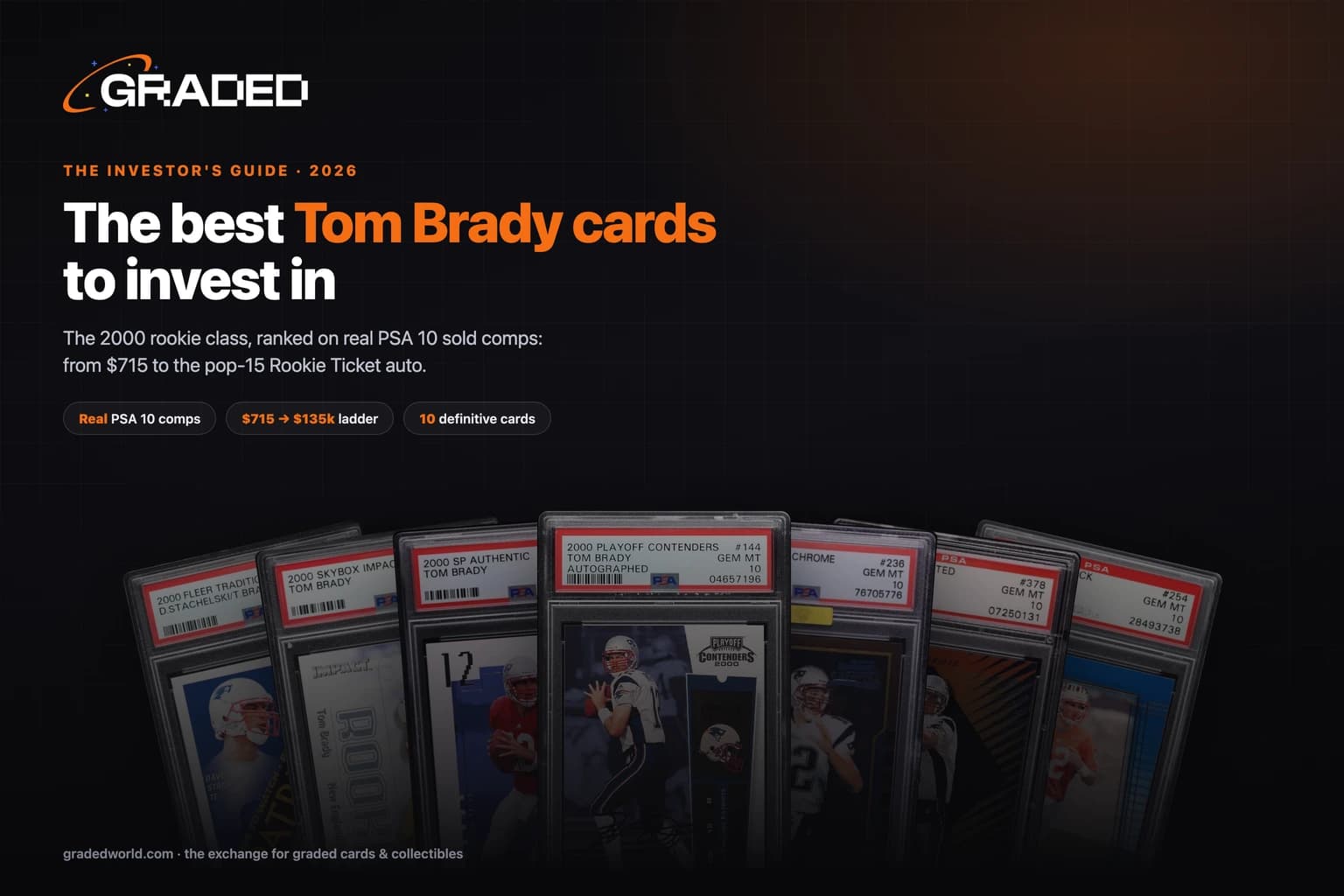
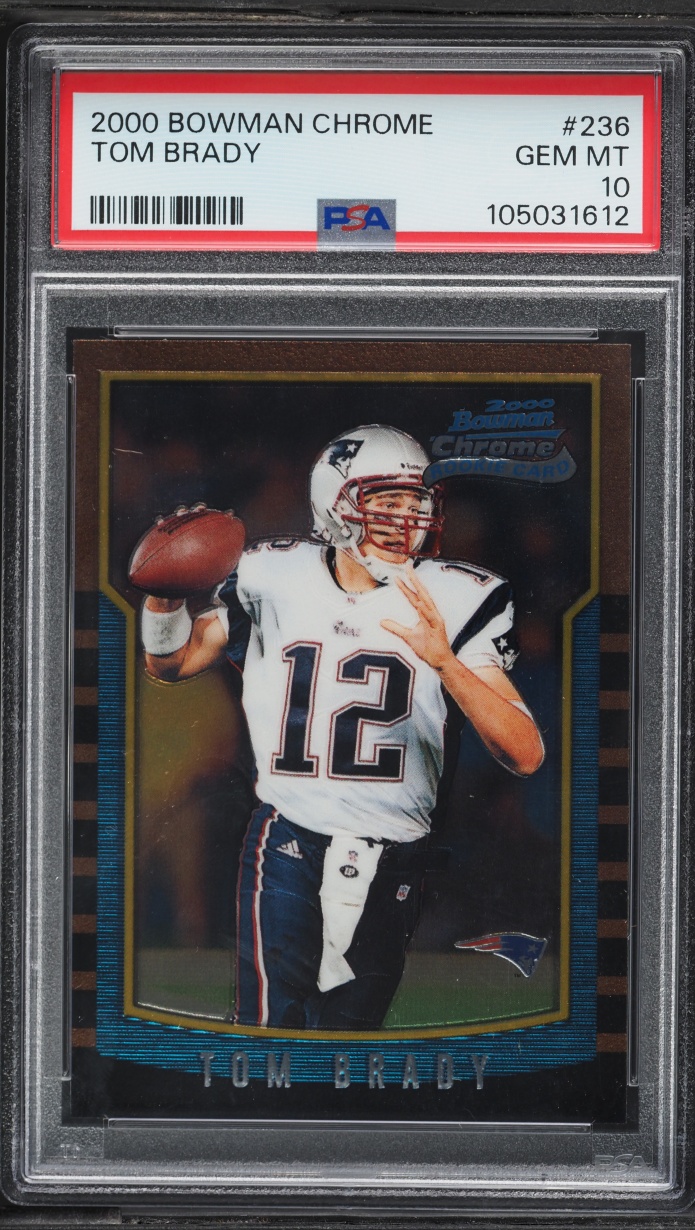
2000 Bowman Chrome Tom Brady #236: The Modern Football Grail
Every sport has one rookie card that becomes the asset, and for football it's the 2000 Bowman Chrome Tom Brady #236. It's the key rookie of the most accomplished quarterback in NFL history, from the chrome set collectors actually chase, and the PSA 10 is genuinely hard to pull, with a gem rate around 20%. Scarcity plus the GOAT is exactly the combination the framework is looking for.
Here's the data straight from Graded's pricing engine: actual PSA 10 sales over the past year, not an estimate:
Real sold comps from Graded's pricing engine · 58 sales (eBay & Fanatics).
View live data on Graded →The PSA 10 sits around $18,000 as of mid-2026, with comps mostly in the $13,000–$20,000 band, up from roughly $8,400 a year earlier, close to a double in twelve months (the chart shows the climb). It's a textbook modern blue-chip: liquid, iconic, and scarce in the top grade. The one caution is supply creep: the PSA 10 population (~1,240 and climbing) is larger than a true vintage grail, so this is a "great card, watch the pop report" hold rather than a fixed-supply lock.
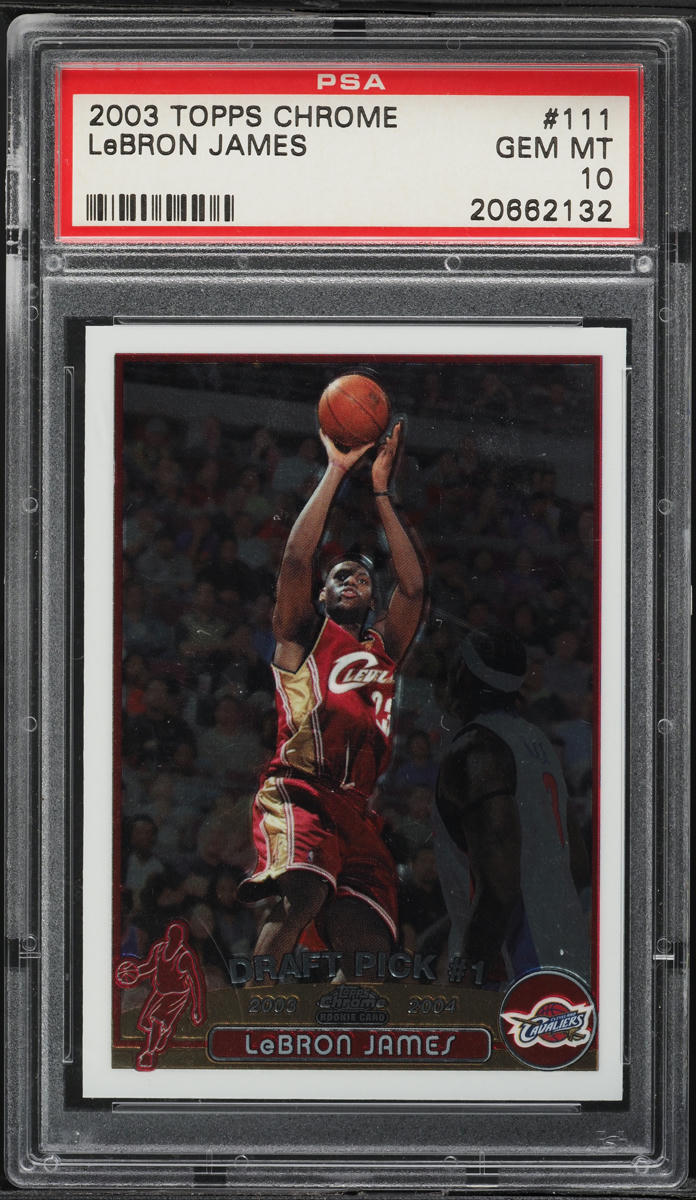
2003 Topps Chrome LeBron James #111: The Basketball Blue-Chip
The basketball equivalent is the 2003 Topps Chrome LeBron James #111, the chase rookie from arguably the deepest rookie class in NBA history (LeBron, Wade, Anthony, Bosh). LeBron's career case is essentially closed: he is the league's all-time scoring leader, and his flagship Topps Chrome rookie is a permanent fixture of the hobby's high end.
Here too the numbers are live from Graded's pricing engine: recent PSA 10 comps run in the $9,600–$13,000 range, with a current fair-market value around $12,900, up from around $4,000 in early 2020. The raw card sells near $1,200, so the PSA 10 carries a steep gem premium, which is exactly what you want: it means the grade is doing real work. A still-active legend keeps demand topped up, and a closed career narrative removes a lot of the downside risk that haunts younger players' cards.
Real sold comps from Graded's pricing engine · 12 sales (eBay & Fanatics).
Blue-Eyes White Dragon (LOB 1st Edition): The Yu-Gi-Oh Foundation
Yu-Gi-Oh's blue-chip is its origin card. The Blue-Eyes White Dragon, LOB-001, 1st Edition from Legend of Blue Eyes White Dragon (the first English set, 2002) is the most iconic monster in the game's history, printed in its scarcest early form. What makes it a serious investment is the population: PSA has graded fewer than 100 copies as a PSA 10, an order of magnitude rarer in the top grade than the Brady or LeBron rookies.
That scarcity shows up in the price: a PSA 10 changed hands for about $31,200 (with premium) in late 2025, and values have been climbing. Early-print Yu-Gi-Oh in PSA 10 is one of the thinnest, most supply-constrained corners of the entire hobby, which cuts both ways: huge upside on demand, but real illiquidity, so patience and the right venue matter more here than almost anywhere else.
Yu-Gi-Oh's origin card in its scarcest English print, with fewer than 100 PSA 10s, an order of magnitude rarer in the top grade than the Brady or LeBron rookies.
Market cap = PSA 10 population × fair-market value. Sources: Card Ladder · PSA APR · PriceCharting.
One Piece Manga Rares: The High-Growth Frontier
The newest entry on the ladder is also the fastest-moving. The One Piece Card Game launched in 2022 and became the most explosive TCG market of the decade, and its trophy cards are the Manga rares: special cards printed in Eiichiro Oda's original black-and-white manga art. They command a 200–400% premium over the standard version of the same card, and the market rewards the headline characters most.
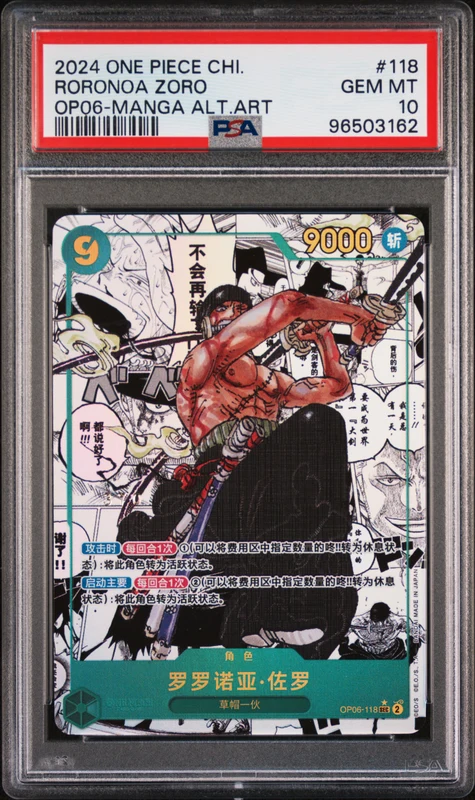
One distinction matters more than any other here, and it's the one casual buyers miss: the English Manga Alternate Art (the black-and-white panel art pulled straight from Oda's manga) is a different, far scarcer card than the standard full-color alternate art, and it trades for multiples more. The same character's standard alt art might be a few hundred dollars while the manga version is several thousand. When collectors talk about One Piece as an investment, they mean the manga rares, so those are the only ones we chart below.
The live data shows the gap plainly: the OP06 Roronoa Zoro Manga sits around $4,400 in PSA 10 (versus roughly $300 for the standard OP06 Zoro alt art, a ~15× premium), the PRB02 Sanji Manga around $3,250, and the crown jewel, the OP09 Gol D. Roger Gold Manga, has changed hands near $18,600. This is the highest-risk, highest-velocity category here (modern cards with still-growing populations) so size the manga rares as the aggressive growth sleeve of a portfolio. Our One Piece graded price guide goes deeper on the set-by-set data.
Real sold comps from Graded's pricing engine · 55 sales (eBay & Fanatics).
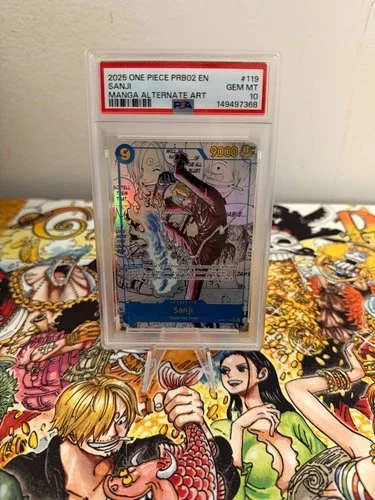
Real sold comps from Graded's pricing engine · 12 sales (eBay & Fanatics).
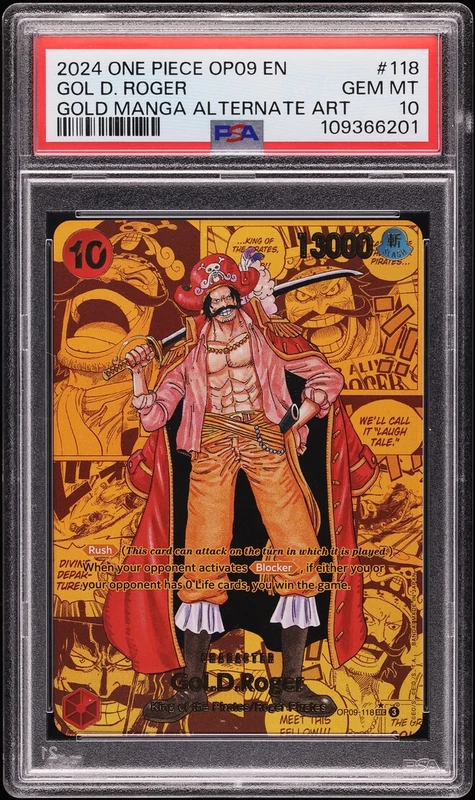
Real sold comps from Graded's pricing engine · 1 sales (eBay & Fanatics).
A Few Other Greats Worth Setting Aside
Beyond the headliners, a handful of cards belong on any serious shortlist because they define their categories:
- 1986 Fleer Michael Jordan #57. The benchmark for the entire sports-card market. Only about 326 have graded PSA 10 out of more than 28,000 submissions (a ~1.2% gem rate), and PSA 10s trade in the six figures. If the Brady is the modern football grail, the Jordan is the vintage basketball one, the card every other rookie is measured against.
- Pikachu Illustrator. Not investable for most (it's a seven-figure trophy), but it sets the ceiling for what a single card can be worth, and anchors the entire Pokémon market beneath it.
- Shadowless Base Set holos & 1st Edition non-holo rares. The accessible entry into vintage Pokémon scarcity, often a fraction of the Charizard's price with the same fixed-supply tailwind.
- Modern alt-art & secret-rare chase cards (e.g. Umbreon VMAX Alt Art, Moonbreon-tier pulls). Higher risk than vintage, but low gem rates and rabid demand have made the best of them genuine performers. See our deeper 2026 picks list for more.
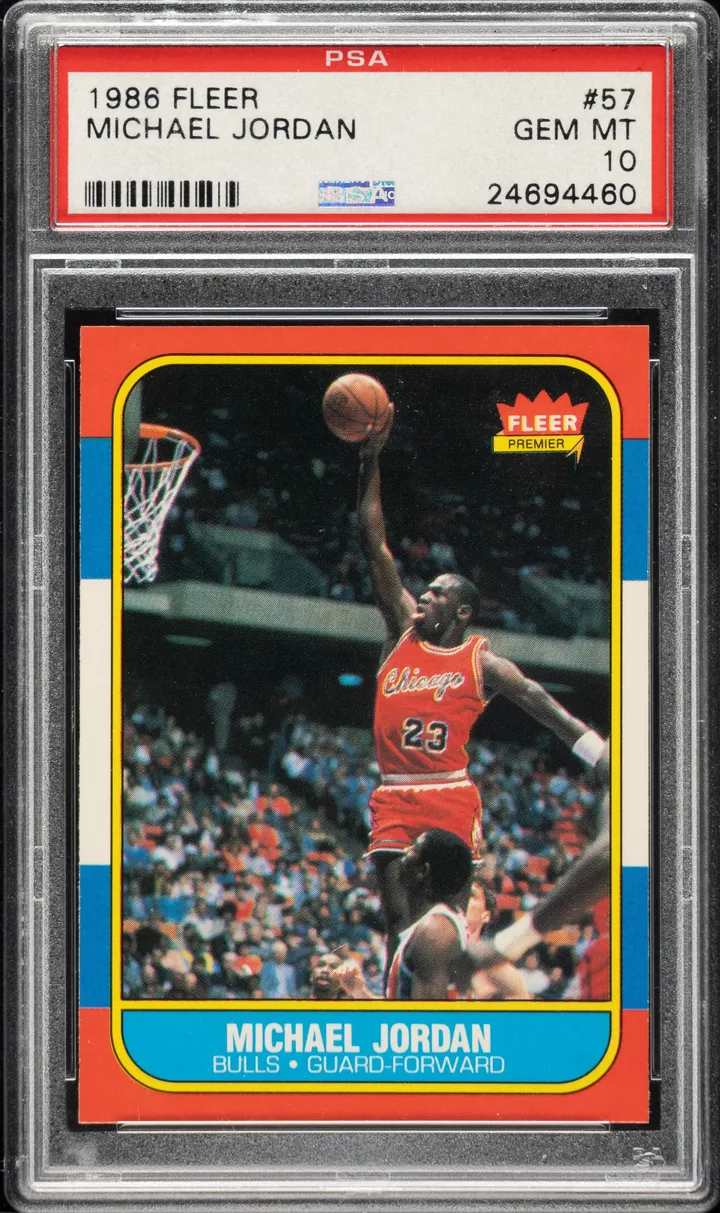
The benchmark for the whole sports-card market, with only 326 PSA 10s of 28,000+ graded (a 1.2% gem rate), trading in the six figures. The rookie every basketball collector anchors to.
Market cap = PSA 10 population × fair-market value. Sources: Card Ladder · PSA APR · PriceCharting.
How High Can Cards Go? Cards vs. Stocks, Crypto, and Art
Here's the bigger thesis, and the reason this is worth paying attention to now: graded cards are an asset class in its first innings. The infrastructure that made stocks, crypto, and fine art investable at scale (transparent pricing, authentication, custody, indices, fractional ownership) is only now arriving for cards. Markets re-rate hard when they cross from "collectible" to "investable." Cards are mid-crossing.
vs. Stocks
The best cards have quietly out-returned the market. A 1st Edition Charizard went from ~$35,000 in 2019 to the high six figures today (a return that embarrasses most equities over the same window) and it did it with near-zero correlation to the S&P. That's the institutional appeal: an asset whose value is driven by nostalgia and scarcity, not interest rates or earnings, is a genuine diversifier. The catch is the obvious one: no cash flow, wider spreads, and you have to pick the right card. And the total card-market cap is still a rounding error next to public equities, which is exactly the room-to-run argument.
vs. Crypto
Cards rhyme with crypto (passionate communities, near-24/7 trading once tokenized, big drawdowns) but with one foundational difference: a graded card is backed by a real, finite, physical object. There will only ever be 124 gem-mint 1st Edition Charizards; new tokens can always be minted. That hard scarcity, plus a 25-year demand track record, is why many investors treat blue-chip cards as the lower-volatility, real-asset corner of the alternative basket: the upside of an emerging market with a collateral floor underneath it.
vs. Fine Art
This is the closest analog, and the most exciting one. A 1st Edition Charizard is blue-chip art (a culturally iconic image, real provenance, a tiny supply), except it's liquid, third-party authenticated, priced in public, and you can own a piece for the cost of a print rather than a Basquiat. Fine art is a multi-hundred-billion-dollar asset class built on exactly these dynamics; cards bring the same dynamics to a far larger, younger, internet-native collector base. As vaulting, fractionalization, and real-time pricing mature, the gap between "a $550k card" and "a $550k painting" keeps closing, and cards have the bigger audience.
None of this promises any card only goes up. It's a volatile, still-young market, and the wrong card or the wrong cycle will hurt. But the structural setup (fixed supply, multi-generational demand, and an asset class still early in becoming investable) is the kind of setup that, in other markets, preceded the biggest re-ratings. The best cards, we think, are early.
Cards vs. the S&P 500: The Returns Over Time
The thesis is nice; the track record is better. Over the last fifteen years, a basket of blue-chip graded cards hasn't just kept up with the stock market. It has out-compounded it. Indexed to a $10,000 investment in 2010, here's how blue-chip cards stack up against the S&P 500's total return.
Over this window, blue-chip cards compounded at roughly 15–16% a year versus about 13% for the S&P 500, turning $10,000 into nearly $90,000 against the index's ~$62,000. But read the shape of the line, not just the endpoint: cards ran far hotter into the 2021 peak and gave a chunk back in 2022. That's the trade: higher long-run yield, bigger swings, and near-zero correlation to equities, which is exactly what makes a modest card sleeve a real diversifier rather than just more of the same risk.
Two caveats, stated plainly. This is an index of the best cards (the blue-chips this guide is built around), not the average card in a shoebox; picking wrong is the real risk, which is why grade, population, and demand matter so much. And past performance never guarantees the future. But the direction is hard to ignore: as the market-cap comparison showed, cards are still a fraction of the size of the assets they now return like. The runway is the whole point.
Matching Cards to Your Risk Tolerance
The categories above aren't interchangeable. They sit in different places on the risk/return map. The safest, most proven assets (vintage sports, WOTC Pokémon) have decades of track record and the lowest volatility; the newest (modern TCG) carry the most price swing and the least history, in exchange for the steepest growth curves.
A sane way to think about a card portfolio mirrors any other: anchor it in blue-chips you'd be happy to hold for ten years (vintage Pokémon, Jordan/Brady-tier rookies), then size a smaller, deliberate sleeve in higher-growth, higher-risk plays (One Piece manga, modern alt-arts) where a few winners can outrun the misses. The mistake isn't buying modern. It's putting your whole position there.
Why Every Investment Card Is Graded
Notice that every single card in this guide is followed by the same three letters and a number: PSA 10. That's not a detail. It's the whole thing. An ungraded card is a claim; a graded card is a fact. For investing, that difference is the line between a hobby and an asset class.
A third-party grader (PSA above all, with BGS, CGC, and SGC behind it) takes a raw card, authenticates it, judges its condition on a 1–10 scale, and seals it in a tamper-evident slab with a unique serial number. Here's what that actually buys you:
- Authentication. The biggest risk in high-value cards is that the card is fake, trimmed, recolored, or restored. Grading removes it: an expert has confirmed the card is genuine and unaltered. You're buying a verified object, not a photo and a promise.
- Condition certainty. "Mint" means something different to every seller. A PSA 10 means the same thing to everyone, everywhere. The grade turns a subjective argument about corners and centering into a single trusted number.
- The grade is the value. The same card in PSA 10 vs. PSA 9 vs. raw isn't worth a little more. It's often worth multiples more. A 1st Edition Charizard is a few thousand dollars raw and approaches half a million in PSA 10. Grading doesn't just describe the asset; it largely creates it.
- Fungibility and liquidity. Because every PSA 10 of a card is certified identical, they trade like units: sight-unseen, at a knowable price, instantly. That's what makes a real market possible: you can price it, sell it, or borrow against it without a five-day inspection.
- Population data. Grading is also what produces the population reports this entire guide leans on. Every slab increments a public count, so scarcity stops being a guess. No grading, no pop report, no way to know what "rare" actually means.
Put simply: grading converts a fragile, subjective, hard-to-verify piece of cardboard into a standardized, authenticated, countable financial object. It's the layer that lets a card be priced, traded, and trusted like an asset, which is why an investment-grade card is, by definition, a graded one. It's also why Graded is built entirely around slabs: the certification is the bedrock that pricing, trading, and lending all stand on.
How to Invest in Cards Safely
Picking the right card is only half the job. At these prices, how you buy, hold, and sell is what actually protects your money. The rules:
- Only buy authenticated, graded slabs, and verify the grade. Counterfeits and altered cards cluster at the high end. A card's value depends entirely on the holder being genuine and the grade being real, so confirm the cert before you pay.
- Price off sold comps, never asking prices. An asking price is a wish. Pull recent sold prices for the exact card, set, and grade, which is exactly what a live pricing engine is for. Read how to find a card's real price.
- Buy the grade, mind the pop report. The PSA 10-over-9 premium is where the money is, but a rising population can erode it. Favor cards with fixed or slow-growing PSA 10 counts.
- Protect against theft, loss, and damage. A six-figure card in a desk drawer is an uninsured, illiquid risk. Professional vaulting and insurance turn it into a safe, tradable asset.
- Plan your exit before you enter. Liquidity is part of the investment. Know where and how fast you can sell (and what it'll cost you) before you buy.
- Diversify and size sensibly. Spread across eras and categories, and never let a single card or a single hype cycle dominate the position.
Investing in Cards on Graded
Every rule above is easier to follow when the infrastructure does the work for you, which is the whole point of Graded. It's an exchange built to treat cards like the asset class they've become:
- Real prices, in one place. The same pricing engine behind this article's charts aggregates live fair-market value across eBay, Collector Crypt, Phygitals, and Courtyard, so you buy and sell off the true market, not one platform's ask.
- Authenticated and vaulted. Every card is a verified, graded slab held in an insured vault (Brink's, PSA Vault, or PWCC): authentication and storage risk handled.
- Liquidity built in. Tokenized ownership means you can sell or trade in seconds with on-chain escrow: no shipping a five-figure slab and hoping. See how trading works.
- Track the whole portfolio at live value. Watch every position move in real time. Read how the portfolio tracker works.
- The physical is always yours. The token is a deed, not a substitute: redeem the real slab to your door whenever you want.
The best cards to invest in have always been the scarce, iconic, liquid ones. What's new is that you can finally own, price, protect, and trade them like real assets. Browse the marketplace and start with the data.
FAQs
What are the best trading cards to invest in right now?
The strongest blue-chips by category are the 1999 1st Edition Base Set Charizard (vintage Pokémon), the 1986 Fleer Michael Jordan and 2000 Bowman Chrome Tom Brady (vintage and modern sports), the Blue-Eyes White Dragon LOB 1st Edition (Yu-Gi-Oh), the 2003 Topps Chrome LeBron James rookie (basketball), and One Piece manga rares like Gear 5 Luffy (high-growth modern TCG). Each combines provable scarcity, durable demand, and real liquidity.
Are trading cards a good investment?
They can be, but they're a volatile alternative asset, not a savings account. The best graded cards have appreciated dramatically over the long run (a 1st Edition Charizard PSA 10 went from a few hundred dollars to the high six figures), but prices swing hard, and thin cards can be illiquid. Treat cards as a small, diversified sleeve of a broader portfolio, buy authenticated slabs, and never invest money you can't afford to lose.
What makes one card a better investment than another?
Five things: a low gem rate (the PSA 10 is genuinely hard to get), a low total PSA 10 population, durable multi-generational demand, real liquidity, and trustworthy authentication. A card that passes all five has scarcity the market will actually pay for; a card that fails them is a hype bet.
Is it safer to invest in graded or raw cards?
Graded, by a wide margin, for investment purposes. Grading authenticates the card and certifies its condition, which is where most of the value and most of the fraud risk live. A raw card relies on your own eye and the seller's honesty; a graded slab in an insured vault is a verifiable, tradable asset.
How do I know what a card is really worth before I buy?
Price off recent sold comps for the exact card, set, and grade, never asking prices. Graded's pricing engine pulls live fair-market value, population, and gem rate from real sales across multiple marketplaces so you can see the true number. See how to find a card's real price.
What is the WOTC era in Pokémon, and why does it matter for investing?
WOTC stands for Wizards of the Coast, which produced the original English Pokémon cards from 1999 to 2003 (Base Set, Jungle, Fossil, Team Rocket, and the early e-Card sets). These have fixed vintage supply, low PSA 10 populations, and the deepest nostalgia in the hobby, which is why 1st Edition WOTC cards are the blue-chip tier of Pokémon investing.