The Best Pikachu Cards to Invest In (2026): From the $16.49M Illustrator Down, With Real Pricing
On this page
- 01The Pikachu framework
- 02The Pikachu card ladder
- 03Pikachu Illustrator
- 04Base Set 1st Ed (Red Cheeks)
- 05Birthday Pikachu
- 06Surfing Pikachu
- 07Flying Pikachu
- 08Gold Star Pikachu
- 09Pikachu VMAX Rainbow
- 10Special Delivery Pikachu
- 11Van Gogh Pikachu
- 12Errors, promos & the premium
- 13How high can they go?
- 14Match cards to your risk
- 15How to buy safely
- 16Investing on Graded
The most valuable trading card on the planet is not a Mantle, a Jordan, or a Charizard. It's a Pikachu. In February 2026, the one PSA 10 Pikachu Illustrator sold at Goldin for $16.49 million, the most ever paid for a trading card of any kind. That's not an accident of hype. Pikachu is the face of the highest-grossing media franchise in history, recognized on every continent, and the demand for its best cards has compounded for 27 years straight.
This guide ranks the best Pikachu cards to invest in, built the same way as our flagship investing guide: on real numbers. Every chart below is drawn from actual sold comps in Graded's pricing engine, not asking prices. We'll cover the framework, the specific cards from $400 to eight figures, live sales charts for each, and how to buy them safely.
Nothing here is financial advice. Cards are a real but volatile asset class, and you should never put in money you can't afford to lose. Here's what the data shows.
- Pikachu holds the all-time record. The single PSA 10 Pikachu Illustrator sold for $16.49 million in 2026, making a Pikachu the most valuable trading card ever, in any category.
- The best Pikachu cards to invest in span every budget: the Illustrator at the top, the 1st Edition Base Set Red Cheeks Pikachu (~$17,000 in PSA 10) and Birthday Pikachu in the vintage middle, and the Van Gogh promo and VMAX Rainbow at the modern end.
- Variants and errors set the price. The Red Cheeks printing error trades at roughly 5× the corrected Yellow Cheeks version of the same 1st Edition card. In Pikachu collecting, the variant is the asset.
- Promos are Pikachu's flagship format. Unlike most Pokémon, Pikachu's biggest cards (Illustrator, Birthday, Surfing, Van Gogh) are promos with small, fixed print runs, not set cards.
- The Gold Star Pikachu just went six figures. Real PSA 10 comps jumped from $15,000 in 2025 to $107,000 and $114,000 in 2026, and the PSA 9 ran 6× in sixteen months. The scarcest printings are repricing fastest.
- Cultural crossovers are the new demand engine. The Van Gogh Museum promo went from a free giveaway in 2023 to a $3,300 PSA 10 on real weekly comps.
The Framework: What Makes a Pikachu Card an Investment
Every card below passes the same five-part filter we use across this series. Pikachu adds one twist: the character itself is the demand engine, so the filter decides which Pikachu, not whether Pikachu.
- One character, concentrated demand. The same force that concentrates a player's value in his rookie card concentrates Pokémon demand in its mascot. When new money enters the hobby, it reaches for the most recognizable thing in it, and that is Pikachu.
- Promos over set cards. Pikachu's trophy cards are promotional releases with small, fixed print runs: contest prizes (Illustrator), event giveaways (Birthday, Surfing), and partnerships (Van Gogh). Fixed supply is the whole point.
- Variants and errors carry the premium. Red Cheeks vs. Yellow Cheeks, 1st Edition stamps, holo vs. non-holo. The market pays multiples for the scarcer printing of the same picture, so know exactly which version you're buying.
- Grade math. Vintage WOTC-era Pikachus are brutally hard to gem, so PSA 10s carry steep premiums and PSA 9s are the liquid tier. Modern promos gem easily, so the population is the ceiling.
- Liquidity. Every card in this guide trades on real comps. Pikachu is the most liquid name in Pokémon, but the trophy tier still moves through auction houses, not eBay, so plan exits accordingly.
The Pikachu Card Ladder
"Best Pikachu cards" spans five orders of magnitude, from a $400 modern gem to the most expensive trading card ever sold. Here's where the marquee cards sit, at the grades they actually trade in:
Bars use a logarithmic scale so every rung is visible. The Illustrator's $16.49M is the most ever paid for a trading card of any kind.
Read it as three tiers. Modern gems (VMAX Rainbow, Van Gogh) are liquid and affordable. The WOTC-era vintage tier (Surfing, Birthday, Base Set 1st Edition) carries fixed 25-year-old supply with real gem scarcity. And the Illustrator sits alone at the top of the entire hobby, all categories included.
Pikachu Illustrator: The Most Valuable Trading Card on Earth
The 1998 Pikachu Illustrator was never sold in a pack. It was awarded to winners of a CoroCoro Comic illustration contest in Japan, and only 39 copies exist. It's the only card that says "Illustrator" instead of "Trainer," and it carries art by Atsuko Nishida, Pikachu's original designer. Exactly one PSA 10 exists. Logan Paul bought it for $5.275 million in 2021 (a Guinness World Record at the time), wore it into WrestleMania, and sold it at Goldin in February 2026 for $16.49 million: the most ever paid for a trading card, of any kind, from any category.
And this is not just an auction-house story. Lower-grade copies trade too, and Graded's pricing engine has the real comps: a PSA 8 sold for $360,000 in mid-2025 and a PSA 8.5 for $300,000 in late 2024 (pictured: a PSA 8 example).
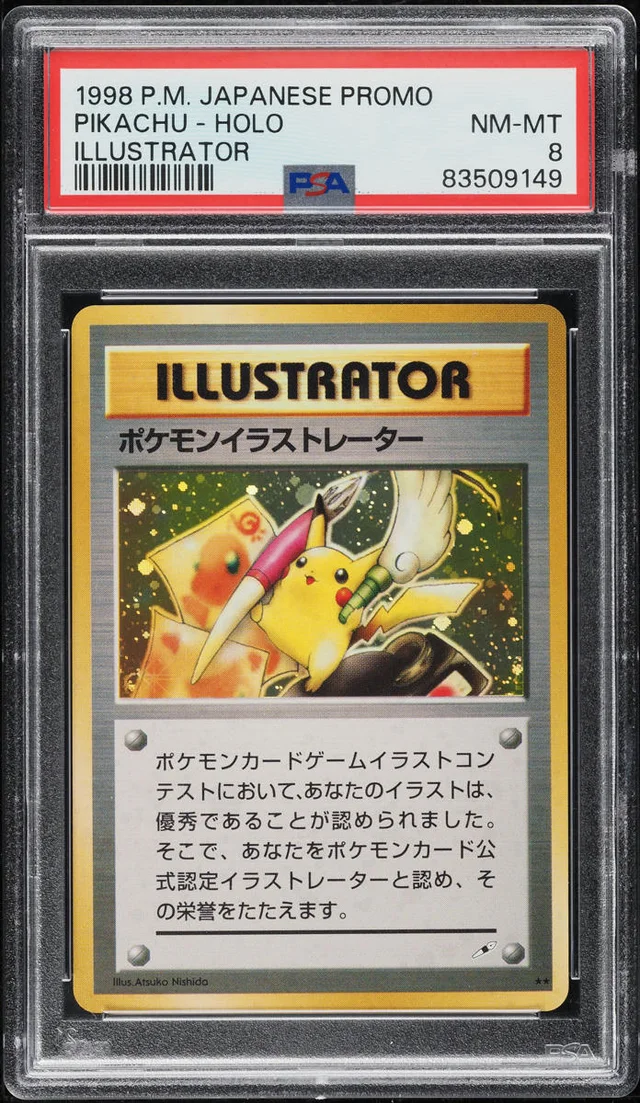
Real sold comps from Graded's pricing engine · 2 sales (eBay & Fanatics).
The investment logic is the purest in the hobby: 39 copies, the franchise's face, its original artist, and a record book that went from $195,000 to $16.49 million in seven years. For almost everyone it's a museum piece rather than a position, but it does for Pikachu what the '52 Mantle does for baseball: it anchors the price of everything below it.
1999 Base Set 1st Edition Pikachu (Red Cheeks): The Vintage Classic
The vintage cornerstone is the 1st Edition Base Set Pikachu #58, and the version that matters is the Red Cheeks printing error. The very first print run colored Pikachu's cheeks red; Wizards of the Coast corrected them to yellow mid-run, and the error became the chase. Real PSA 10 sales:
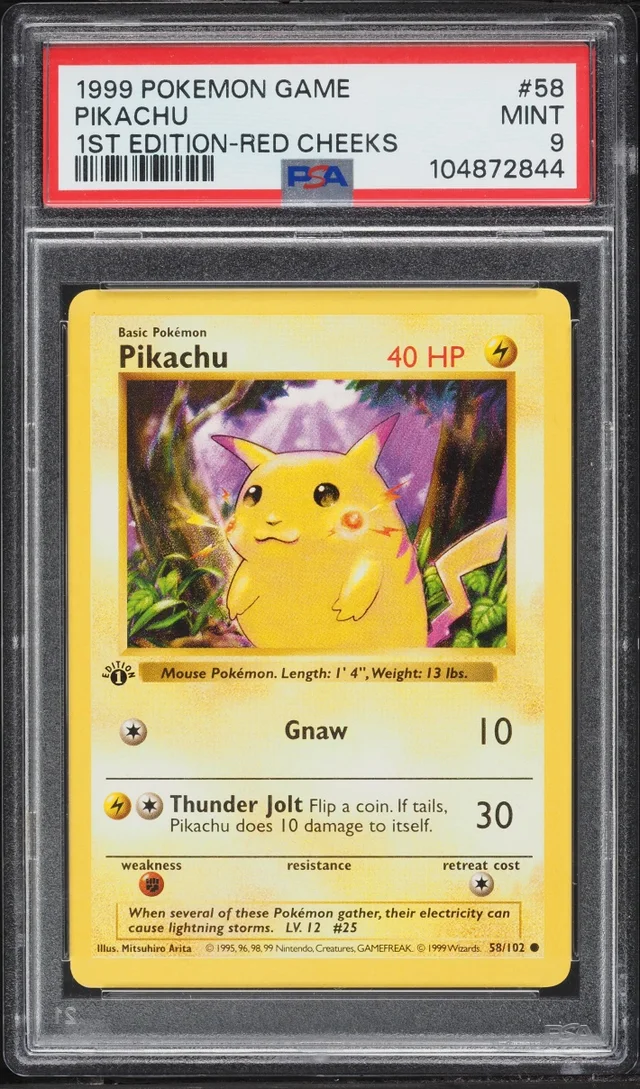
Real sold comps from Graded's pricing engine · 18 sales (eBay & Fanatics).
The Red Cheeks PSA 10 has been repricing fast: recent sales cluster around $17,000, up from a longer-run median near $7,800, with one June 2026 sale at $29,400 (pictured: a PSA 9 example). The corrected Yellow Cheeks 1st Edition gem trades near $3,000, which makes the error premium roughly 5× for the same card, same set, same stamp. That's the variant rule of Pikachu collecting in one number. PSA 9s of the Red Cheeks run about $1,700 to $2,900 and are the liquid way in.
Birthday Pikachu (Black Star Promo #24): The Iconic WOTC Promo
The most beloved WOTC-era promo is "_____'s Pikachu", universally known as Birthday Pikachu: a party-hat Pikachu with a blank line to write your name, released as Black Star Promo #24 in 2000. Its charm made it one of the most-saved and most-played-with promos of the era, which is exactly why high grades are scarce. Real PSA 9 sales:
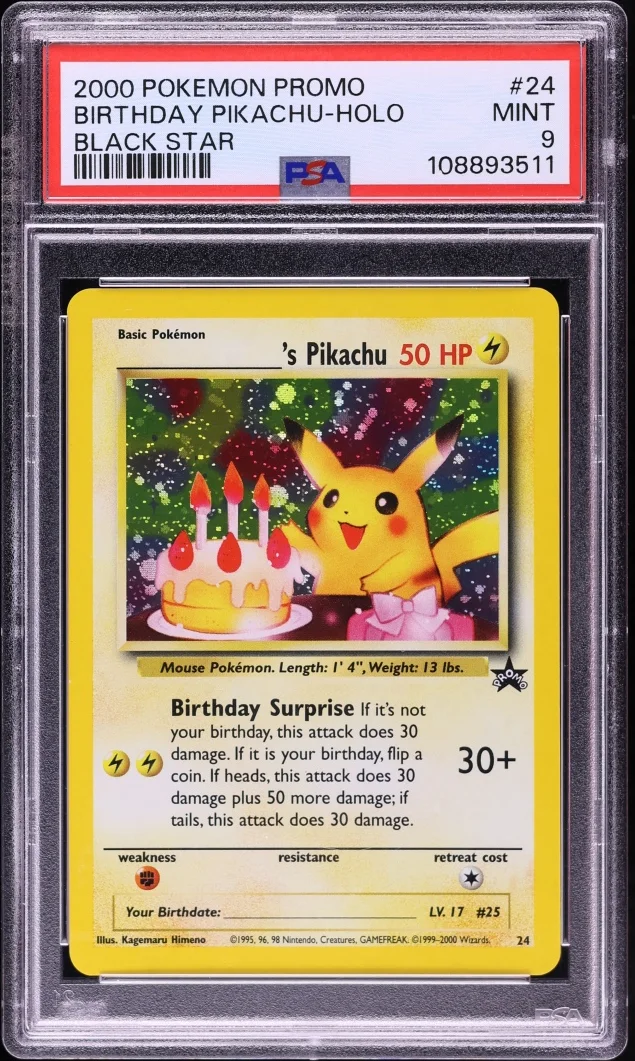
Real sold comps from Graded's pricing engine · 7 sales (eBay & Fanatics).
The PSA 9 trades around $420, and the gem is where the scarcity shows: a PSA 10 sold for $10,800 in March 2026 on Graded's comps. That 25× gap between the 9 and the 10 is classic WOTC grade math, and it makes the 9 the value entry while the 10 trades like a trophy.
Surfing Pikachu (Black Star Promo #28): The Cult Classic
Surfing Pikachu started as a fan-favorite Game Boy minigame and became one of the era's defining promos: Black Star Promo #28, handed out through the Pokémon League in 2001. Real PSA 10 sales:
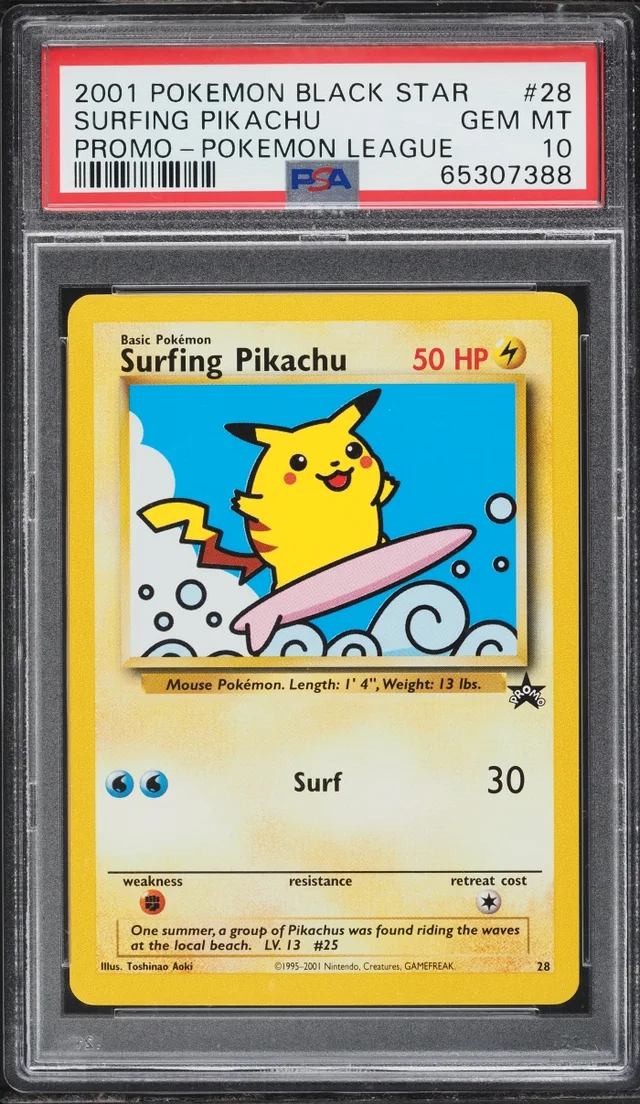
Real sold comps from Graded's pricing engine · 32 sales (eBay & Fanatics).
The PSA 10 trades around $600 on recent comps, up from a longer-run median near $220, with PSA 9s under $200. It's the accessible face of WOTC promo investing: the same fixed 25-year-old supply dynamics as the Birthday Pikachu, at a fraction of the price, with nostalgia that spans everyone who ever plugged a Game Boy into a Nintendo 64.
Flying Pikachu (Black Star Promo #25): The Other Half of the Pair
Surfing Pikachu's sibling is Flying Pikachu, Black Star Promo #25, released through the same 2001 Pokémon League runs: Pikachu aloft on a bundle of balloons. The two trade as a pair, and the Flying is the cheaper entry. Real PSA 10 sales:
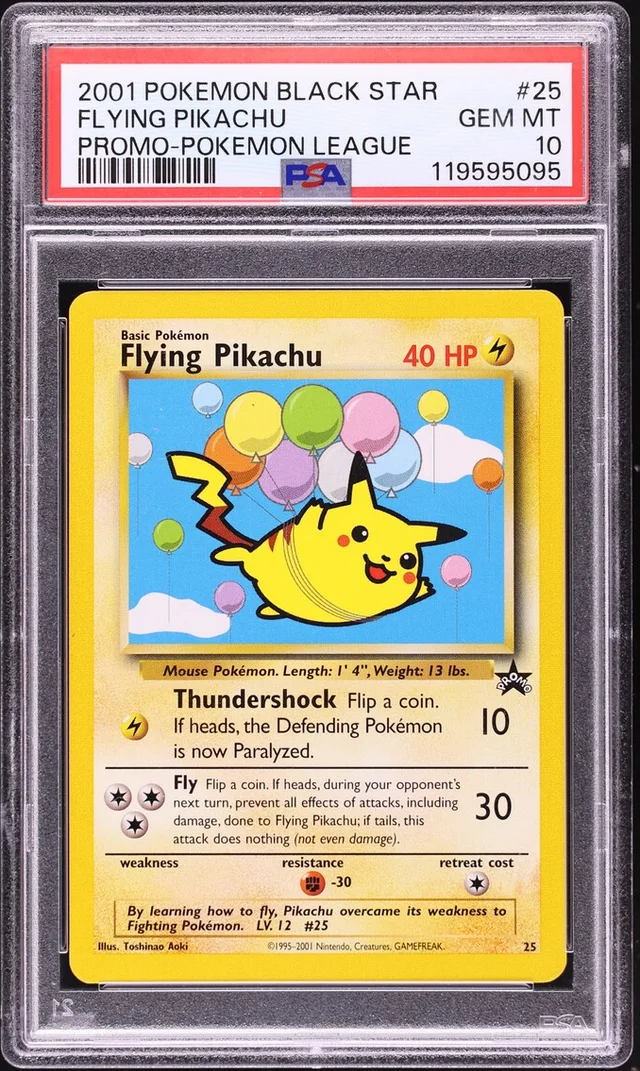
Real sold comps from Graded's pricing engine · 23 sales (eBay & Fanatics).
The PSA 10 has traded around $275 across the longer window, with the most recent sale at $700 in January 2026. Same fixed WOTC-era supply as the Surfing, same nostalgia pool, at the lowest vintage price on this list. For collectors building the classic promo run (Ivy #1, Birthday #24, Flying #25, Surfing #28), this is where most start.
Gold Star Pikachu (EX Holon Phantoms): The Six-Figure Sleeper
The biggest mover on this entire list is the 2006 EX Holon Phantoms Pikachu Gold Star #104. Gold Stars were the mid-2000s' rarest pull (roughly one per two boxes), they carry art by Masakazu Fukuda, and the Pikachu is the most demanded card in the entire Gold Star series. The market just repriced it violently: real PSA 10 comps went from $15,000 in May 2025 to $107,000 and $114,000 in back-to-back May 2026 sales. The PSA 9 tells the same story on deeper volume:
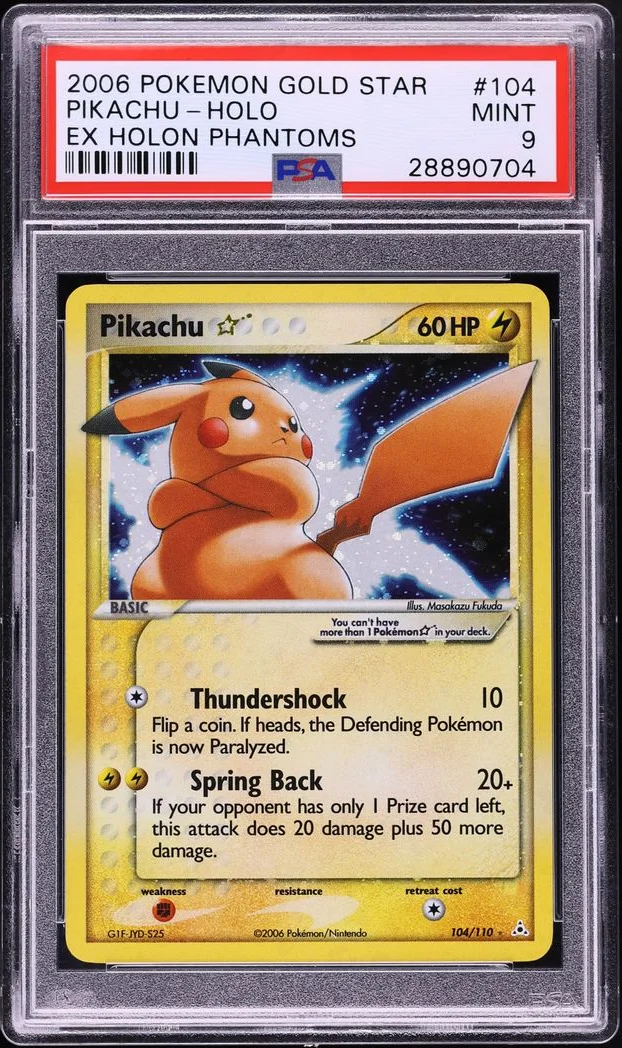
Real sold comps from Graded's pricing engine · 8 sales (eBay & Fanatics).
PSA 9 comps ran from about $3,000 in early 2025 to $17,000 to $23,400 in 2026, a 6× move in sixteen months. What's driving it is the framework in action: a two-decade-old card, a brutal pull rate, a tiny gem population, and Pikachu demand concentrating on the scarcest printings as the vintage tier reprices. Its counterpart, the Gold Star Charizard, printed a real $100,000 PSA 10 sale in February 2026 on the same dynamic. It's the closest thing this list has to a mid-cap growth asset, and the volatility runs in both directions. Size it accordingly.
Pikachu VMAX Rainbow Rare: The Modern Chase
The modern era's defining Pikachu is the Vivid Voltage Pikachu VMAX #188 rainbow secret rare, affectionately known as the "Chonkachu." It was the chase card of the biggest set of the 2020 boom, and it's still the reference modern Pikachu. Real PSA 10 sales:
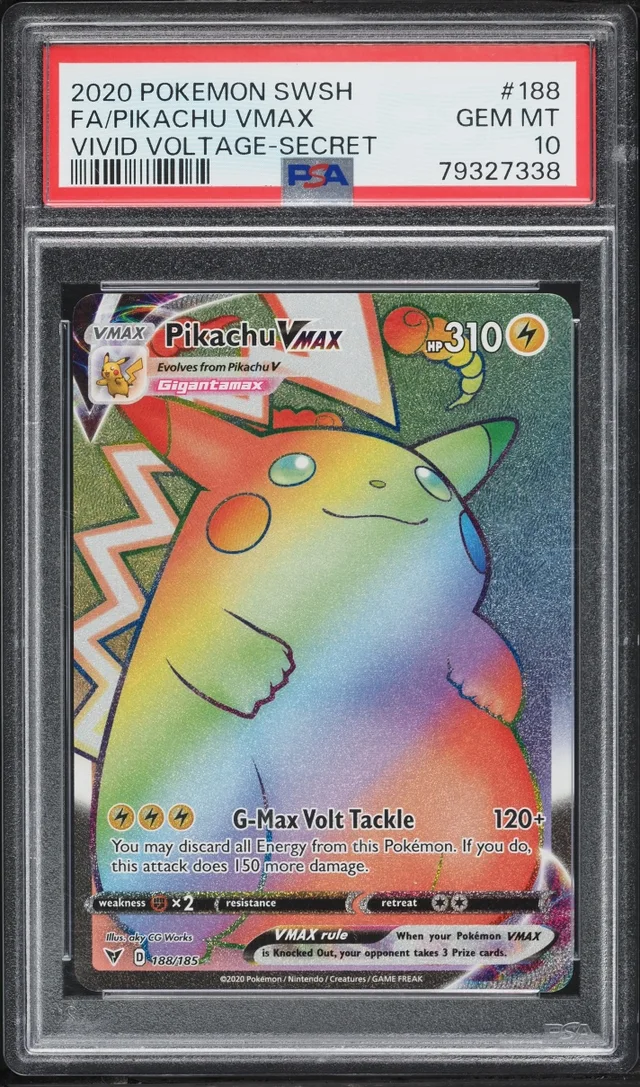
Real sold comps from Graded's pricing engine · 31 sales (eBay & Fanatics).
The PSA 10 trades around $385 with steady weekly volume. Understand what it is: a liquid, iconic modern card with a large gem population, so it behaves like the base rookies in our sports guides. It's the entry ticket and the exit door of Pikachu investing, not the scarcity asset. The upside case rests on Vivid Voltage's sealed supply drying up and the card's status as the era's icon.
Special Delivery Pikachu: The Modern Exclusive
The modern era's scarcity play is Special Delivery Pikachu, a mail-carrier Pikachu promo available only through Pokémon Center online orders in 2020 and 2021. Unlike pack-pulled moderns, its supply was capped by a short exclusive window, which is why it trades at a premium to far flashier cards. Real PSA 9 sales:
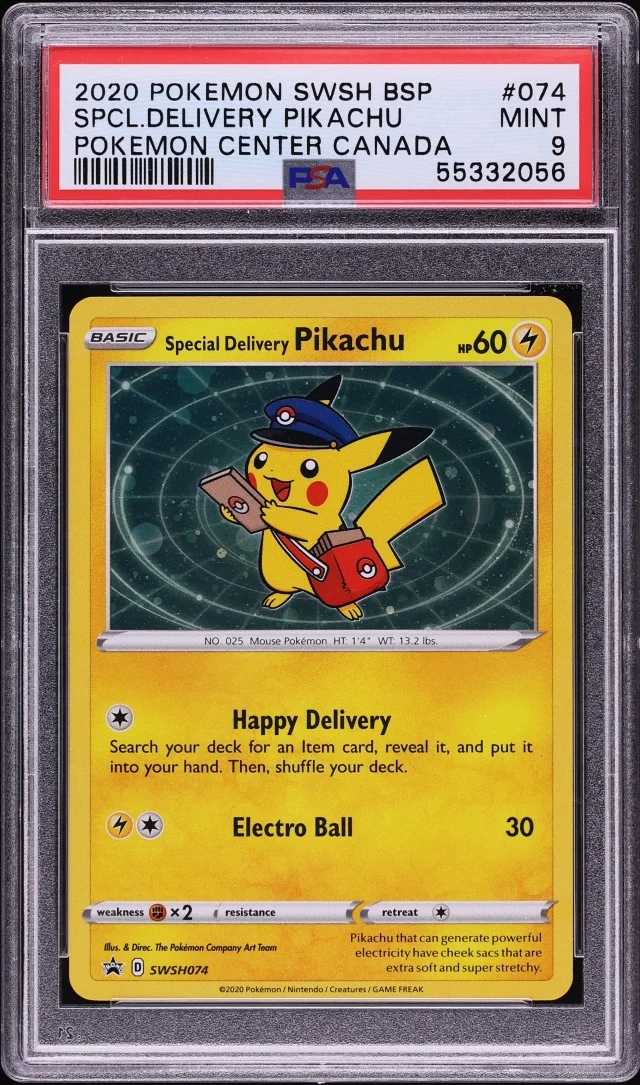
Real sold comps from Graded's pricing engine · 4 sales (eBay & Fanatics).
The PSA 9 trades around $455, and a PSA 10 sold for $1,440 in late 2025 on Graded's comps. It's the modern proof of the promo rule: distribution scarcity beats pack scarcity. A plain-looking mail Pikachu out-prices rainbow-foil chase cards because the print window, not the pull rate, fixed the supply.
Van Gogh Pikachu: The Cultural Crossover
In September 2023, the Van Gogh Museum in Amsterdam handed out a free promo to visitors: Pikachu With Grey Felt Hat, painted in the style of Van Gogh's self-portrait. The collaboration caused scenes: lines around the block, scalpers, the museum pulling the card within weeks. Then it kept climbing. Real PSA 10 sales:
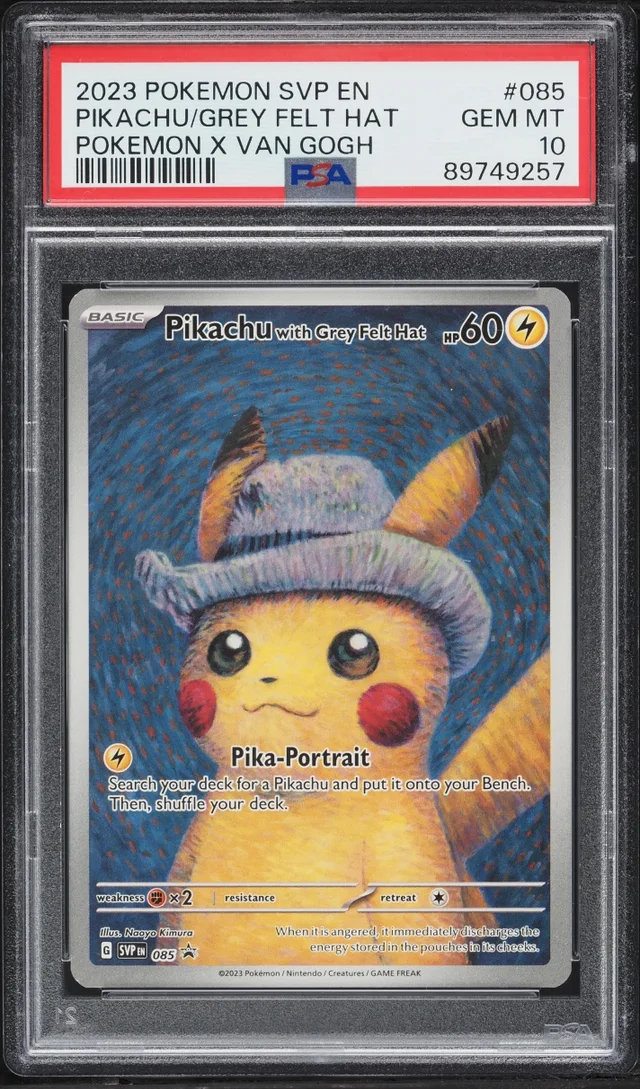
Real sold comps from Graded's pricing engine · 60 sales (eBay & Fanatics).
The PSA 10 now trades around $3,300, up from roughly $2,000 across the longer comp window, on deep weekly volume. A free museum giveaway became a four-figure asset in three years because it sits at the intersection of two demand pools that never used to overlap: Pokémon collectors and art-world buyers. It's the clearest evidence yet that Pikachu demand extends far beyond the hobby, and it's why we treat cultural crossovers as their own tier now.
Errors, Promos, and the Pikachu Premium
Zoom out on the nine cards above and the pattern is the discipline: in Pikachu collecting, the variant is the asset. It's the K-shaped economy inside a single character. Millions of ordinary Pikachu cards exist and are worth pennies; the scarce printings of the same face keep setting records.
- Errors beat corrections. Red Cheeks over Yellow Cheeks at roughly 5×. And the pattern repeats on Black Star Promo #1, the first promo card ever printed: the error copies bearing a Jungle set symbol with a 1st Edition stamp (the "Ivy Pikachu" error) trade at $2,000 to $5,400 in PSA 9 on real comps, while the common League version sells for about $50. Same picture, 100× apart.
- Promos beat set cards. The Illustrator, Birthday, Surfing, and Van Gogh were all giveaways with small print runs, and all of them out-appreciate the set cards of their eras.
- The gem premium is the WOTC moat. A Birthday Pikachu PSA 10 is 25× its PSA 9. Vintage Pikachu holos punished every playground shuffle, and grading turned that damage into scarcity.
- Crossovers create new demand pools. Van Gogh proved a Pikachu promo can reprice on demand from outside the hobby entirely. Watch every future partnership through that lens.
The playbook: hold the liquid gems (VMAX, Surfing) for exposure, make the vintage scarcity (Red Cheeks, Birthday) the core position, treat crossovers as calculated momentum bets, and let the Illustrator anchor your understanding of how high concentrated character demand can go.
How High Can Pikachu Cards Go?
Pikachu's ceiling argument is now the strongest in all of collectibles, because it was just tested in public: $16.49 million for a single card. The asset class it sits in is still tiny next to the markets it trades like:
Total market value: collectibles as an asset class, next to gold, mega-cap tech, and crypto.
The right column is how many times bigger each one is than the entire collectibles market. Collectibles are already a real asset class, larger than a top-ten crypto like Dogecoin, yet still a fraction of a single mega-cap stock and barely a rounding error next to gold. That gap is the runway: as collectibles mature into a transparently priced, investable asset class, the best cards have room to re-rate that the giants no longer do.Figures approximate, 2026: gold = all above-ground gold; equities = market cap; crypto = network value; collectibles = estimated global market size. Bars use a log scale for visibility.
And the returns case is on the board. Indexed from 2010, blue-chip cards have out-compounded the S&P 500:
Pikachu's specific edge is franchise scale. Pokémon is the highest-grossing media franchise ever created, bigger than Star Wars and Marvel, and it mints new collectors on every continent every year. All of that demand funnels toward one mascot, and the mascot's best cards have fixed, 25-year-old supply. That's the same supply-demand geometry as the vintage sports grails, with a younger and more global buyer base.
Matching Pikachu Cards to Your Risk Tolerance
The tiers sit in very different places on the risk map:
A sane Pikachu portfolio anchors in vintage WOTC scarcity (Red Cheeks 1st Edition, Birthday Pikachu at the best grade you can afford), holds the liquid modern icons (VMAX Rainbow, Surfing) as the tradable sleeve, and sizes cultural crossovers (Van Gogh) as momentum bets. The Illustrator tier is for trophy hunters. The most common mistake is paying vintage prices for modern supply; the pop report tells you which one you're holding.
Why Every Card Here Is Graded
Every card in this guide is quoted at a PSA grade because, for investing, the grade is the asset. The same Birthday Pikachu is $420 in a PSA 9 and $10,800 in a PSA 10. Grading authenticates the card, certifies the condition, and produces the population data this whole analysis runs on. It matters double for Pikachu, the most counterfeited character in the hobby. Our flagship guide covers grading in depth, and our Pokémon PSA 10 price guide goes deeper on the whole Pokémon market.
How to Buy Pikachu Cards Safely
- Price off sold comps, never listings. Look up the exact card, variant, and grade on Graded's value calculator before you bid.
- Verify the variant. Red vs. Yellow Cheeks, 1st Edition stamp vs. unlimited, English vs. Japanese. The same picture spans a 100× price range depending on the printing, so read the label, not the artwork.
- Assume fakes exist. Pikachu is the most counterfeited card subject on earth, and Illustrator reprints are sold openly as novelties. Graded slabs with verifiable cert numbers are the floor, especially for anything vintage.
- Respect the hype cycle on crossovers. The Van Gogh worked out; most novelty promos don't. Buy crossovers on real comp momentum, not press releases.
- Trade without shipping risk. On Graded's Trading Floor, vaulted cards trade instantly with on-chain escrow, so a five-figure Red Cheeks never rides in a mailer.
Investing in Pikachu Cards on Graded
Everything this guide measures, Graded does live. Look up any Pikachu card's real fair-market value, population, and gem rate with the value calculator, browse authenticated, vaulted slabs across every major tokenization platform in the marketplace, and trade peer-to-peer with instant on-chain settlement on the Trading Floor. No shipping, no scam risk, and you don't need to know anything about crypto to use any of it.
FAQs
What is the best Pikachu card to invest in?
The Pikachu Illustrator is the grail: only 39 copies exist and the single PSA 10 sold for $16.49 million in 2026, the record for any trading card. For real-world budgets, the 1st Edition Base Set Red Cheeks Pikachu (~$17,000 in PSA 10, ~$2,000 in PSA 9) and Birthday Pikachu promo are the vintage blue-chips, with the Van Gogh promo (~$3,300 in PSA 10), Surfing Pikachu (~$600), and VMAX Rainbow (~$385) covering the modern end.
Why is the Pikachu Illustrator worth so much?
It was a contest prize, never sold in packs, with only 39 copies awarded through CoroCoro Comic in 1998. It features art by Pikachu's original designer, it's the only card titled "Illustrator," and exactly one PSA 10 exists. Fixed supply of 39 meeting demand from the world's biggest media franchise took its record from $195,000 in 2019 to $16.49 million in 2026.
What is the difference between Red Cheeks and Yellow Cheeks Pikachu?
The first 1999 Base Set print run colored Pikachu's cheeks red by mistake; Wizards of the Coast corrected them to yellow mid-run. Both exist as 1st Edition cards, but the error version is scarcer and trades at roughly 5× the corrected one: about $17,000 vs. $3,000 in PSA 10 on real comps.
Is the Van Gogh Pikachu a good investment?
It has been so far: a free 2023 museum giveaway that now trades around $3,300 in PSA 10 on deep weekly volume. It created a new template, a card whose demand comes from outside the hobby. The caution is that it's a modern promo with a large gem population, so treat it as a momentum position sized accordingly rather than a fixed-supply vintage hold.