The Best Ken Griffey Jr. Cards to Invest In (2026): The First Refractor & the Full Ladder, in PSA 10
On this page
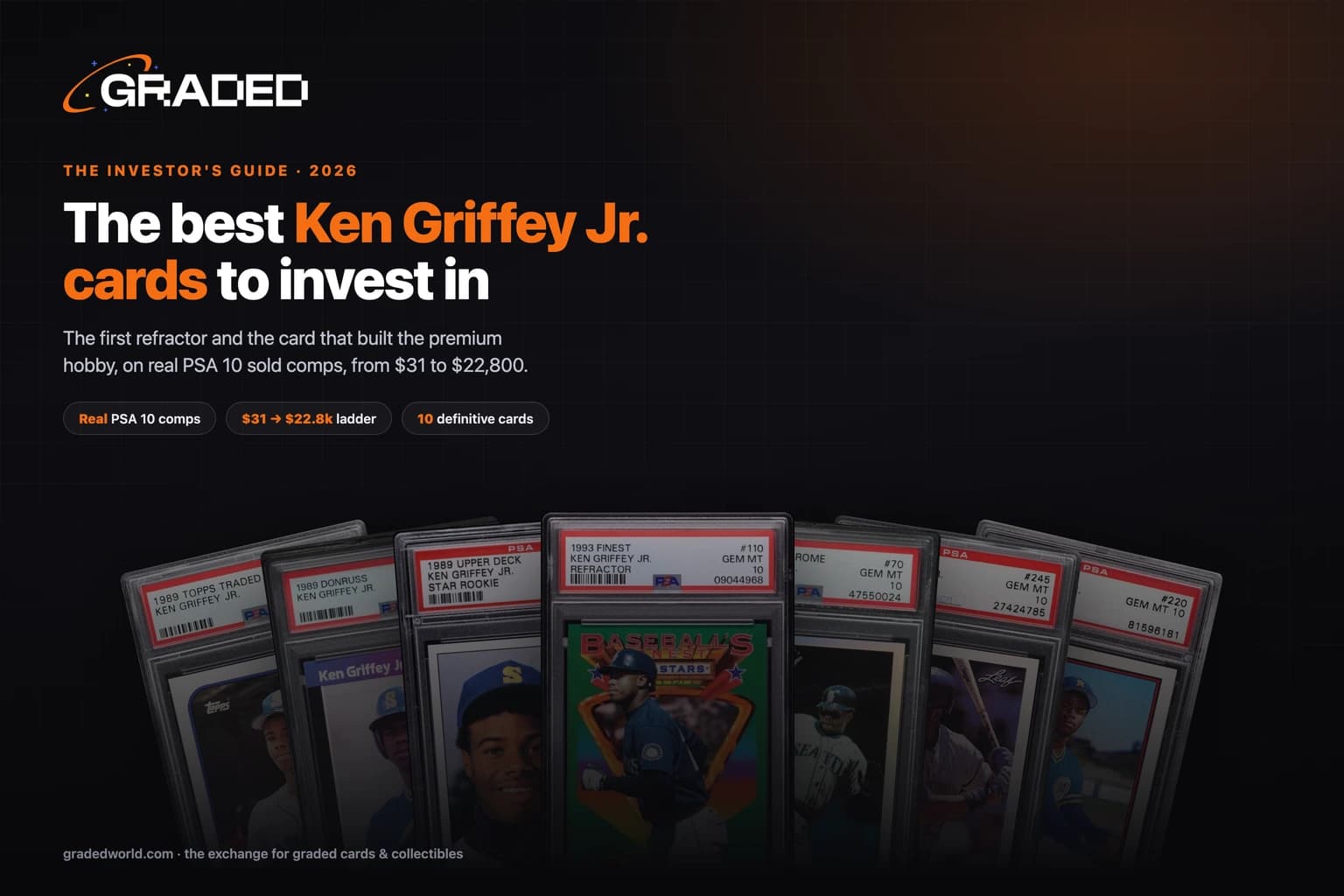
Two revolutions in the hobby have the same face on the front. The 1989 Upper Deck Ken Griffey Jr. #1 launched the premium card industry, and the 1993 Finest Refractor #110 was the first refractor ever printed, the technology every modern chase card still uses. One trades at $5,280 on twenty gem comps; the other at $22,800 on eleven. Beneath them runs the deepest junk-wax gem economy in baseball, down to a $31 Fleer. This guide maps all of it on real sold comps.
Built the same way as our baseball, Mantle, and Kobe guides: every price below is a real PSA 10 sold comp from Graded's pricing engine (eBay and Fanatics), never an asking price. Ten cards, 1989 to 1996, tracked live on the Ken Griffey Jr. market index.
Nothing here is financial advice. Cards are a real but volatile asset class. Here's what the data shows.
- The '93 Finest Refractor is the Griffey grail: the first refractor in card history, $22,800 on 11 gem comps, with a 2016-2026 tape that ran $2,325 to $26,400.
- The '89 Upper Deck #1 is the industry's founding card: $5,280 on 20 gem comps, the card that created the premium hobby and still its most recognizable rookie.
- Junk-wax liquidity is real: the 1990 Leaf has 74 archived gem comps at $118, the deepest tape in this entire guide.
- Five rookies, five prices: the same 1989 face costs $31 (Fleer), $210 (Topps Traded), $552 (Bowman), $810 (Donruss), or $5,280 (Upper Deck). Print quality and brand story set the spread, not scarcity.
- Every card in this guide is quoted in PSA 10: Griffey's era graded young, and his gem markets are genuinely deep.
- The safest narrative in 90s baseball: no scandal, no asterisk, first-ballot Hall of Famer, and the sweetest swing the sport ever filmed.
The Framework: What Makes a Griffey Card an Investment
- Two founding documents: Griffey fronts both the card that started the premium era ('89 UD #1) and the first refractor ('93 Finest). Historical firsts hold bids the way rookies of ordinary stars cannot.
- Junk-wax print runs, real gem scarcity: his 1989 rookies were printed in the millions, but gem centering separates a $31 Fleer from an $810 Donruss.
- The cleanest 90s story: Griffey is the era's superstar who never touched the steroid narrative, and the market has always paid for that.
- Closed résumé: 630 home runs, 13 All-Star nods, unanimous-era Hall induction. The ladder moves on supply and macro alone.
The Griffey Card Ladder
Ten cards, on real PSA 10 sold comps:
Bars use a logarithmic scale so every rung is visible. Every value is a real PSA 10 sold comp, not an asking price.
1993 Finest Refractor #110: The First Refractor Ever Made
The engine has every archived PSA 10 sale:
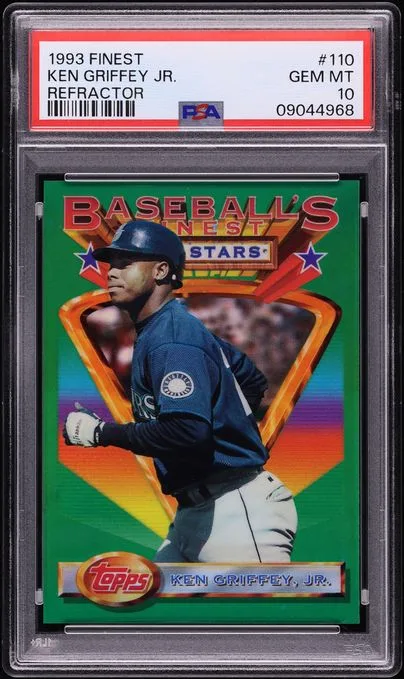
Real sold comps from Graded's pricing engine · 11 sales (eBay & Fanatics).
$22,800 fair market value ($25,200 in February 2026). Topps printed refractors for the first time in 1993 Finest, roughly 241 of each card, and Griffey's #110 is the one the market treats as the technology's birth certificate. The tape tells a clean repricing story: $2,325 in 2016, $7,150 in 2018, and a $20,000-$26,400 band it has held since 2022. Every refractor, prizm, and parallel printed since 1993 descends from this card.
1989 Upper Deck #1: The Card That Built an Industry
Real PSA 10 sales:
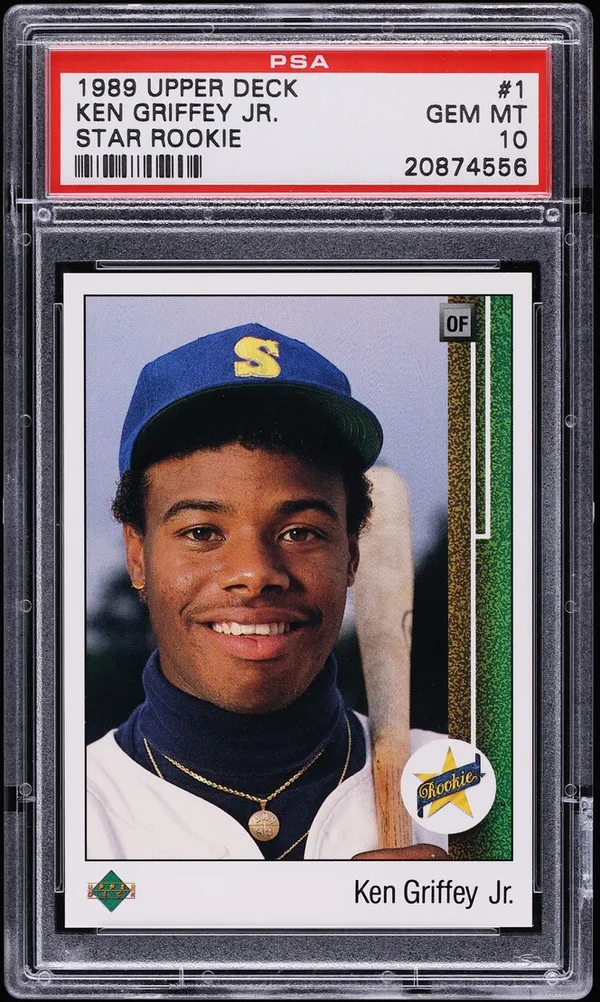
Real sold comps from Graded's pricing engine · 20 sales (eBay & Fanatics).
$5,280 on 20 gem comps. Upper Deck launched in 1989 with tamper-proof holograms, premium stock, and the rookie of a 19-year-old as card #1 of its first set. It is the most consequential card of the modern era, and its PSA 10 market has the liquidity to match the story. The counterfeit history is equally famous: cert-verify every copy.
The Chrome-Era Chase: '96 Topps Chrome Refractor and '93 Finest
The 1996 Topps Chrome Refractor #70 is the scarce-tape trophy: two archived gem comps, the latest at $21,600 in March 2026:
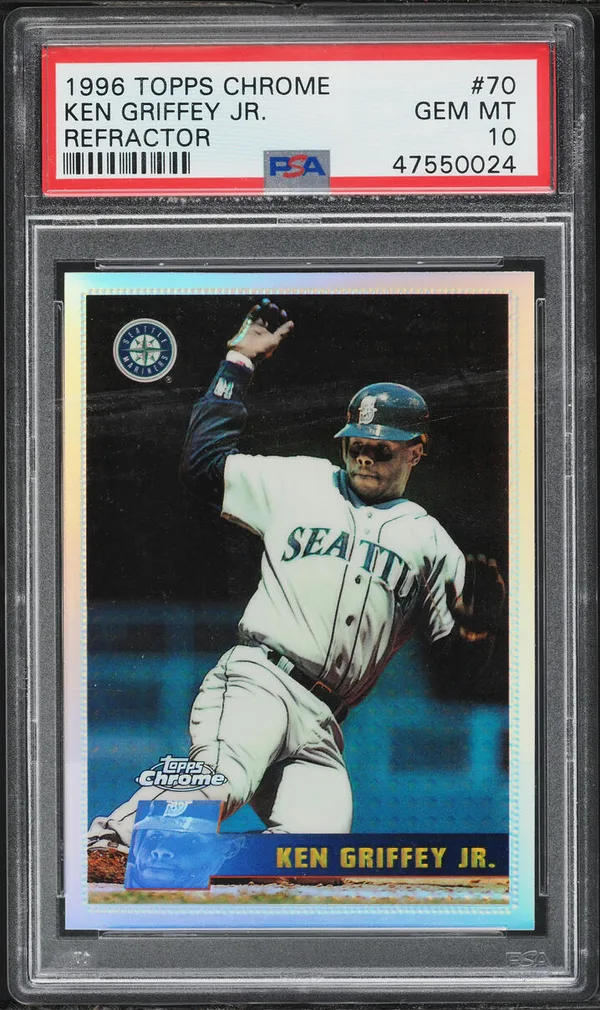
Real sold comps from Graded's pricing engine · 2 sales (eBay & Fanatics).
The base 1993 Finest #110 is the affordable way to own the first-chrome story, $1,300 on nine comps:
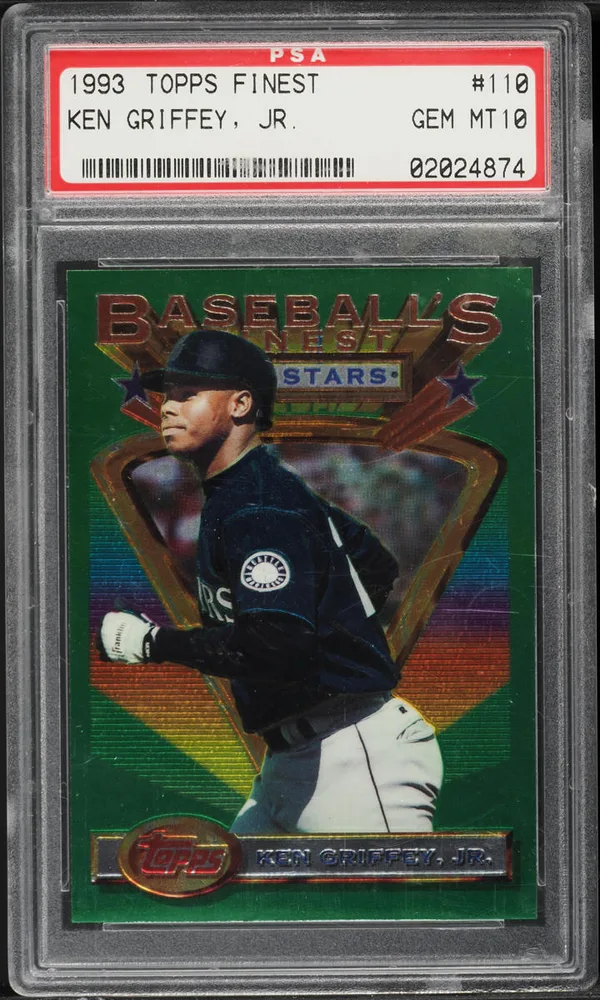
Real sold comps from Graded's pricing engine · 9 sales (eBay & Fanatics).
The 1989 Rookie Class: Donruss, Bowman, Topps Traded, Score, Fleer
The Donruss Rated Rookie #33 leads the paper tier at $810 on 23 comps, and the tall-boy Bowman #220 follows at $552:
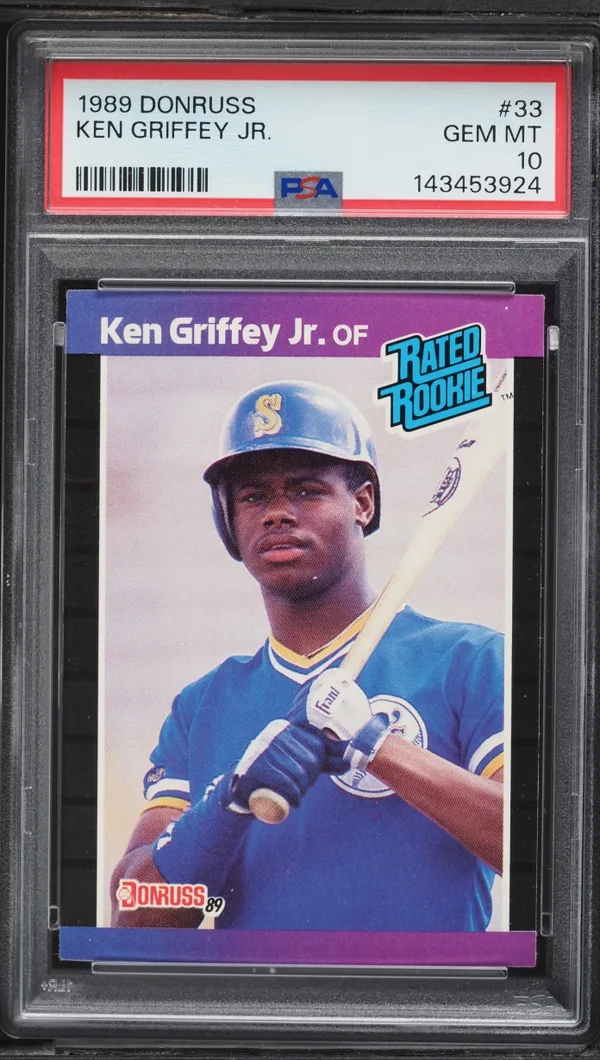
Real sold comps from Graded's pricing engine · 23 sales (eBay & Fanatics).
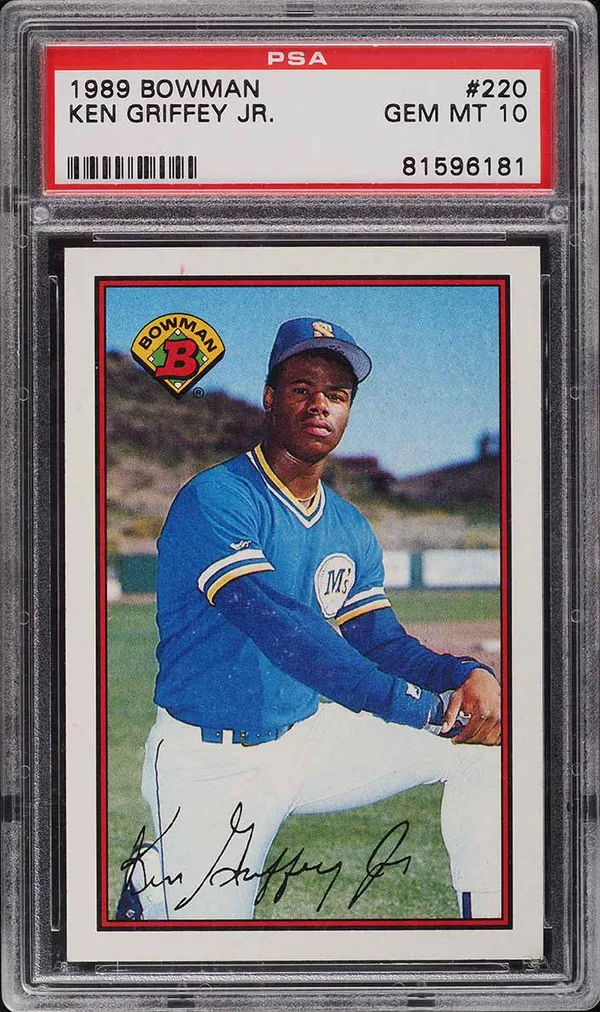
Real sold comps from Graded's pricing engine · 9 sales (eBay & Fanatics).
The Topps Traded #41T (29 comps at $210), the oddball Score Young Superstars #18 ($236), and the Fleer #548 ($31, the cheapest real Griffey gem market) close the class:
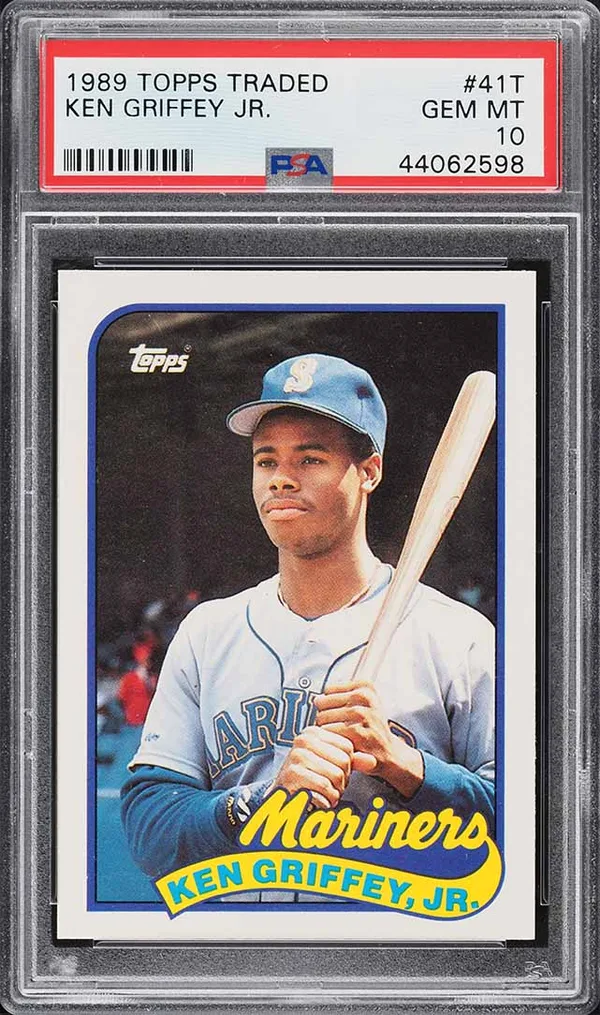
Real sold comps from Graded's pricing engine · 29 sales (eBay & Fanatics).
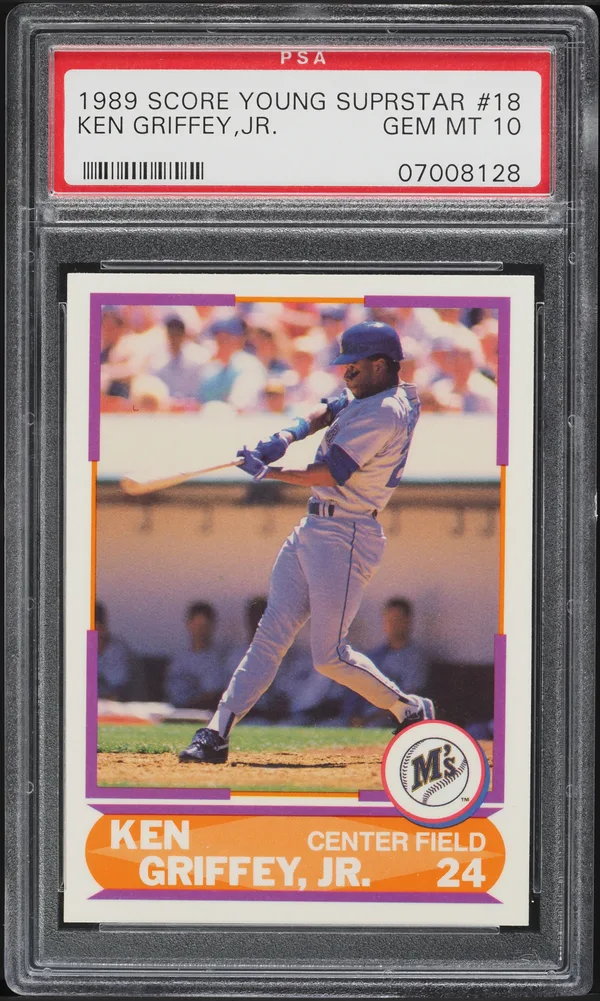
Real sold comps from Graded's pricing engine · 3 sales (eBay & Fanatics).
Real sold comps from Graded's pricing engine · 17 sales (eBay & Fanatics).
1990 Leaf #245: The Liquidity King
Real PSA 10 sales:
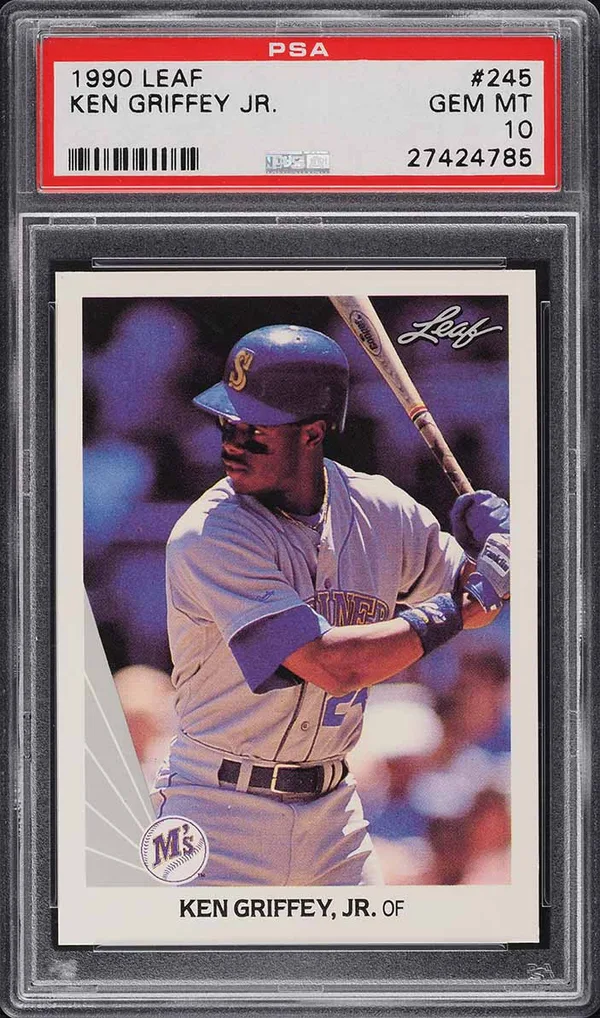
Real sold comps from Graded's pricing engine · 74 sales (eBay & Fanatics).
$118 on 74 archived gem comps, the deepest tape of any card in this guide. 1990 Leaf was the hobby's first premium base set after Upper Deck proved the category, and its Griffey is the definition of an accumulation card: cheap, liquid, and always in demand.
Reading the Class: Firsts, Spreads, and the Gem Filter
- Historical firsts carry the ladder: the first refractor ($22,800) and the first premium card ($5,280) are the two bids that never rotate.
- The 1989 spread is a print-quality story: five rookies of the same player span $31 to $5,280 in the same grade. Fleer's centering was terrible; Upper Deck's stock was revolutionary. The gem filter priced it.
- Liquidity lives at the bottom: 74 comps on the Leaf, 29 on the Topps Traded, 23 on the Donruss. Positions get built here.
- The '96 Chrome Refractor trades on scarcity: two comps in the archive. Patience is the entire strategy at that rung.
How High Can Griffey Cards Go?
The '93 Finest Refractor is a ten-bagger since 2016 and has held its post-2022 band without giving it back. The asset class it belongs to is still tiny:
Total market value: collectibles as an asset class, next to gold, mega-cap tech, and crypto.
The right column is how many times bigger each one is than the entire collectibles market. Collectibles are already a real asset class, larger than a top-ten crypto like Dogecoin, yet still a fraction of a single mega-cap stock and barely a rounding error next to gold. That gap is the runway: as collectibles mature into a transparently priced, investable asset class, the best cards have room to re-rate that the giants no longer do.Figures approximate, 2026: gold = all above-ground gold; equities = market cap; crypto = network value; collectibles = estimated global market size. Bars use a log scale for visibility.
And the returns case is on the board:
Matching Griffey Cards to Your Risk Tolerance
Griffey is a closed-résumé ladder with two trophies and the deepest entry tier in 90s baseball. Anchor in the liquid tapes ('89 UD, '90 Leaf, '89 Donruss), size the refractors as trophies, and treat the '96 Chrome Refractor's two-comp market as an auction event, not a position.
Why Every Card Here Is a PSA 10
Unlike vintage Mantle, Griffey's era graded young and graded often: every card in this guide has a real PSA 10 market, from the refractor's 11 comps to the Leaf's 74. Our PSA 10 price guide covers the grade math in depth, and the value calculator prices any card instantly.
How to Buy Griffey Cards Safely
- Price off sold comps, never listings, via Graded's value calculator.
- The '89 Upper Deck is heavily counterfeited. It was faked in period and is faked now. Cert-verified slabs only.
- Refractor vs base on '93 Finest: same card number at a 17x spread. Tilt the card or trust the label, never the listing title.
- Watch Tiffany and Glossy variants: 1989 Topps Traded Tiffany is a different, scarcer card than the base Traded. Our comps keep them separate.
- Trade without shipping risk on Graded's Trading Floor, with instant on-chain escrow.
Investing in Griffey Cards on Graded
Everything this guide measures, Graded does live: real fair-market values with the value calculator, authenticated vaulted slabs in the marketplace, live tracking on the Ken Griffey Jr. index, and instant peer-to-peer settlement on the Trading Floor.
FAQs
What is the best Ken Griffey Jr. card to invest in?
The 1993 Finest Refractor #110: the first refractor ever printed, $22,800 on 11 real PSA 10 comps, holding a $20,000-$26,400 band since 2022. For a liquid core position, the 1989 Upper Deck #1 at $5,280 on 20 comps is the class's reference card.
How much is a Ken Griffey Jr. rookie card worth?
In PSA 10, his 1989 rookies run $31 (Fleer #548), $210 (Topps Traded #41T), $552 (Bowman #220), $810 (Donruss Rated Rookie #33), and $5,280 (Upper Deck #1). Every number is a real sold comp from our archive, and the spread is a print-quality story, not a scarcity one.
Why is the 1989 Upper Deck Griffey so famous?
It was card #1 of Upper Deck's first set, the product that invented the premium card industry: hologram security, quality stock, and a teenage superstar on the cover. It is the most historically important card of the modern era and still its most recognizable rookie.
What was the first refractor card?
The 1993 Topps Finest refractor parallel, roughly 241 copies per card. Ken Griffey Jr. #110 is the set's marquee card, which makes it the collectible ancestor of every refractor, prizm, and chrome parallel printed in the thirty years since. It trades at $22,800 in PSA 10.
What is the most liquid Griffey card?
The 1990 Leaf #245: 74 archived PSA 10 comps around $118. The 1989 Topps Traded (29 comps) and 1989 Donruss (23) follow. For five-figure positions, the '93 Finest Refractor's 11 comps make it unusually liquid for a grail.
Are Ken Griffey Jr. cards a good investment?
Griffey pairs a closed, scandal-free résumé with two of the hobby's founding documents. The junk-wax tier gives the ladder real liquidity, and the refractor tier has repriced and held through a full cycle. The main risk is macro, not narrative: his print runs are enormous below gem, so the grade filter is the entire investment case.