The Best Mike Trout Cards to Invest In (2026): The Reference Rookie & Its Parallel Ladder, in PSA 10
On this page
The 2011 Topps Update #US175 is the last flagship rookie card of an inner-circle Hall of Famer that ordinary collectors actually pulled from retail packs. Its PSA 10 trades at $1,020 on 32 archived comps, its retail-exclusive Target Red Border parallel has printed $56,400, and the ladder between those two numbers is the cleanest study in modern parallel economics the hobby offers. This guide maps all of it on real sold comps.
Built the same way as our baseball, Griffey, and Brady guides: every price below is a real PSA 10 sold comp from Graded's pricing engine (eBay and Fanatics), never an asking price. Nine cards, 2009 to 2011, tracked live on the Mike Trout market index.
Nothing here is financial advice. Cards are a real but volatile asset class. Here's what the data shows.
- The Update #US175 is modern baseball's reference rookie: $1,020 in PSA 10 on 32 comps, the liquid entry into an inner-circle career.
- The parallels are the price ladder: the same photo costs $1,020 (base), $4,260 (Diamond Anniversary), $8,350 (Gold /2011), $10,800 (Cognac), or $34,251 (Target Red Border) in the same grade.
- The 2009 Bowman Chrome Draft auto is the prospect-era icon: $6,900 on 16 gem comps, with a $39,000 peak print in 2021.
- The 2011 Bowman Chrome Refractor is the sleeper tape: 30 gem comps at $1,920, the most liquid refractor in the class.
- Trout's cycle already happened: the 2021 boom and repricing are in the data, and the post-correction bands have held for three years.
- Career-twilight, legacy-secure profile: three MVPs and the best analytic résumé of his generation, with retirement the only remaining catalyst.
The Framework: What Makes a Trout Card an Investment
- One rookie card, many doors: unlike Mahomes-era football, Trout's class has a single flagship rookie (#US175) and its parallels. The choice is which door, not which card.
- Retail exclusives became the trophies: the Target Red and Walmart Blue borders were pack filler in 2011; scarcity in gem made them the class's five-figure cards.
- The prospect auto predates the fame: the 2009 Bowman Chrome Draft auto was signed by a 17-year-old draft pick; it is the class's only on-card rookie-era autograph with a deep PSA 10 market.
- Analytics-proof legacy: whatever happens from here, WAR already put him in the inner circle. The remaining catalyst is the retirement news cycle.
The Trout Card Ladder
Nine cards, on real PSA 10 sold comps:
Bars use a logarithmic scale so every rung is visible. Every value is a real PSA 10 sold comp, not an asking price.
2009 Bowman Chrome Draft Auto #BDPP89: The Prospect Icon
The engine has a decade of PSA 10 sales:
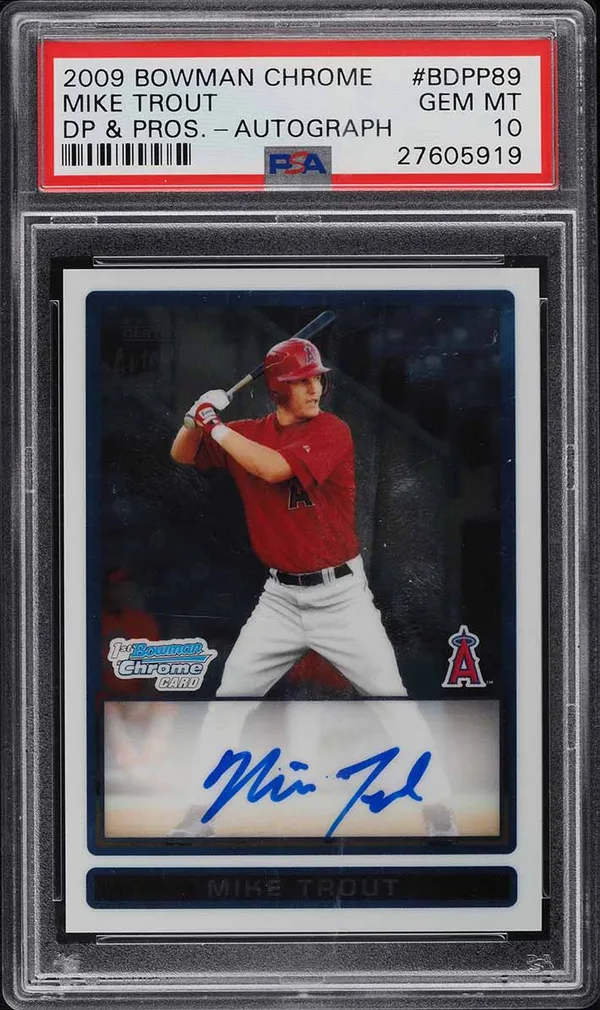
Real sold comps from Graded's pricing engine · 16 sales (eBay & Fanatics).
$6,900 on 16 gem comps. The tape is a complete market cycle in one card: $2,250 in 2016, a steady $6,000-$8,900 band through 2018, a $39,000 peak print in May 2021, and a return to its long-term band where it has sat since. The serial-numbered refractor versions of this auto run to six figures; the base auto is the liquid way to own the story.
2011 Topps Update #US175: The Reference Rookie
Real PSA 10 sales:
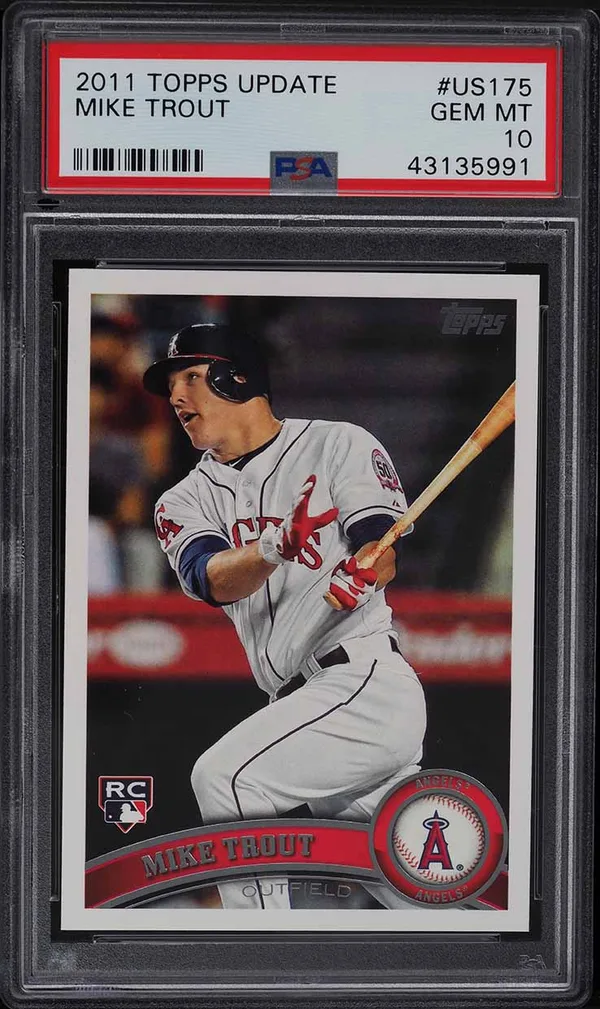
Real sold comps from Graded's pricing engine · 32 sales (eBay & Fanatics).
$1,020 on 32 comps, the deepest tape in the class. This is the card the entire modern hobby uses as its baseball benchmark: pack-pulled, flagship, and graded by the tens of thousands. The gem premium does the work: raw copies are worth lunch money while the PSA 10 holds four figures through every cycle.
The Parallel Ladder: Diamond Anniversary, Gold, Cognac, Target Red
The Diamond Anniversary sparkle parallel is the liquid step up, $4,260 on 18 comps:
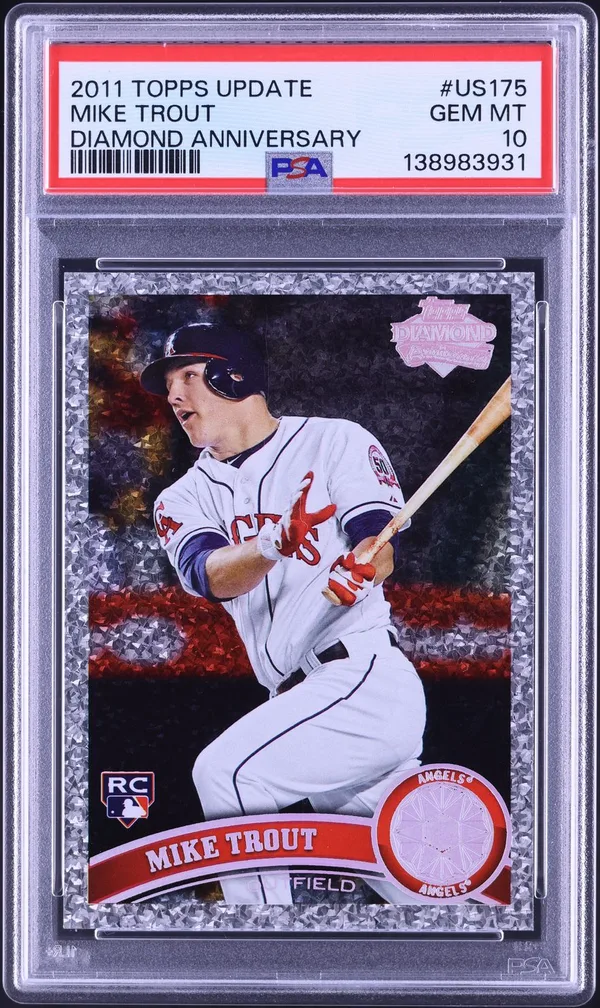
Real sold comps from Graded's pricing engine · 18 sales (eBay & Fanatics).
The Gold /2011 is the serial-numbered rung at $8,350, and the retail Cognac short print trades above it at $10,800 on scarcer supply:
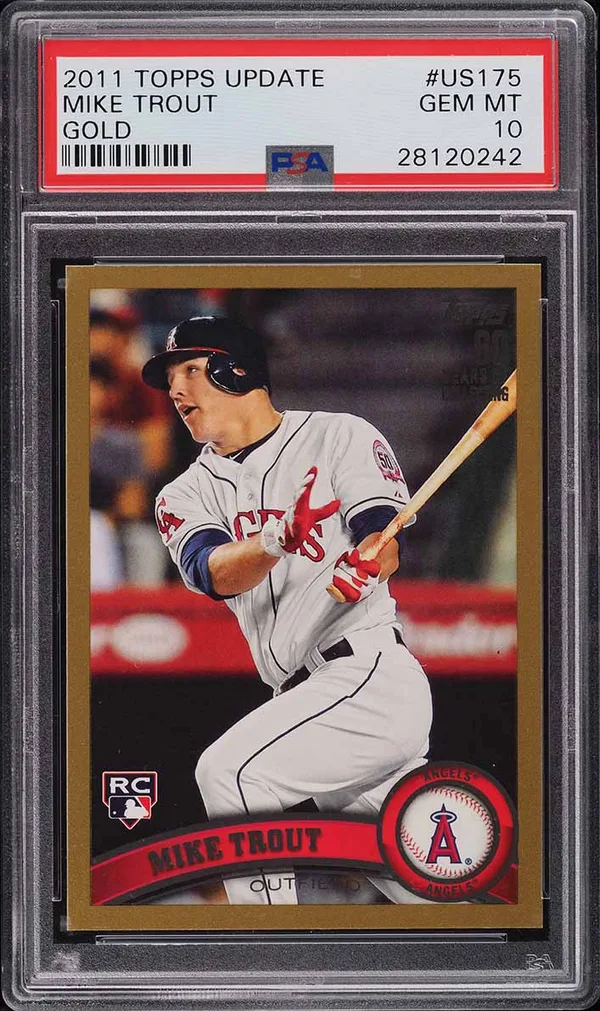
Real sold comps from Graded's pricing engine · 8 sales (eBay & Fanatics).
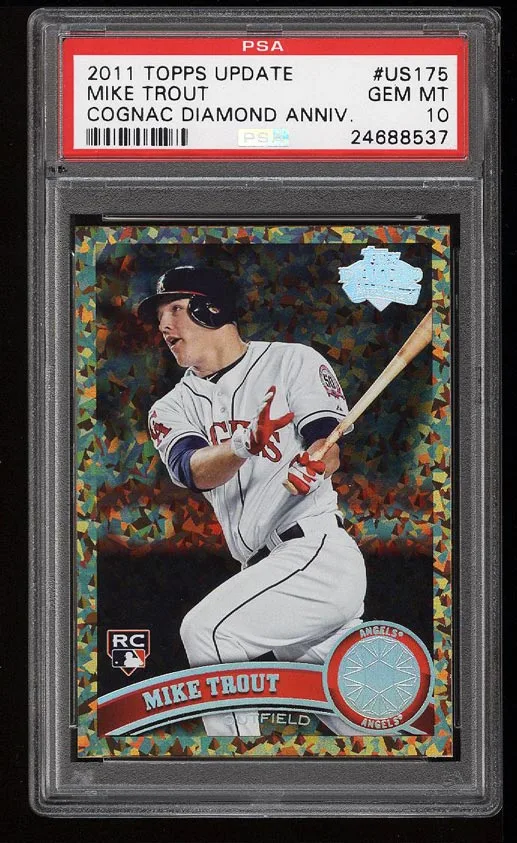
Real sold comps from Graded's pricing engine · 7 sales (eBay & Fanatics).
At the top, the Target Red Border is the class trophy: two archived gem comps, $34,251 fair market value, and a $56,400 print in 2022. A retail exclusive that shoppers threw in carts for pocket change became the most valuable non-auto Trout rookie in existence:
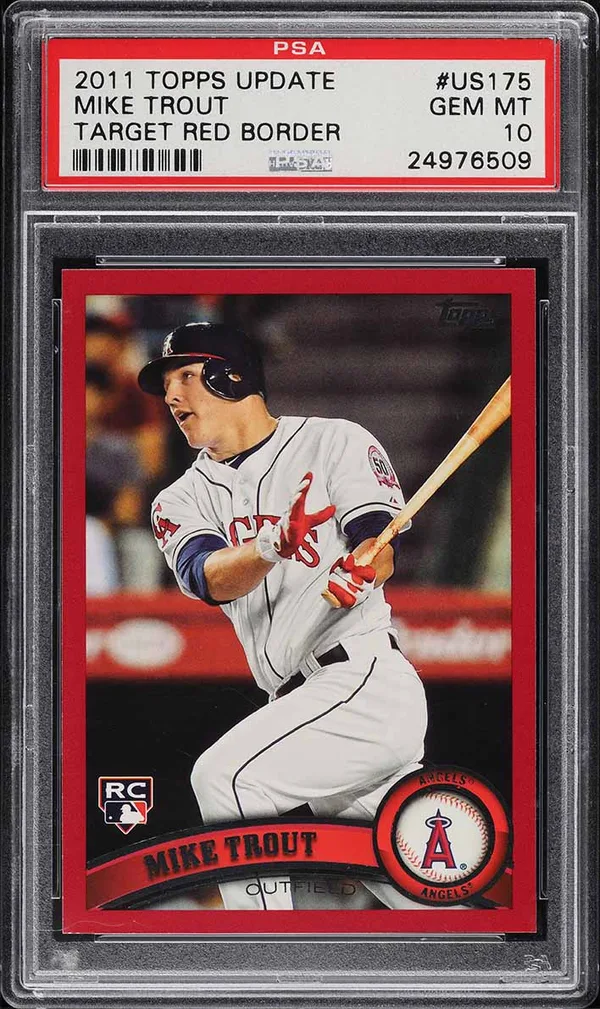
Real sold comps from Graded's pricing engine · 2 sales (eBay & Fanatics).
The Chrome Tier: 2011 Bowman Chrome and the Finest Auto
The 2011 Bowman Chrome Refractor #175 is the class's hidden liquidity: 30 gem comps at $1,920. The base Bowman Chrome #175 is the entry at $750:
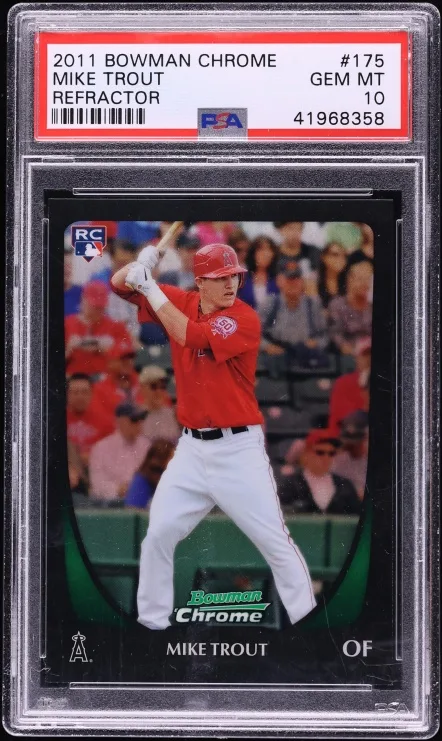
Real sold comps from Graded's pricing engine · 30 sales (eBay & Fanatics).
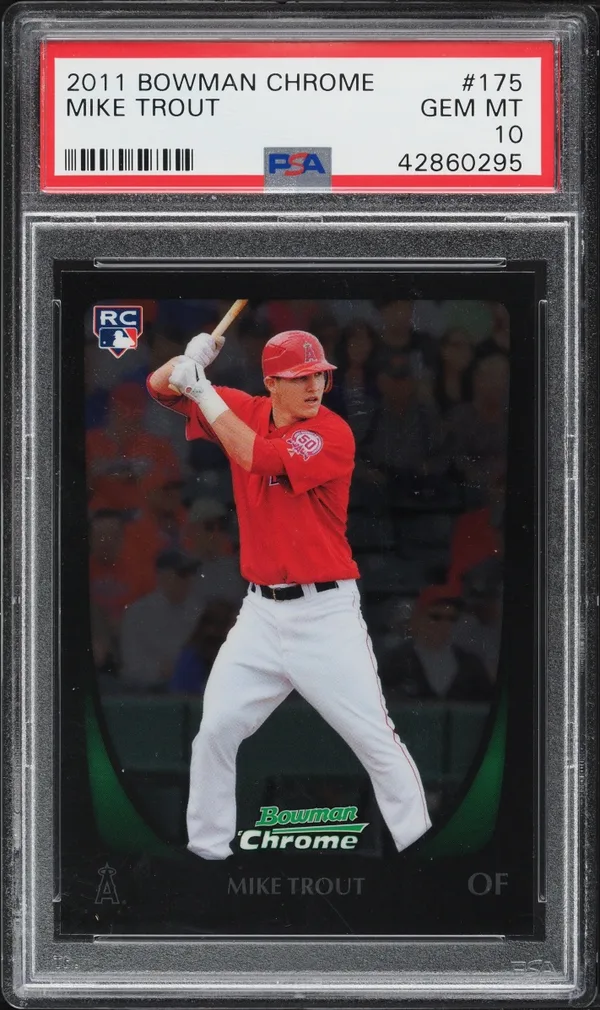
Real sold comps from Graded's pricing engine · 18 sales (eBay & Fanatics).
And the 2011 Finest Gold Refractor auto /75 is the serial rookie autograph: $13,400 on 5 comps, with $28,800 prints at the 2022 highs:
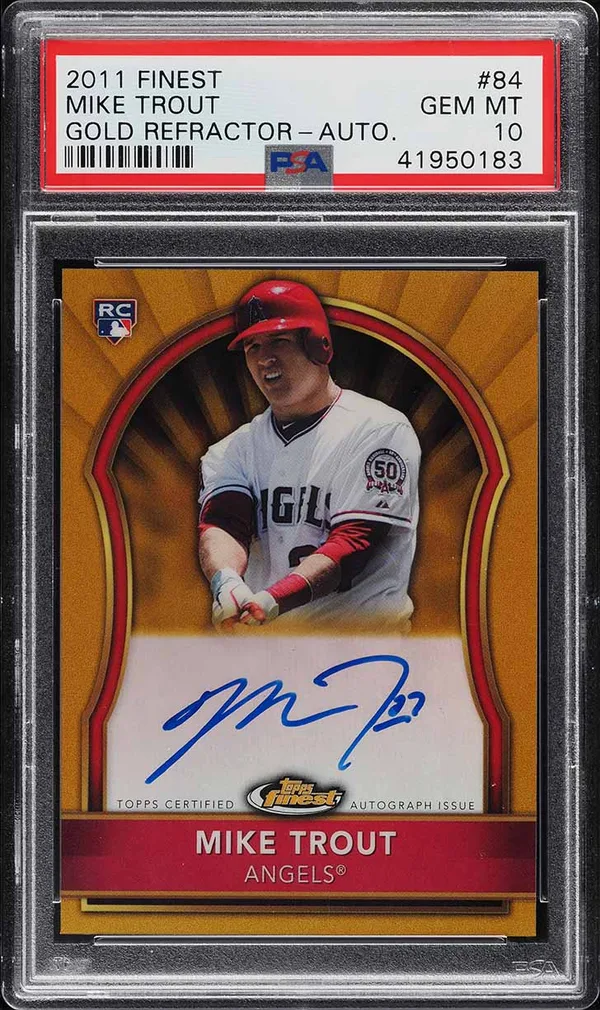
Real sold comps from Graded's pricing engine · 5 sales (eBay & Fanatics).
Reading the Class: Parallel Economics in One Player
- The photo is free, the border is the price: base to Target Red is a 34x spread on identical cardboard. Gem-graded scarcity is the entire difference.
- Retail exclusives beat serials: the unnumbered Target Red ($34,251) trades over the numbered Gold /2011 ($8,350) because nobody saved retail borders in 2011.
- Liquidity lives in the middle: the base Update (32 comps), BC Refractor (30), and Diamond Anniversary (18) are where positions get built.
- The 2021 lesson is priced in: every card in this guide peaked in 2021-22 and has held a lower band since. You are buying the post-cycle market, not the mania.
How High Can Trout Cards Go?
The next catalyst is scripted: retirement, the countdown, and first-ballot induction. The asset class remains tiny:
Total market value: collectibles as an asset class, next to gold, mega-cap tech, and crypto.
The right column is how many times bigger each one is than the entire collectibles market. Collectibles are already a real asset class, larger than a top-ten crypto like Dogecoin, yet still a fraction of a single mega-cap stock and barely a rounding error next to gold. That gap is the runway: as collectibles mature into a transparently priced, investable asset class, the best cards have room to re-rate that the giants no longer do.Figures approximate, 2026: gold = all above-ground gold; equities = market cap; crypto = network value; collectibles = estimated global market size. Bars use a log scale for visibility.
And the returns case is on the board:
Matching Trout Cards to Your Risk Tolerance
Trout is the rare modern ladder whose speculative cycle already resolved. The liquid middle (base Update, BC Refractor, Diamond Anniversary) trades on collector demand, not momentum; the trophies (Target Red, Finest auto) trade on scarcity events. Anchor in the middle, treat the trophies as auctions, and let the retirement cycle be upside rather than thesis.
Why Every Card Here Is a PSA 10
Trout's class is the most-graded rookie class in baseball history, and every card here has a real PSA 10 market, from the Target Red's two comps to the base Update's 32. Our PSA 10 price guide covers the grade math in depth, and the value calculator prices any card instantly.
How to Buy Trout Cards Safely
- Price off sold comps, never listings, via Graded's value calculator.
- 2011 Topps Update vs 2011 Topps: only the Update series card is the rookie. Listings blur them at a 10x spread.
- Border parallels are unlabeled on some slabs: older PSA labels do not always say "Target Red" or "Cognac". Match the card image, not just the label line.
- The 2009 auto has refractor tiers: base, refractor /500, X-Fractor /225, and up. The serial on the card is the truth.
- Trade without shipping risk on Graded's Trading Floor, with instant on-chain escrow.
Investing in Trout Cards on Graded
Everything this guide measures, Graded does live: real fair-market values with the value calculator, authenticated vaulted slabs in the marketplace, live tracking on the Mike Trout index, and instant peer-to-peer settlement on the Trading Floor.
FAQs
What is the best Mike Trout card to invest in?
For most collectors, the 2011 Topps Update #US175 in PSA 10 at $1,020 on 32 comps: the reference rookie of the era's best player. For scarcity, the Target Red Border at $34,251 and the 2009 Bowman Chrome Draft auto at $6,900 on 16 comps are the class trophies.
How much is a Mike Trout rookie card worth?
In PSA 10, the 2011 Topps Update runs $1,020 base, $4,260 Diamond Anniversary, $8,350 Gold /2011, $10,800 Cognac, and $34,251 Target Red Border. The 2009 Bowman Chrome Draft prospect auto trades at $6,900. Every number is a real sold comp from our archive.
What is Mike Trout's true rookie card?
The 2011 Topps Update #US175 carries the RC designation. The 2009 Bowman Chrome Draft #BDPP89 is his first Topps-family card and his rookie-era autograph, printed while he was a 17-year-old draft pick; the market treats both as the class's twin pillars.
Why is the Target Red Border Trout so valuable?
It was a Target-exclusive retail border in 2011 that nobody preserved, and gem copies are now census rarities. Its two archived PSA 10 comps run $12,102 and $56,400, and our fair market value sits at $34,251. Retail exclusives with destroyed populations are the modern hobby's accidental trophies.
Are Mike Trout cards a good investment?
Trout offers an inner-circle career with the speculative cycle already washed out: every card in this guide peaked in 2021-22, repriced, and has held its band since. The liquid middle trades on real collector demand, and the retirement-and-induction news cycle is a scripted future catalyst. The main risk is that baseball's collector base ages; the main case is that all-time greatness eventually gets repriced the way Mantle's was.