The Best Wayne Gretzky Cards to Invest In (2026): The $108,000 Rookie & the Real Grade Ladder
On this page
Hockey's entire card market prices off one piece of 1979 cardboard, and the census explains everything about how it trades: exactly two PSA 10 O-Pee-Chee Gretzky rookies exist against 96 PSA 9s, so the nine is the market. It trades at $108,000 on 41 archived comps, the deepest high-grade tape in the sport. Beneath it runs the whole O-Pee-Chee dynasty run, down to a $372 card from the season he scored 92 goals. This guide maps all of it on real sold comps at the grades that actually trade.
Built the same way as our Mantle, Jordan, and Brady guides: every price below is a real sold comp from Graded's pricing engine (eBay and Fanatics), never an asking price. Eight cards, 1979 to 1986, tracked live on the Wayne Gretzky market index.
Nothing here is financial advice. Cards are a real but volatile asset class. Here's what the data shows.
- The '79 O-Pee-Chee rookie in PSA 9 is hockey's reference asset: $108,000 on 41 comps, with a census of two PSA 10s that trade like museum pieces.
- The '79 Topps twin is the 60% discount: $43,200 in PSA 9 on 35 comps, the same rookie printed for the US market on cleaner stock.
- The '80 O-Pee-Chee is his first real gem market: $35,100 in PSA 10 on 18 comps, the card that starts the PSA 10 era of the run.
- The dynasty run is genuinely collectible: '81 through '86 O-Pee-Chees give the ladder five rungs between $372 and $7,800, each with a real tape.
- Rough-cut O-Pee-Chee is the grade story: OPC's notorious cuts and prints are why the rookie has two gems and why every mid-80s PSA 10 carries a premium.
- Closed-résumé, untouchable records: 2,857 points and records no one will approach. The Great One's bid does not rotate.
The Framework: How Gretzky Cards Actually Trade
- OPC vs Topps is the first decision: O-Pee-Chee printed the Canadian cards on rough stock with bilingual backs; Topps printed the US version. The OPC rookie carries a 2.5x premium on hobby tradition and scarcity in grade.
- The nine is the rookie's market: with two PSA 10s in existence, PSA 9 is where the '79 OPC actually trades, and its 41-comp tape is hockey's deepest.
- Gem markets start in 1980: from the second year on, PSA 10s exist in tradeable numbers, and the guide switches to gem pricing accordingly.
- Every season is a story: 92 goals ('81-82 season, on the '82 card), 215 points ('85-86, on the '86 card). The run sells history, not just cardboard.
The Gretzky Card Ladder
Eight cards, each at its tracked grade, on real sold comps:
Bars use a logarithmic scale so every rung is visible. Every value is a real sold comp at the labeled grade. The 1979 rookies track PSA 9 because exactly two PSA 10 O-Pee-Chee rookies exist.
1979 O-Pee-Chee #18: The Rookie, in Its Real Grade
The engine has 41 archived PSA 9 sales:
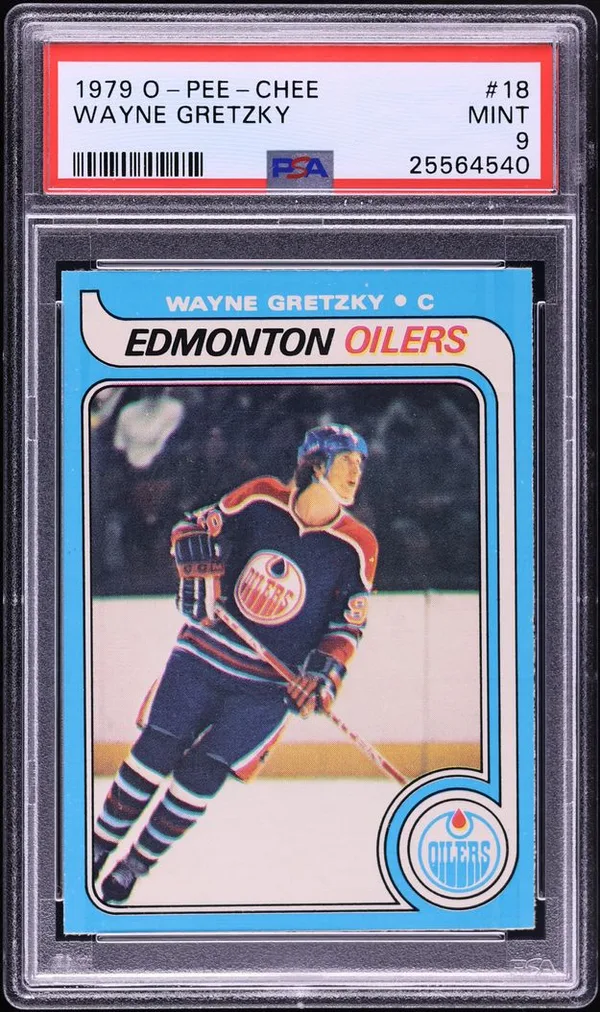
Real sold comps from Graded's pricing engine · 41 sales (eBay & Fanatics).
$108,000 fair market value, with a $132,000 print in June 2026. The curve shows a healthy trophy market: a $204,000 peak in 2021, a repricing through 2023-2025, and higher prints returning in 2026. The two PSA 10s in the census have traded hands at seven figures privately; the PSA 9 is where hockey's most important card actually has a market, and 41 comps make it more liquid than most cards at a hundredth of the price.
1979 Topps #18: The Twin at a Discount
Real PSA 9 sales:
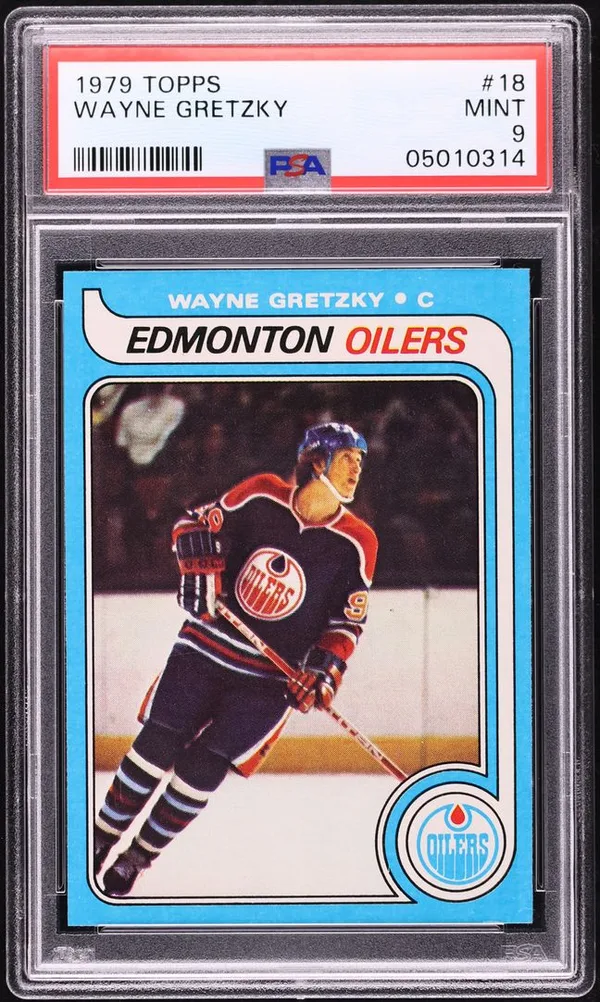
Real sold comps from Graded's pricing engine · 35 sales (eBay & Fanatics).
$43,200 on 35 comps: the same rookie card, US-printed on cleaner stock, at 40% of the OPC's price. The Topps gem census is larger, its nines are plentiful, and the discount has narrowed in every bull cycle. This is the classic twin trade of vintage hockey.
1980 O-Pee-Chee #250: The First Gem Market
Real PSA 10 sales:
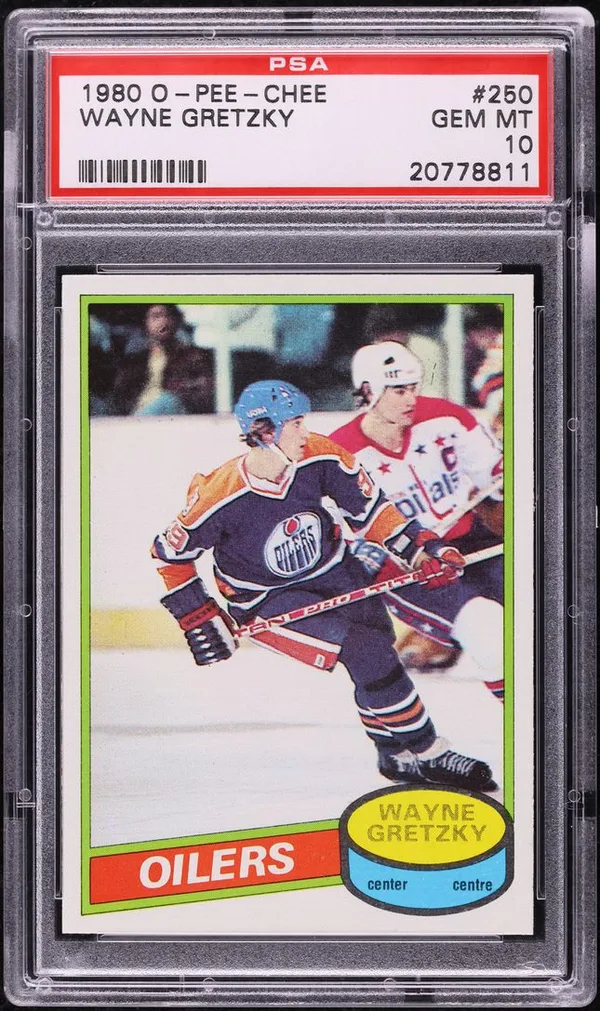
Real sold comps from Graded's pricing engine · 18 sales (eBay & Fanatics).
$35,100 on 18 gem comps ($60,400 top print). His second-year card is the first Gretzky with a functioning PSA 10 market, which makes it the bridge between the rookie's nine-market and the gem pricing of everything after. Scarcity in ten keeps this the run's second-most valuable card.
The Dynasty Run: 1981-1986 O-Pee-Chee
The 1985 O-Pee-Chee #120 is the toughest mid-80s gem, $7,800 on 16 comps ($11,400 top print). The 1986 #3, from his 215-point season, trades at $2,205:
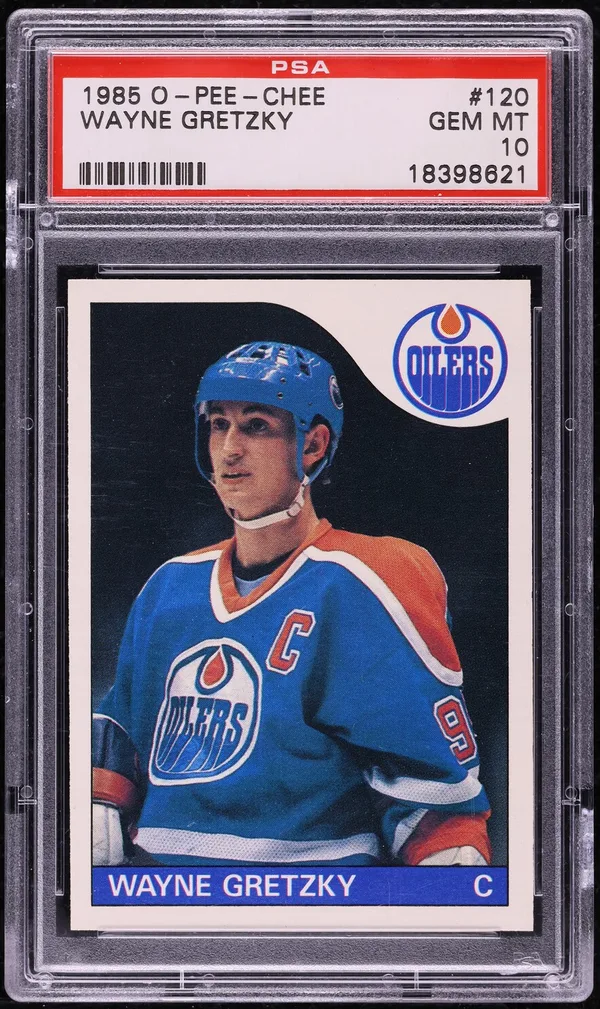
Real sold comps from Graded's pricing engine · 16 sales (eBay & Fanatics).
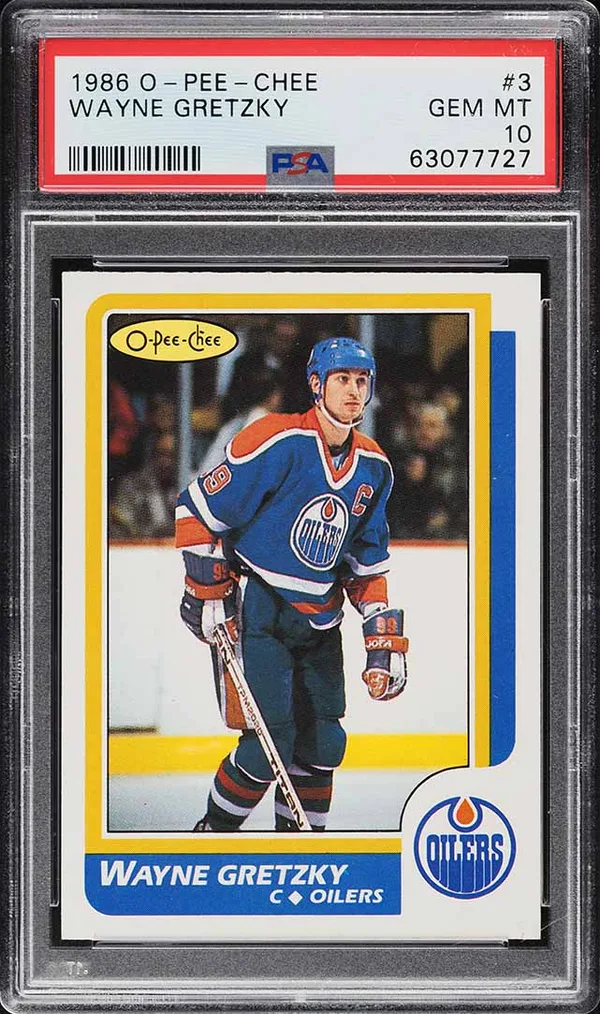
Real sold comps from Graded's pricing engine · 12 sales (eBay & Fanatics).
The 1984 #243 (24 gem comps at $1,920) is the liquid gem of the run. The 1981 #106 tracks PSA 9 at $955 on 27 comps, and the 1982 #106, the card of the 92-goal season, is the entry at $372:
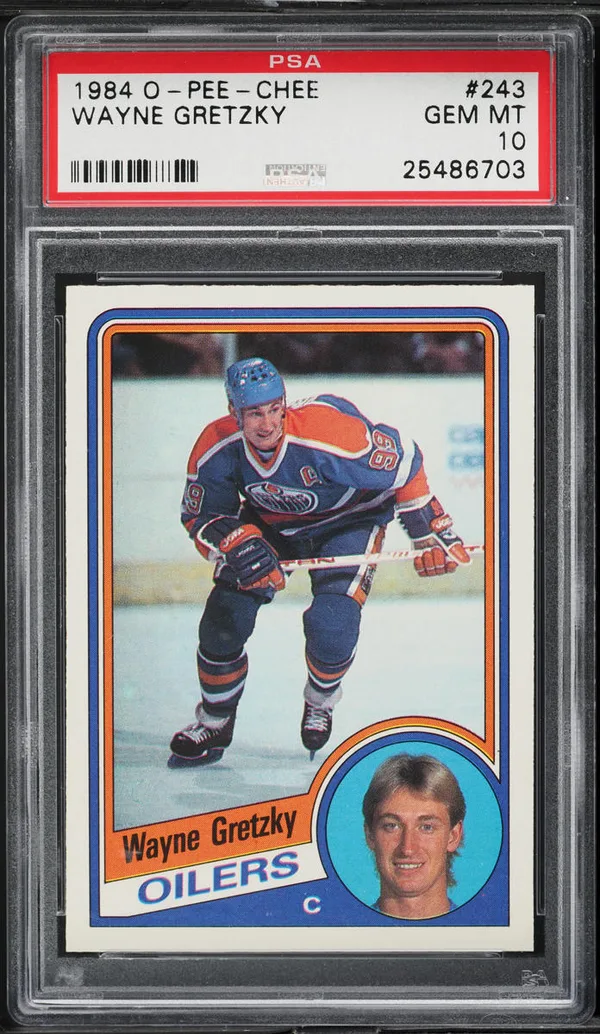
Real sold comps from Graded's pricing engine · 24 sales (eBay & Fanatics).
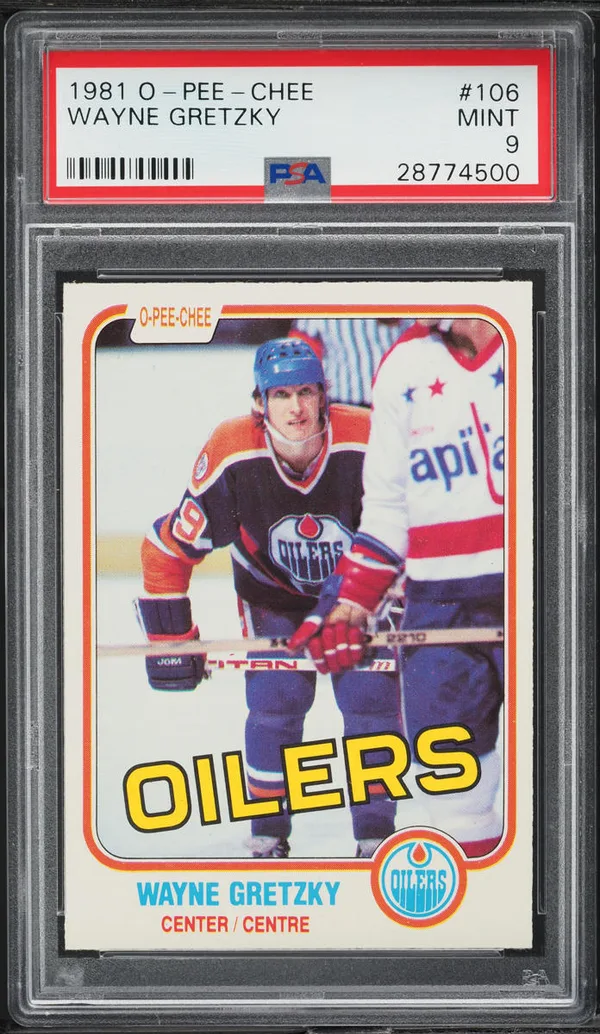
Real sold comps from Graded's pricing engine · 27 sales (eBay & Fanatics).
Real sold comps from Graded's pricing engine · 17 sales (eBay & Fanatics).
Reading the Run: Census Truth and the OPC Premium
- Two gems, one market: pricing the '79 OPC off a PSA 10 is quoting a card that trades once a decade. The nine is the asset.
- The OPC premium is tradition plus scarcity: rough cuts destroyed OPC print quality, so its high grades are structurally scarcer than Topps at every year.
- The mid-80s gems are sleepers: the '85 at $7,800 and '86 at $2,205 trade on tapes most collectors do not know exist.
- Liquidity lives in nines: the rookie's 41 comps and the '81's 27 are the two deepest tapes in the guide.
How High Can Gretzky Cards Go?
The rookie's nine printed $204,000 at the 2021 peak, repriced, and is climbing again on 2026 prints. The asset class it anchors is still tiny:
Total market value: collectibles as an asset class, next to gold, mega-cap tech, and crypto.
The right column is how many times bigger each one is than the entire collectibles market. Collectibles are already a real asset class, larger than a top-ten crypto like Dogecoin, yet still a fraction of a single mega-cap stock and barely a rounding error next to gold. That gap is the runway: as collectibles mature into a transparently priced, investable asset class, the best cards have room to re-rate that the giants no longer do.Figures approximate, 2026: gold = all above-ground gold; equities = market cap; crypto = network value; collectibles = estimated global market size. Bars use a log scale for visibility.
And the returns case is on the board:
Matching Gretzky Cards to Your Risk Tolerance
Gretzky is a closed-résumé ladder whose records are actuarially safe. Anchor in the rookie nines (the OPC if capital allows, the Topps twin otherwise), use the '84 and '86 gems as the liquid middle, and treat the '80 OPC ten as the trophy. Hockey's collector base is smaller than basketball's, which cuts both ways: thinner exits, and a reference asset still priced below its cross-sport peers.
Why the Rookies Are Not Quoted in PSA 10
Two PSA 10 O-Pee-Chee rookies exist. Every table on this page and the live index quotes the grade that actually trades, labeled per card. The full grade math is in our PSA 10 price guide, and the value calculator prices any card at any grade.
How to Buy Gretzky Cards Safely
- Price off sold comps at the exact grade, via Graded's value calculator.
- OPC vs Topps at a 2.5x spread: the backs differ (bilingual vs English). The label says which one you own.
- Assume trimming on high-grade OPC. Rough factory cuts invite razors. Cert-verified slabs only.
- Beware the 1979 reprints, which have circulated for decades. Raw "deals" on this rookie are not deals.
- Trade without shipping risk on Graded's Trading Floor, with instant on-chain escrow.
Investing in Gretzky Cards on Graded
Everything this guide measures, Graded does live: real fair-market values with the value calculator, authenticated vaulted slabs in the marketplace, live tracking on the Wayne Gretzky index, and instant peer-to-peer settlement on the Trading Floor.
FAQs
What is the best Wayne Gretzky card to invest in?
The 1979 O-Pee-Chee rookie #18 in PSA 9: $108,000 on 41 archived comps, hockey's reference asset. The 1979 Topps twin at $43,200 is the value entry to the same rookie, and the 1980 O-Pee-Chee at $35,100 is the run's first real PSA 10 market.
How much is a Wayne Gretzky rookie card worth?
In PSA 9, about $108,000 for the 1979 O-Pee-Chee (June 2026 print $132,000) and $43,200 for the 1979 Topps. PSA 8s trade in the $20,000s and $10,000s respectively. The two PSA 10 OPC rookies in existence have traded privately at seven figures.
Why is the Gretzky rookie priced in PSA 9?
Because the PSA 10 census is two copies: O-Pee-Chee's rough 1979 print run made gem copies nearly impossible. The PSA 9, with 96 in the census and 41 archived sales, is where the card actually has a market.
O-Pee-Chee or Topps Gretzky rookie: which should I buy?
The OPC is the hobby's canonical version and carries a 2.5x premium; the Topps is the same card with a deeper gem census and better liquidity per dollar. Buy the OPC for the trophy, the Topps for the position, and never pay OPC money for a Topps slab.
Are Wayne Gretzky cards a good investment?
Gretzky pairs untouchable records with a closed résumé and the deepest high-grade tape in hockey. The 2021-2026 curve shows a trophy that repriced and recovered. The structural consideration is hockey's smaller collector base: thinner than basketball, but with a reference asset priced accordingly.