The Best Larry Bird Cards to Invest In (2026): The $438,000 Tri-Panel & the Full Ladder, in PSA 10
On this page
Larry Bird's rookie card is one third Larry Bird: the 1980 Topps Bird/Erving/Magic tri-panel, the most valuable card of basketball's pre-Jordan era, with 24 PSA 10s and an $840,000 peak print. His first solo card, the 1981 Topps #4, trades at $19,800 on 26 gem comps and is the class's underpriced grail. Beneath them: the Fleer run and a junk-wax tier that starts at $60. This guide maps all of it on real sold comps.
Built the same way as our Jordan, Magic, and Kobe guides: every price below is a real PSA 10 sold comp from Graded's pricing engine (eBay and Fanatics), never an asking price. Ten cards, 1980 to 1990, tracked live on the Larry Bird market index.
Nothing here is financial advice. Cards are a real but volatile asset class. Here's what the data shows.
- The tri-panel rookie is pre-Jordan basketball's trophy: $438,000 fair market value on nine gem comps, $840,000 peak, pop 24, shared with Magic Johnson and Julius Erving.
- The 1981 Topps #4 is the solo grail: his first individual card, $19,800 on 26 comps, at 4.5% of the tri-panel's price.
- The regional East #101 is the sleeper: a second 1981 Bird most collectors have never seen, $13,800 on nine comps.
- The 1986 Fleer pair is the liquid core: #9 at $8,700 on 47 comps and the Sticker at $10,999 on 32, the deepest Bird tapes in the archive.
- Every card in this guide is quoted in PSA 10: even the 1980 tri-panel has a working gem market, rare for its era.
- The rivalry is the demand engine: Bird-Magic is the story that saved the NBA, and their shared rookie makes the two markets one trade.
The Framework: What Makes a Bird Card an Investment
- One rookie, three legends: Topps put Bird, Erving, and Magic on a single 1980 panel. Both Bird and Magic collectors bid the same card, doubling its demand base.
- The perforation is the grade story: the tri-panel came perforated; gem copies survive by miracle, and single separated panels are near-worthless. Pop 24 tells the tale.
- 1981 Topps is scarcity by apathy: basketball cards barely sold in 1981, and the set was distributed regionally. His first solo card is structurally scarce.
- Closed résumé, permanent rivalry: three MVPs, three rings, and the Bird-Magic story that never stops recruiting new collectors.
The Larry Bird Card Ladder
Ten cards, on real PSA 10 sold comps:
Bars use a logarithmic scale so every rung is visible. Every value is a real PSA 10 sold comp, not an asking price.
1980 Topps Bird/Erving/Magic: The Shared Rookie
The engine has every archived PSA 10 sale:
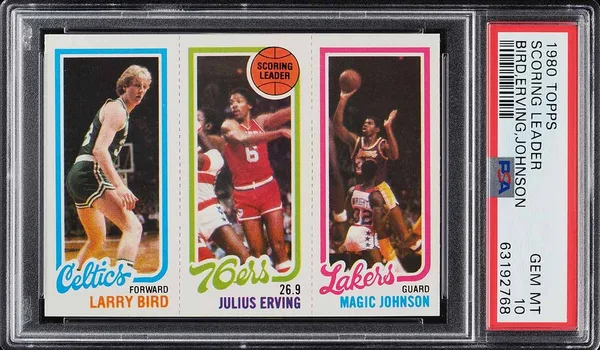
Real sold comps from Graded's pricing engine · 9 sales (eBay & Fanatics).
$438,000 fair market value on the 2024-2025 prints. The tape runs $14,450 (2012) through $125,200 (2018) to the $840,000 peak (April 2022), then a four-print band between $432,000 and $492,000 that has held for two years. Twenty-four PSA 10s exist of the perforated tri-panel, and it is the one card in basketball that two GOAT-tier fanbases bid on simultaneously.
1981 Topps #4: The First Solo Card
Real PSA 10 sales:
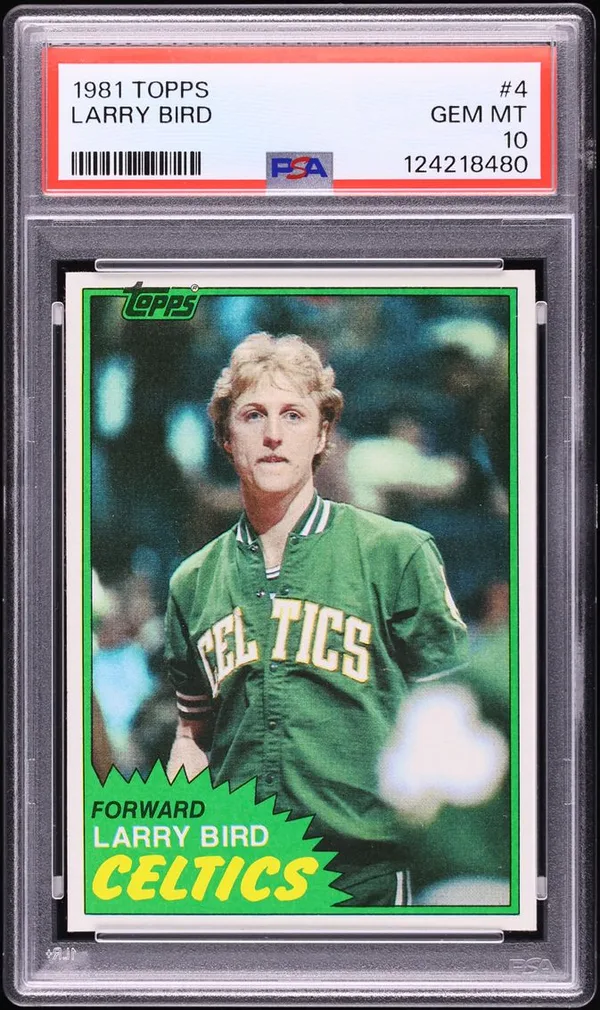
Real sold comps from Graded's pricing engine · 26 sales (eBay & Fanatics).
$19,800 on 26 gem comps ($27,500 top print). This is the first card that is entirely Larry Bird, from a regionally-distributed set nobody collected in 1981. At 4.5% of the tri-panel it is the class's clearest relative-value trade, and its 26-comp tape makes it genuinely liquid for a five-figure vintage card.
1981 Topps East #101: The Regional Sleeper
Real PSA 10 sales:
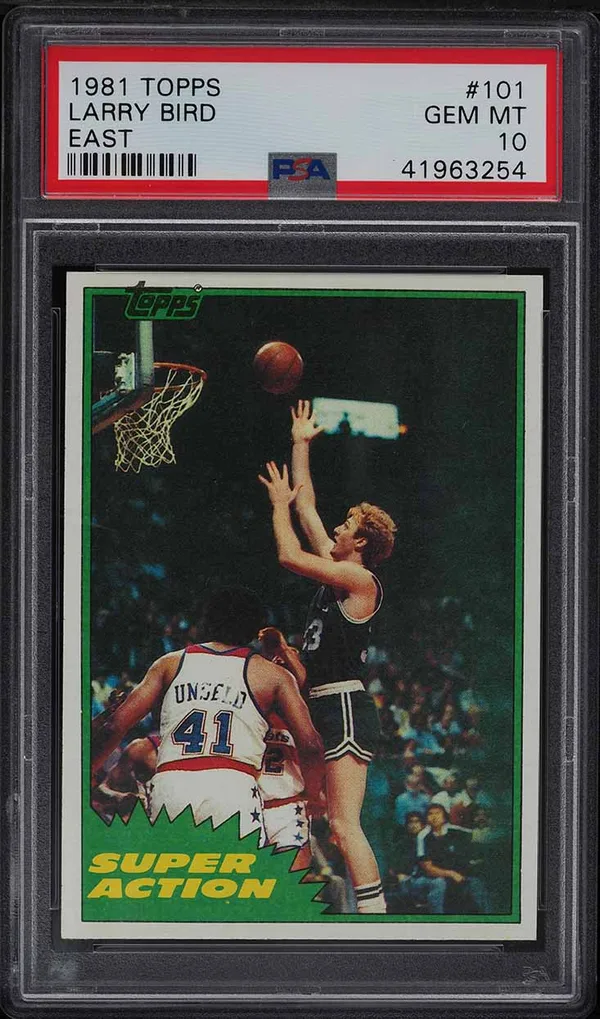
Real sold comps from Graded's pricing engine · 9 sales (eBay & Fanatics).
$13,800 on nine comps ($23,000 top print). The 1981 set had regional subsets, and the East #101 Bird is the version most collectors have never encountered. Thin tape, real scarcity, and a discount to the #4 that closes a little every cycle.
The 1986 Fleer Pair: #9 and the Sticker
The 1986 Fleer #9 is the liquid core of the Bird market, $8,700 on 47 comps. The Sticker #2 trades above it at $10,999 on 32:
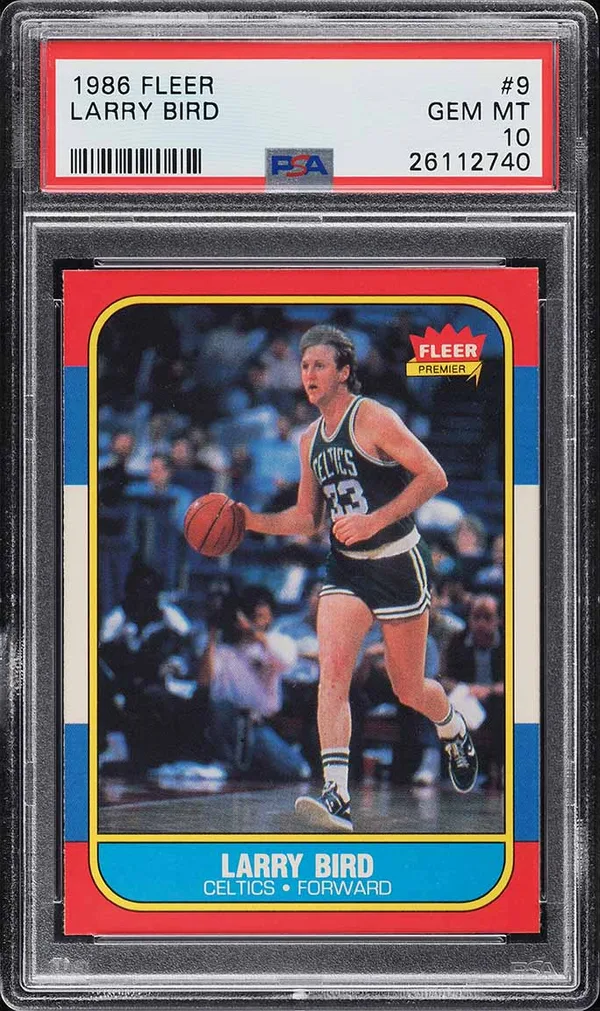
Real sold comps from Graded's pricing engine · 47 sales (eBay & Fanatics).
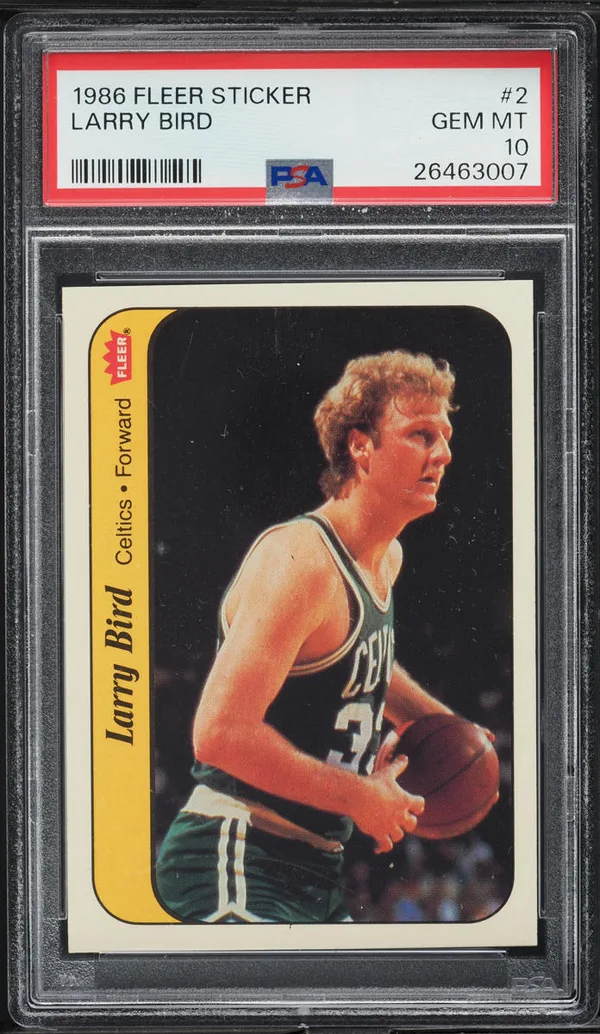
Real sold comps from Graded's pricing engine · 32 sales (eBay & Fanatics).
Same product that made the Jordan rookie, same scarcity class, and the same sticker-over-base inversion Jordan's market shows: the one-per-pack sticker is scarcer in gem than the base card.
The Late Run: '87 Fleer to '90 Hoops
The 1987 Fleer #11 is the second-year card at $1,325, and the 1988 Fleer #20 is the liquid junk-wax entry, $307 on 45 comps:
Real sold comps from Graded's pricing engine · 13 sales (eBay & Fanatics).
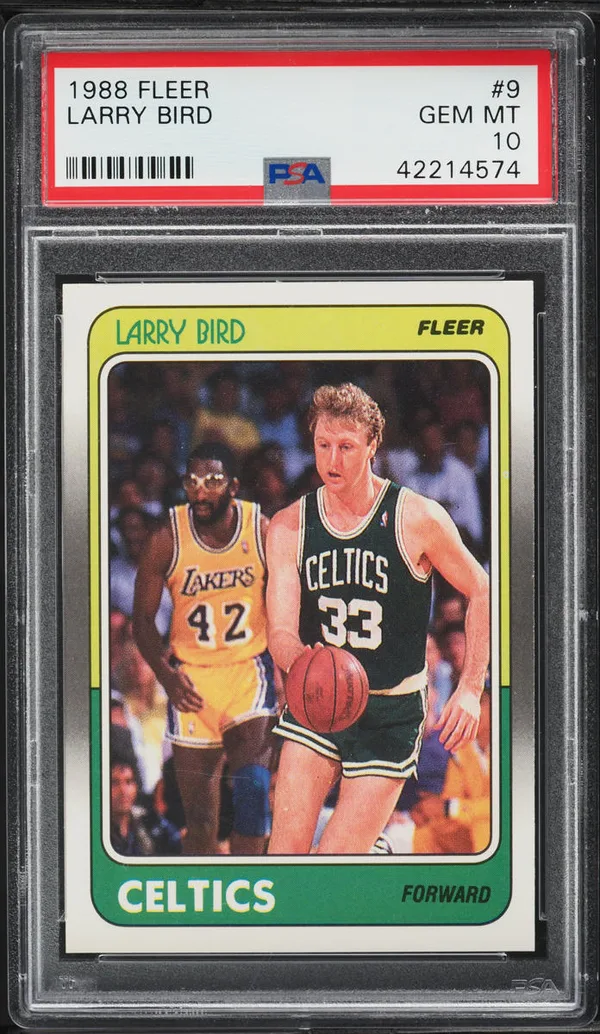
Real sold comps from Graded's pricing engine · 45 sales (eBay & Fanatics).
The 1989 Fleer ($250), 1989 Hoops #150 ($60 on 28 comps), and 1990 Hoops ($63) close the ladder as pocket-money gems of a three-MVP career:
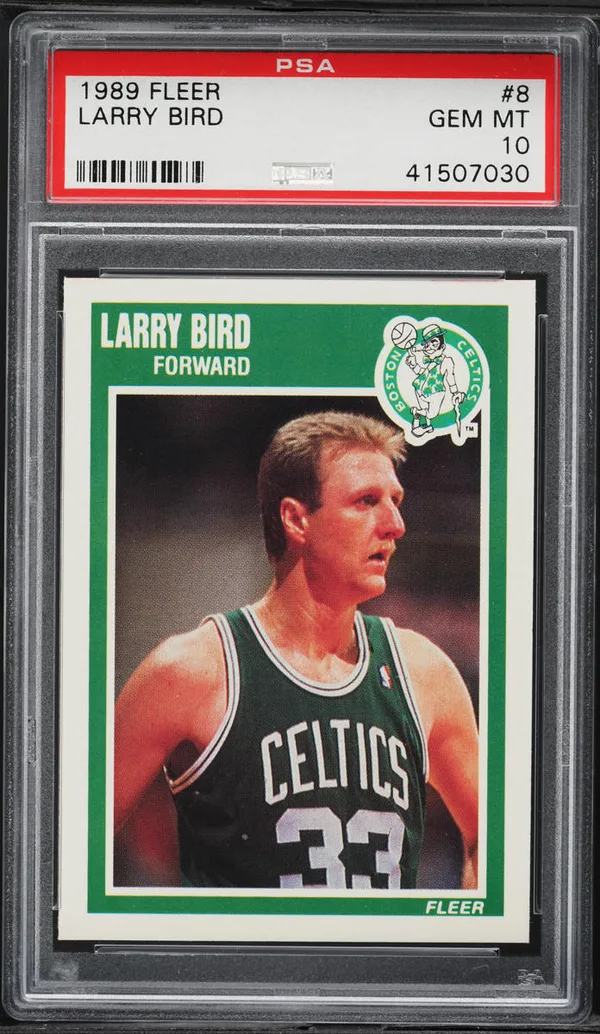
Real sold comps from Graded's pricing engine · 17 sales (eBay & Fanatics).
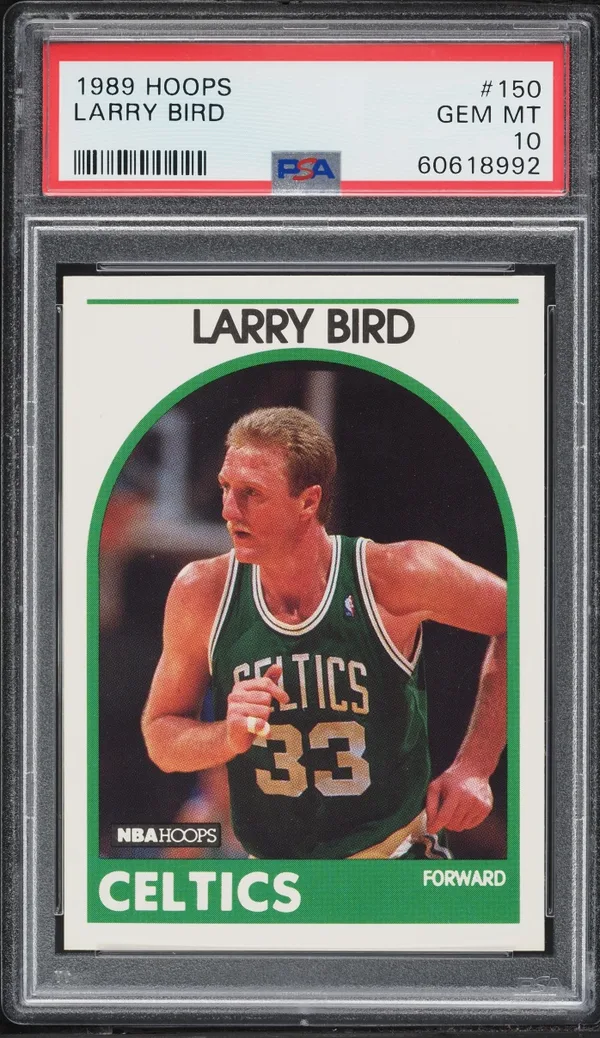
Real sold comps from Graded's pricing engine · 28 sales (eBay & Fanatics).
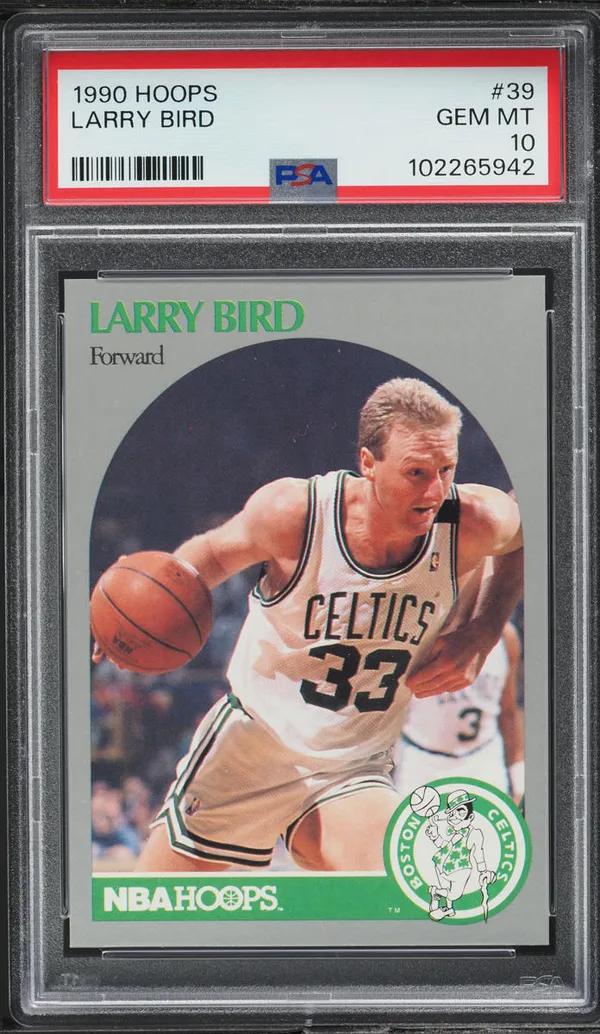
Real sold comps from Graded's pricing engine · 6 sales (eBay & Fanatics).
Reading the Class: One Card, Two Fanbases
- The tri-panel is a two-player asset: it is simultaneously the most valuable Bird card and the most valuable Magic card. Read both markets before bidding.
- Never buy separated panels: cut singles from the perforated card trade for a tiny fraction and pollute listings constantly.
- The solo-card discount is the trade: the '81 #4 at 4.5% of the tri-panel is the widest legend-rookie gap in the sport.
- Liquidity lives in Fleer: 47 and 32 comps on the 1986 pair; positions get built there.
How High Can Bird Cards Go?
The tri-panel's $432,000-$492,000 band has held for two years after the 2022 spike, and the '81 solo keeps printing new highs. The asset class remains tiny:
Total market value: collectibles as an asset class, next to gold, mega-cap tech, and crypto.
The right column is how many times bigger each one is than the entire collectibles market. Collectibles are already a real asset class, larger than a top-ten crypto like Dogecoin, yet still a fraction of a single mega-cap stock and barely a rounding error next to gold. That gap is the runway: as collectibles mature into a transparently priced, investable asset class, the best cards have room to re-rate that the giants no longer do.Figures approximate, 2026: gold = all above-ground gold; equities = market cap; crypto = network value; collectibles = estimated global market size. Bars use a log scale for visibility.
And the returns case is on the board:
Matching Bird Cards to Your Risk Tolerance
Bird is a closed-résumé ladder with a two-fanbase trophy. Anchor in the 1986 Fleer pair for liquidity, hold the '81 #4 as the growth position, and treat the tri-panel as the auction event it is. The junk-wax tier is accumulation without stress.
Why Every Card Here Is a PSA 10
Unusually for a 1980s class, every Bird card in this guide has a working PSA 10 market, from the tri-panel's nine comps to the Fleer's 47. Our PSA 10 price guide covers the grade math in depth, and the value calculator prices any card instantly.
How to Buy Bird Cards Safely
- Price off sold comps, never listings, via Graded's value calculator.
- Whole panel or nothing: the 1980 rookie must be the intact tri-panel. Separated singles and hand-cut cards are a different, near-worthless market.
- #4 vs East #101 vs leaders cards: 1981 Topps has multiple Birds. The label and number are the truth.
- Sticker ≠ base on 1986 Fleer, same as the Jordan market. The sticker says Sticker.
- Trade without shipping risk on Graded's Trading Floor, with instant on-chain escrow.
Investing in Bird Cards on Graded
Everything this guide measures, Graded does live: real fair-market values with the value calculator, authenticated vaulted slabs in the marketplace, live tracking on the Larry Bird index, and instant peer-to-peer settlement on the Trading Floor.
FAQs
What is the best Larry Bird card to invest in?
The 1980 Topps Bird/Erving/Magic tri-panel if capital allows: $438,000 on nine gem comps with two fanbases bidding. For most collectors, the 1981 Topps #4 solo rookie at $19,800 on 26 comps is the class's best relative value, and the 1986 Fleer #9 at $8,700 on 47 comps is the liquid core.
How much is a Larry Bird rookie card worth?
The 1980 Topps tri-panel trades at $438,000 in PSA 10 (peak $840,000 in 2022), roughly $25,200 in PSA 9, and four figures in PSA 8. His first solo card, the 1981 Topps #4, trades at $19,800 in PSA 10. Every number is a real sold comp.
Why does Larry Bird share his rookie card?
Topps returned to basketball in 1980 with perforated three-player panels, and put Bird, Julius Erving, and Magic Johnson on one card. Both rookies debuted on it, which is why it anchors both players' markets and why intact gem copies are census events.
What is the 1981 Topps Larry Bird East card?
The 1981 Topps set included regional subsets, and East #101 is a second Bird card distributed only in Eastern markets. It trades at $13,800 in PSA 10 on nine comps, a sleeper most collectors have never seen.
Are Larry Bird cards a good investment?
Bird pairs a closed three-MVP résumé with the sport's greatest rivalry story and a trophy two fanbases bid on. The tri-panel's band has held for two years post-spike, the solo rookie keeps appreciating, and the Fleer tier gives the ladder real liquidity. Anchor in Fleer, grow in the '81, trophy in the tri-panel.