
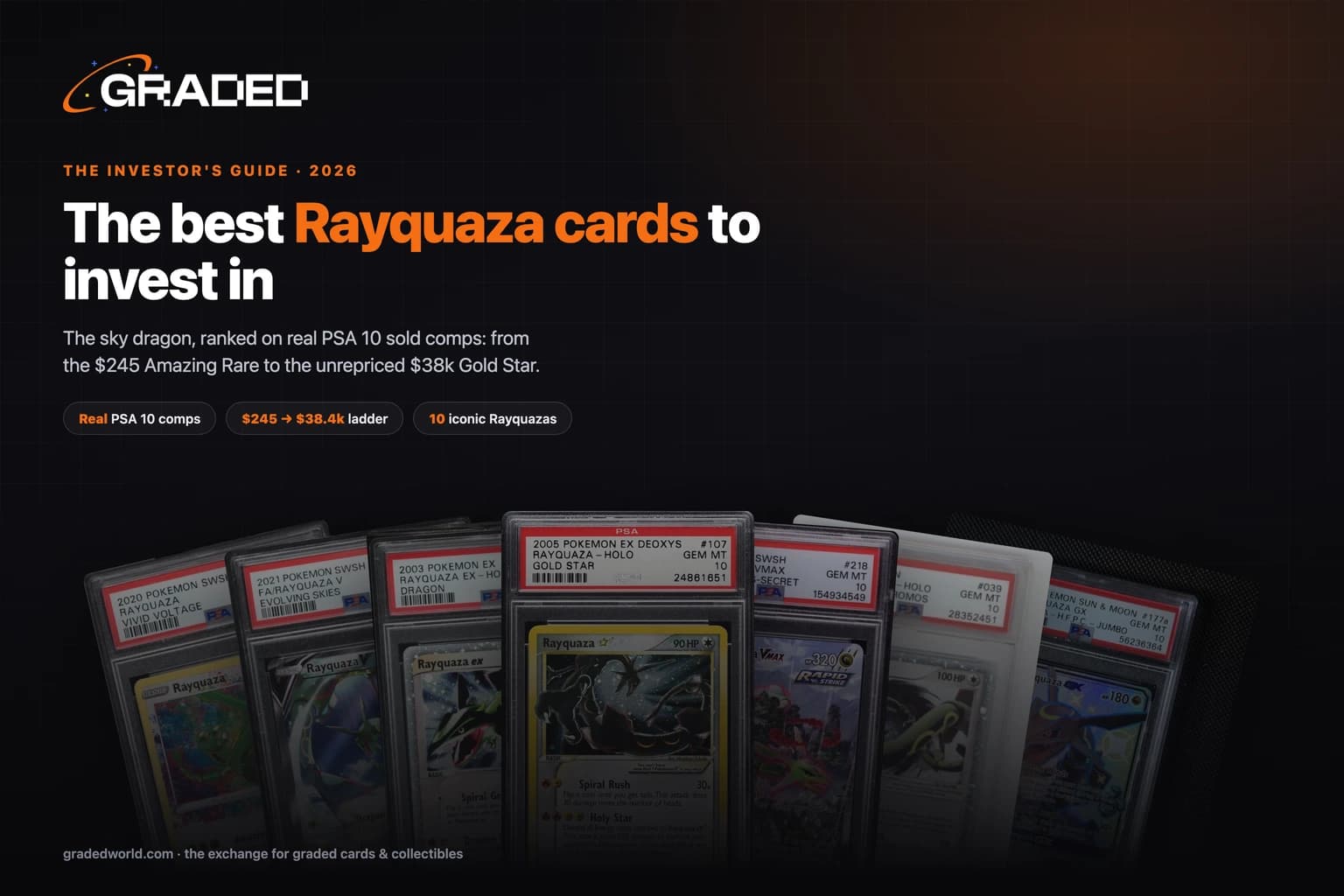
The Best Rayquaza Cards to Invest In (2026): The Unrepriced Gold Star & Every Era's Dragon, in PSA 10
On this page
- 01The Rayquaza framework
- 02The Rayquaza card ladder
- 03Rayquaza Gold Star
- 04EX Dragon Rayquaza ex
- 05Roaring Skies Full Art
- 06Black Star Promo ex
- 07Evolving Skies VMAX Alt
- 08Evolving Skies V Alt
- 09Shiny Rayquaza GX
- 10The liquid tier
- 11The star, the ex & the premium
- 12How high can they go?
- 13Match cards to your risk
- 14How to buy safely
- 15Investing on Graded
Every Gold Star repriced in 2026: Charizard $100,000, Pikachu $114,000, Umbreon $168,000, Mew $192,000. Every one except Rayquaza's. The sky dragon's star last printed $38,400 in late 2023, and while no gem has traded since, its PSA 9s have quietly run to $27,000. That gap is the single most interesting setup in Pokémon investing right now, and it headlines a Rayquaza market that repriced everywhere else: the EX Dragon ex ran to $15,600, the Roaring Skies full art printed $13,562, and the Evolving Skies alt arts remain modern icons.
This guide ranks the best Rayquaza cards to invest in, built the same way as the rest of this series (the Pokémon pillar, Charizard, Umbreon, Mew): on real numbers. Every price below is a real PSA 10 sold comp from Graded's pricing engine (eBay and Fanatics), not an asking price. Ten cards, every era, $245 to $38,400, and how to buy each one safely.
Nothing here is financial advice. Cards are a real but volatile asset class, and you should never put in money you can't afford to lose. Here's what the data shows.
- The Rayquaza Gold Star is the last unrepriced Gold Star. Its last real PSA 10 print is $38,400 (December 2023), while its classmates set records of $100,000-$192,000 in 2026 and its own PSA 9s ran to $27,000. The next gem to surface prints the new market.
- Every card in this guide is quoted in PSA 10, because in Rayquaza collecting the gem is the asset: the same EX Dragon ex is $2,000 in PSA 9 and $15,600 in PSA 10.
- The ex-era dragons repriced hard: the EX Dragon Rayquaza ex ran from $1,650 in early 2025 to $15,600 in April 2026 (9×), and the 2006 promo ex printed $13,112.
- The thin-market full arts are moving: the 2015 Roaring Skies FA printed $10,156 and $13,562 on a near-zero gem float.
- The Evolving Skies pair is the modern core: the VMAX alt art around $3,120 on 105 real comps, its V alt sibling around $1,470 on 87.
- Rayquaza has the deepest budget tier in the dragon class: the Amazing Rare ($245 on 179 comps), TG20 ($600 on 138), and the shiny GX ($870) all trade daily.
The Framework: What Makes a Rayquaza Card an Investment
Every card below passes the same five-part filter we use across this series. Rayquaza's twist: the sky dragon is the hobby's purest class-arbitrage market. Its cards belong to scarcity classes whose other members already repriced, which means most of the analysis writes itself; you're not asking whether these printings are scarce, you're asking why one of them is still quoted like it's 2023.
- Apex demand. Rayquaza is the franchise's definitive dragon after Charizard itself, the legendary that headlines every era it appears in, from Emerald's box to the Evolving Skies print run.
- The print run is the asset. One character, one rule: the star, the exes, and the promos carry the scarcity; the set cards carry the liquidity.
- Class arbitrage is live. Rayquaza's Gold Star is the only member of its class that hasn't repriced publicly. Classes converge; that's the whole 2026 lesson.
- Gem scarcity is the moat. Black-bordered ex-era holos and full arts gem brutally; the 9-17× gem premiums across this list are the proof.
- Liquidity is modern. Evolving Skies and its reprints trade daily; the vintage tier trades quarterly. Match size to exits.
The Rayquaza Card Ladder
Ten cards, every era, on real PSA 10 sold comps:
Bars use a logarithmic scale so every rung is visible. Every value is a real 2025-2026 PSA 10 sold comp, not an asking price.
Read it as four tiers. The liquid entries (Amazing Rare, TG20, the Deoxys holo) are the on-ramp, all under $650 with daily volume. The modern alt arts hold the four-figure middle with the deepest premium markets of their era. The ex-era sleepers and the Roaring Skies full art form the repriced five-figure band, every one of them printed 3-9× moves inside eighteen months. And the Gold Star sits alone at the top, quoted off a 2023 print that the entire class above and below it says is stale.
2005 EX Deoxys Rayquaza Gold Star: The Unrepriced Grail
The Rayquaza Gold Star #107 is the sky-high chase of EX Deoxys and one of the most recognizable Gold Stars ever printed. Real PSA 10 sales:
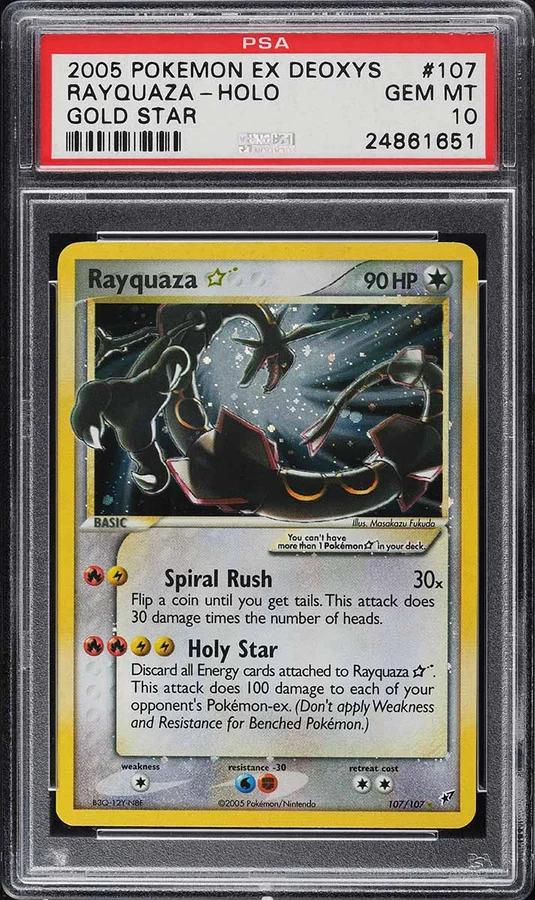
Real sold comps from Graded's pricing engine · 4 sales (eBay & Fanatics).
The star's history explains the setup. Gold Stars were pulled roughly once per two booster boxes in the mid-2000s, and Rayquaza's, from EX Deoxys in 2005, spent fifteen years as the poster child of the series alongside Charizard's. Four gem prints between $34,200 and $39,600, all from 2022-2023, and nothing since. Meanwhile its classmates repriced in sequence (Charizard $100,000, Pikachu $114,000, Umbreon $168,000, Mew $192,000), and Rayquaza's own PSA 9s ran to $27,000. Either the star is the class's bargain or the class overshot; the next gem print answers it, and everything about the 2026 tape says it answers high.
2003 EX Dragon Rayquaza ex: The 9× Sleeper
The EX Dragon Rayquaza ex #97 fronts the set that opened the ex era, and its 2026 tape is the sharpest on this list:
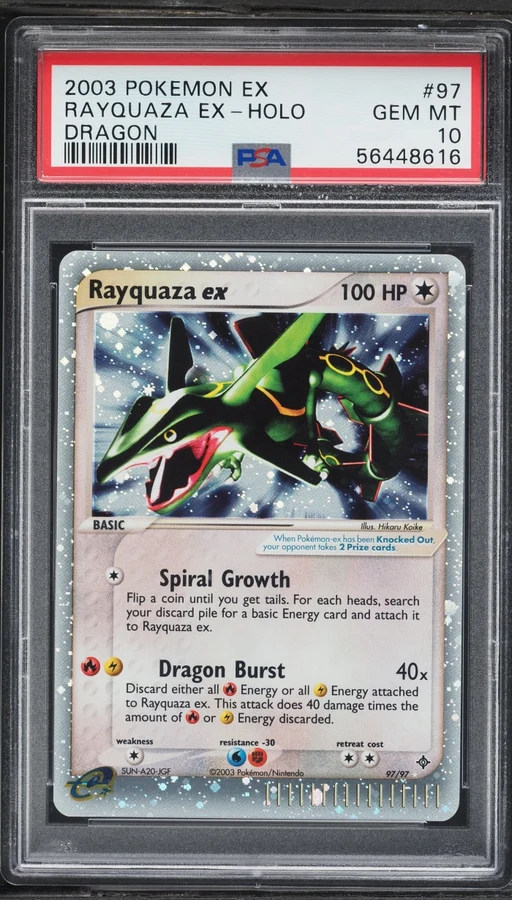
Real sold comps from Graded's pricing engine · 3 sales (eBay & Fanatics).
From $1,650 in February 2025 to $15,600 in April 2026: a 9× move matching its class (the Dragon Frontiers Dragonite ex ran 10× over the same window, and the Unseen Forces Lugia ex 5×). The ex-era secret rares are repricing as a class, and this is the class's namesake dragon. PSA 9s around $2,000 are the entry.
2015 Roaring Skies Rayquaza EX Full Art: The Thin-Market FA
The Roaring Skies full art #104 is the definitive card of Rayquaza's own 2015 set, printed in the hobby's quietest era. Real PSA 10 sales:
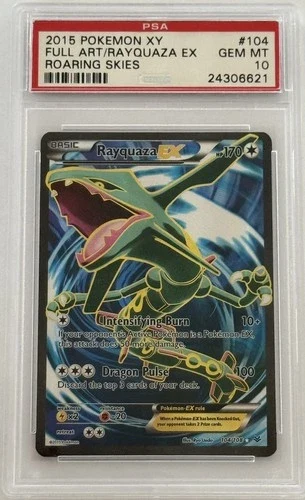
Real sold comps from Graded's pricing engine · 2 sales (eBay & Fanatics).
Two recent prints, $10,156 and $13,562, on a gem float that barely exists: XY-era full arts came out of packs with edge wear, and almost nobody graded them for a decade. It's the forgotten-era arithmetic that repriced the HGSS Primes and e-Series holos, working through the XY window. One-print market rules apply; the PSA 9 around $500 is the sane entry.
2006 Black Star Promo Rayquaza ex: The Promo Sleeper
The promo Rayquaza ex #39, a Nintendo-era box topper, is the scarcest ex on this list by distribution. Real PSA 10 sales:
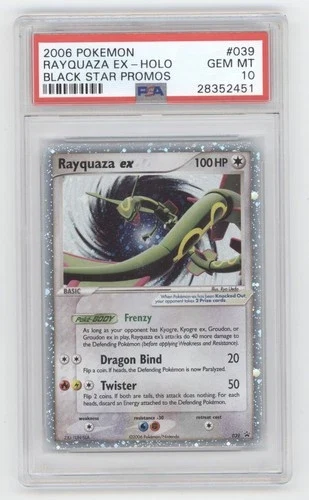
Real sold comps from Graded's pricing engine · 2 sales (eBay & Fanatics).
Two recent gems: $4,080 (January 2025), then $13,112 (January 2026), a 3× print in a year. Promo-exclusive distribution plus mid-2000s condition attrition equals a float thinner than any pack-pulled ex. Same class, same thesis, deeper scarcity.
2021 Evolving Skies Rayquaza VMAX Alt Art: The Modern Icon
The Evolving Skies Rayquaza VMAX alternate art #218, the lightning-wreathed dragon that sits beside Moonbreon atop the modern alt-art pantheon. Real PSA 10 sales:
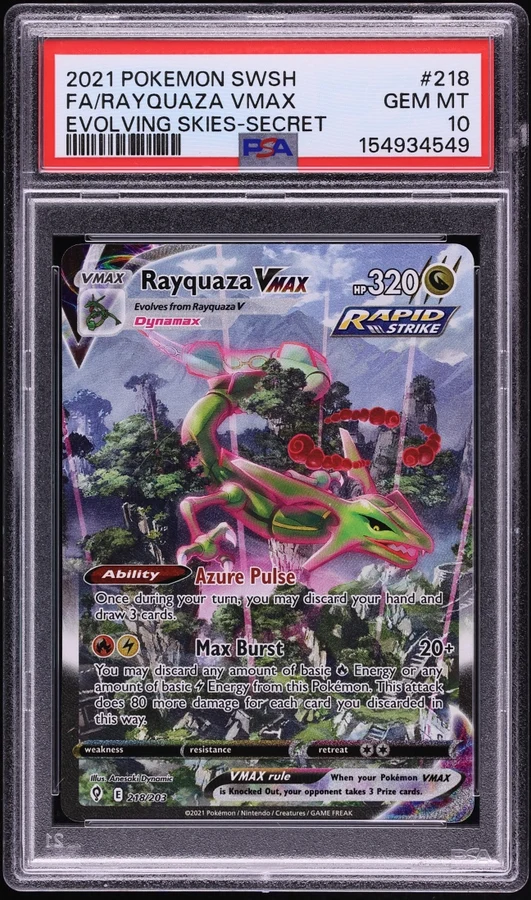
Real sold comps from Graded's pricing engine · 40 sales (eBay & Fanatics).
The gem trades around $3,120 on 105 real comps with weekly depth, a firm three-year uptrend, and the same sealed-supply tailwind as everything Evolving Skies: the set is the modern era's most opened premium product, its singles keep outrunning its boxes, and its alt-art class has held value through every cycle since 2021 while flashier sets round-tripped. Behind Moonbreon and the Prismatic SIR, it's the third pillar of modern premium Pokémon.
2021 Evolving Skies Rayquaza V Alt Art: The Sibling
The Rayquaza V alt art #194 from the same set is the VMAX's calmer sibling. Real PSA 10 sales:
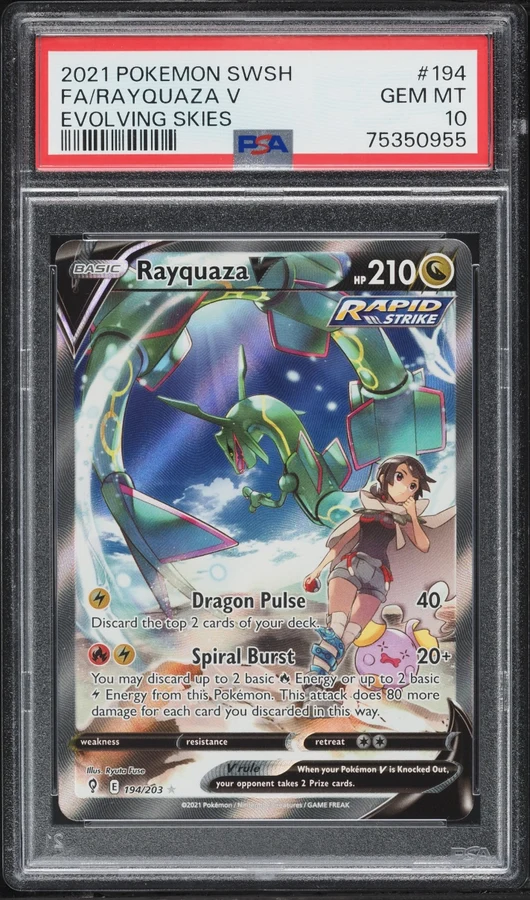
Real sold comps from Graded's pricing engine · 40 sales (eBay & Fanatics).
Around $1,470 on 87 comps and climbing faster in percentage terms than the VMAX over the last year, a pattern worth watching: when a set's second-tier alt starts outpacing its headliner, it usually means new collectors are entering at the affordable rung and working upward, which is the healthiest kind of demand a modern card can have. The V-alt class (this, Umbreon V #188, the Dragonite V) is where modern collectors graduate after their first VMAX.
2018 Celestial Storm Shiny Rayquaza GX: The Black Dragon
The shiny Rayquaza GX #177a put the black shiny on a full art and instantly became the Sun & Moon era's Rayquaza. Real PSA 10 sales:
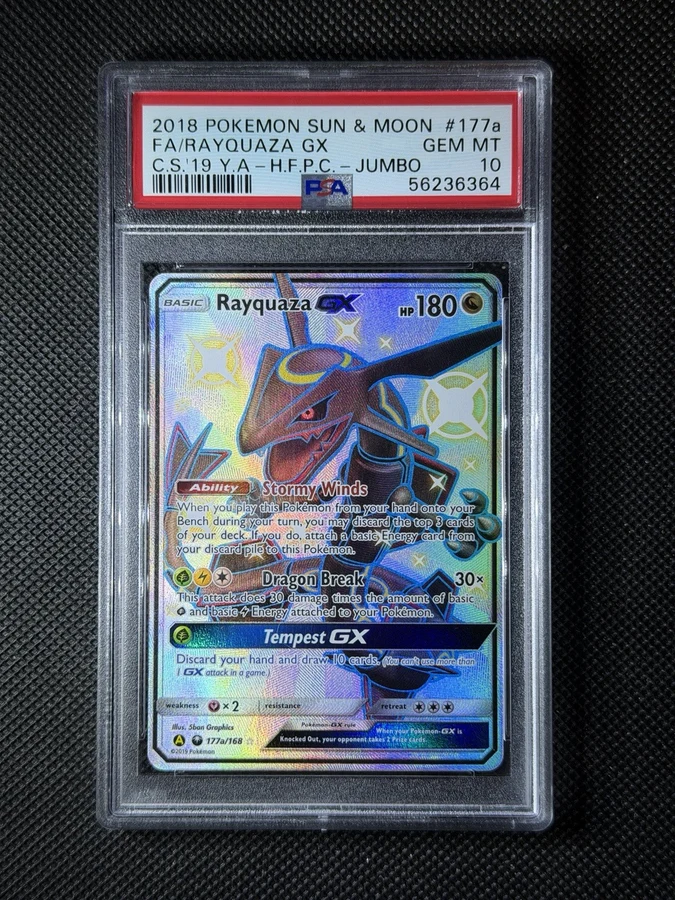
Real sold comps from Graded's pricing engine · 40 sales (eBay & Fanatics).
Around $870 on 52 real comps (its rainbow-rare #177 sibling printed $2,130 in June). Shiny-Rayquaza demand is its own franchise inside the hobby: the black dragon has headlined event distributions, box legends, and chase slots since 2012, and every one of those printings feeds collectors back toward this card, the first English shiny Rayquaza in a premium slot. Its Sun & Moon-era gem population is moderate, its demand is structural, and its price has compounded quietly every year since release.
The Liquid Tier: TG20, the Deoxys Holo, and the Amazing Rare
Three cards make the on-ramp, and none of them are filler: each is the cheapest liquid claim on a specific slice of Rayquaza demand. The Silver Tempest TG20, the Trainer Gallery reprint of the VMAX alt, trades around $600 on 138 comps, discounting the original's artwork by 80% while tracking its direction almost perfectly:
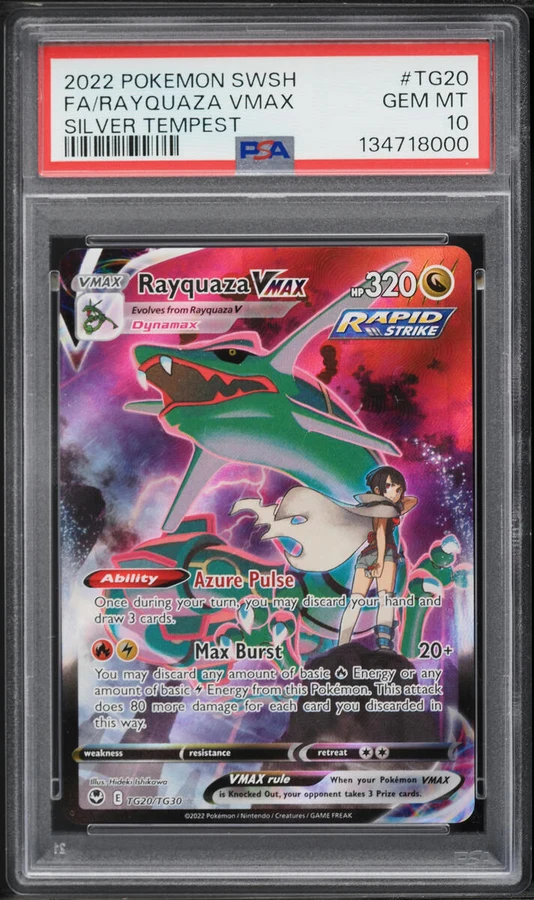
Real sold comps from Graded's pricing engine · 40 sales (eBay & Fanatics).
The original EX Deoxys set holo #22, the Gold Star's pack-mate, runs about $504:
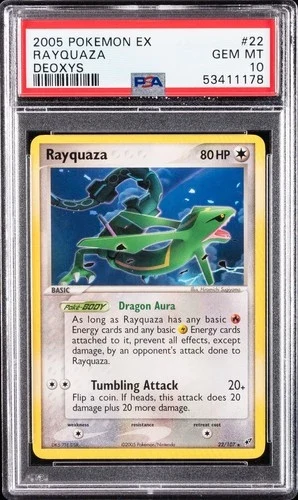
Real sold comps from Graded's pricing engine · 8 sales (eBay & Fanatics).
And the Vivid Voltage Amazing Rare, the budget icon of the 2020 boom, trades around $245 on 179 comps, the deepest Rayquaza pool of all:
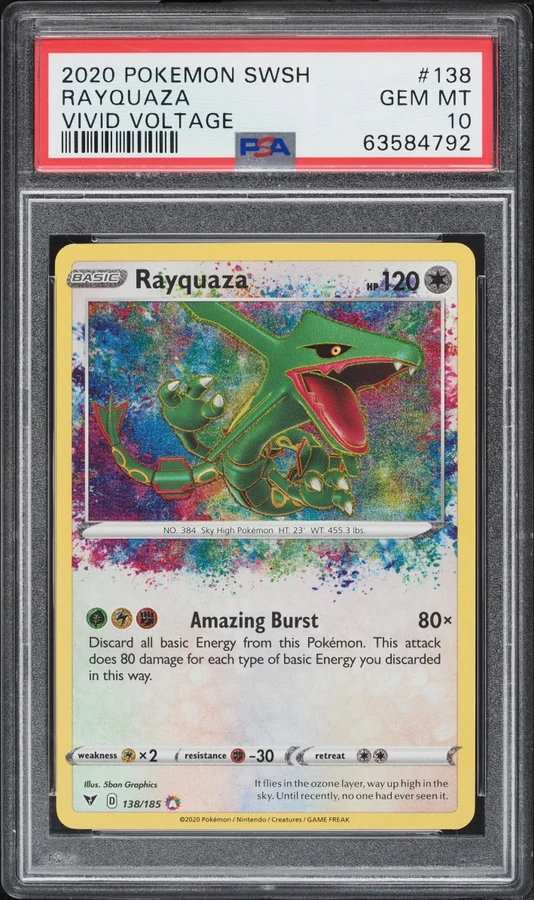
Real sold comps from Graded's pricing engine · 40 sales (eBay & Fanatics).
The Star, the ex, and the Rayquaza Premium
- The Gold Star gap is the trade. Last gem print $38,400; classmates at $100,000-$192,000; PSA 9s at $27,000. No card in this series has a clearer setup.
- The ex-era class keeps converging: EX Dragon 9×, the promo ex 3×, with Lugia and Dragonite's exes running the same arc. Buy the classmates before the headlines.
- Forgotten eras keep getting found: the Roaring Skies FA's five-figure prints are the XY window's first repricing. The rest of that era's full arts are the research list.
- Modern is three-deep: VMAX alt, V alt, TG20: one artwork family, three price points, all liquid. The reprint discounts the original and the original keeps outrunning it.
The playbook: hold the Gold Star thesis through its PSA 9 unless a gem surfaces (then pay attention), size the ex-era pair as growth positions that already ran, keep the Evolving Skies pair as the liquid core, and use the sub-$1,000 tier to build exposure.
How High Can Rayquaza Cards Go?
The ceiling question has a live answer pending: if the Gold Star class comps hold, Rayquaza's star is mispriced by 3-5× at its last print. And the demand side is not speculative. Rayquaza fronted the franchise's third generation, headlined the Delta Emerald era, anchors the shiny-hunting culture that made black dragons a collecting genre, and returns to the spotlight with every Hoenn revival. The asset class it sits in is still tiny next to the markets it behaves like:
Total market value: collectibles as an asset class, next to gold, mega-cap tech, and crypto.
The right column is how many times bigger each one is than the entire collectibles market. Collectibles are already a real asset class, larger than a top-ten crypto like Dogecoin, yet still a fraction of a single mega-cap stock and barely a rounding error next to gold. That gap is the runway: as collectibles mature into a transparently priced, investable asset class, the best cards have room to re-rate that the giants no longer do.Figures approximate, 2026: gold = all above-ground gold; equities = market cap; crypto = network value; collectibles = estimated global market size. Bars use a log scale for visibility.
And the returns case is on the board:
Matching Rayquaza Cards to Your Risk Tolerance
Anchor in the Evolving Skies pair (the liquid core), hold the Gold Star through its PSA 9, and size the ex-era and FA sleepers knowing they just ran 3-9× on thin floats. The most common mistake is treating the Gold Star's stale $38,400 print as its price; the class and the PSA 9 tape both say otherwise, in which direction nobody knows until the next gem trades.
Why Every Card Here Is a PSA 10
The same EX Dragon ex is $2,000 in PSA 9 and $15,600 in PSA 10; the same Amazing Rare is $47 versus $245. Grading authenticates the card, certifies the condition, and produces the population data this analysis runs on. Our Pokémon PSA 10 price guide covers the grade math in depth.
How to Buy Rayquaza Cards Safely
- Price off sold comps, never listings, via Graded's value calculator.
- Verify the number: shiny #177a versus rainbow #177, alt #218 versus rainbow #252, TG20 versus the original, star #107 versus holo #22.
- Respect thin markets: half this list's top tier trades a few times a year.
- Assume fakes on the star and the alts. Cert-verified slabs are the floor.
- Trade without shipping risk on Graded's Trading Floor, with instant on-chain escrow.
Investing in Rayquaza Cards on Graded
Everything this guide measures, Graded does live: real fair-market values with the value calculator, authenticated vaulted slabs in the marketplace, and instant peer-to-peer settlement on the Trading Floor.
FAQs
What is the best Rayquaza card to invest in?
The EX Deoxys Rayquaza Gold Star is the grail: last printed at $38,400 in PSA 10 (December 2023) with PSA 9s now at $27,000, and it's the only Gold Star that hasn't repriced in 2026's $100,000-$192,000 class run. The EX Dragon ex (~$15,600), Evolving Skies VMAX alt (~$3,120 on 105 comps), and the sub-$1,000 liquid tier cover every budget.
Why hasn't the Rayquaza Gold Star repriced like the others?
No gem has come to market since December 2023, so there's been no print to reprice it. The signals underneath moved anyway: its PSA 9s ran from the mid-teens to $27,000, and every classmate star set a record ($100,000 to $192,000) in 2026. The next PSA 10 to surface at auction sets the new level.
Is the Evolving Skies Rayquaza VMAX a good investment?
It's modern Pokémon's third pillar after Moonbreon and the Prismatic Umbreon: around $3,120 in PSA 10 on 105 real comps with weekly liquidity and a firm three-year trend. A demand bet with a large gem population, best sized as the liquid core of a Rayquaza position.
What is the most expensive Rayquaza card?
On real PSA 10 comps: the Gold Star at $34,200-$39,600 (2022-2023 prints), then the EX Dragon ex at $15,600, the Roaring Skies full art at $13,562, and the 2006 promo ex at $13,112, all three of which printed those numbers in 2026.
Are Rayquaza cards a good investment?
The 2026 tape repriced Rayquaza's ex-era 9×, its promo 3×, and its forgotten full art to five figures, while its Gold Star sits on a stale print beneath a repriced class. Demand is apex-tier and renews with every era. Volatile like all cards: buy scarce printings at proven grades, price off real comps, and size for the swings.